Technical SEO
· 8 min read
HTTP 401 Error: Meaning, Causes & Fixes
See what an HTTP 401 error means, how it differs from 403 and how users or developers can fix authentication problems. Check the steps now.
Read article
Compare outsourced SEO, agency support and in-house hiring by cost, control, expertise and speed. Use the guide before choosing a model.
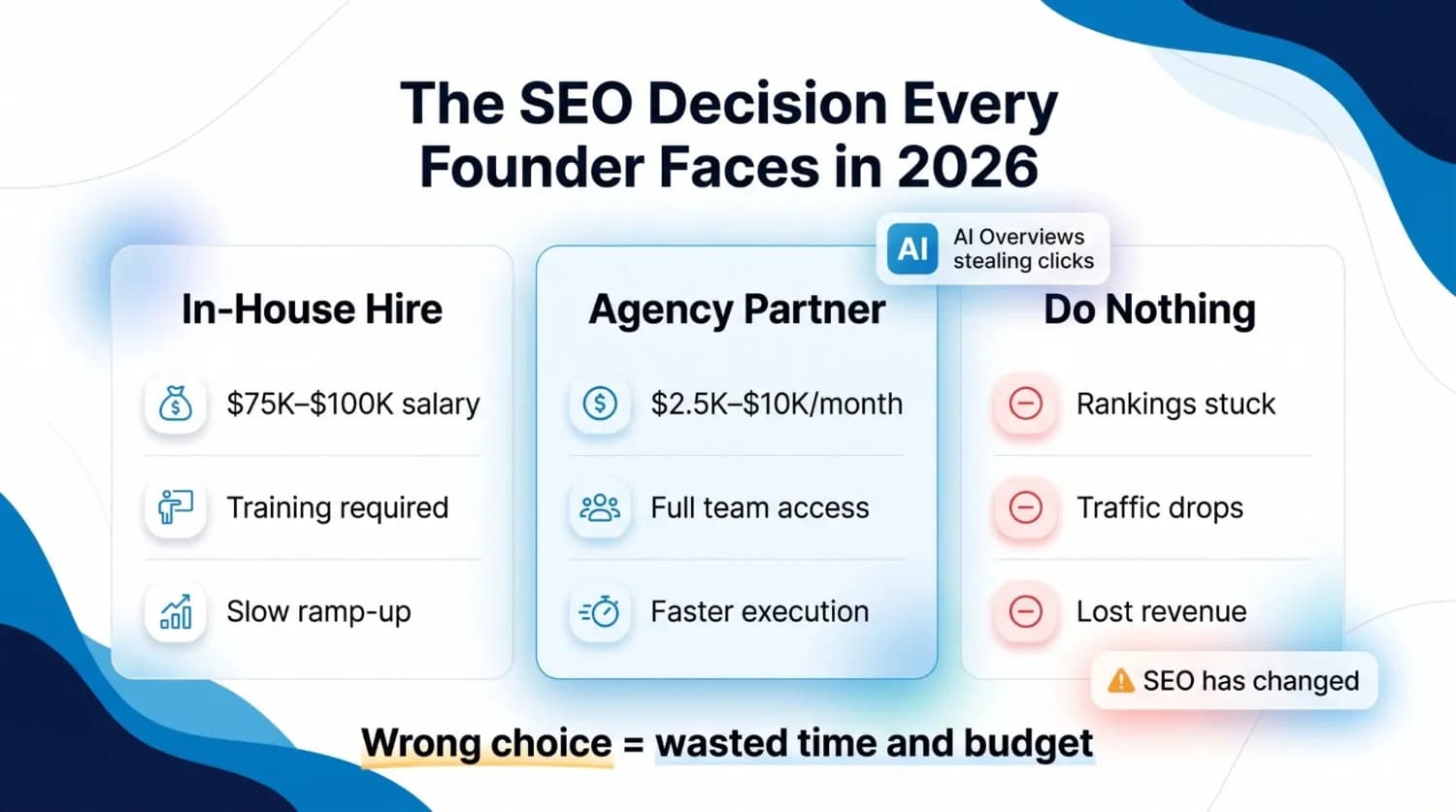
Picture a Mississauga founder at his desk at 11 PM, two LinkedIn tabs open side by side. One is a job post for a senior SEO specialist asking $95,000 a year plus benefits. The other is an agency proposal at $3,000 a month. His in-house marketer is buried. His rankings haven't moved in six months. Google's AI Overviews keep answering the exact questions his website used to answer. He is stuck and he can't afford to guess wrong.
If that sounds familiar, you're not alone. Thousands of growing Canadian businesses are trying to work out the same math in 2026: pay for a full-time hire, build a team, or lean on a partner for professional SEO outsourcing support that moves rankings without draining payroll?
This guide is not another recycled "definition and benefits" post. It's a real decision framework for owners who care about the only scoreboard that matters organic growth, qualified leads, and revenue.
Search has changed more in the last 18 months than in the previous decade. ChatGPT, Perplexity, and Google's AI Overviews now answer questions that used to send traffic to your site. According to Pew Research Center, about 58% of U.S. Google users saw at least one AI-generated summary in March 2025, and those users clicked regular search links far less often when a summary appeared.
Three new realities are hitting every growing business at once. Senior SEO talent is expensive and hard to keep. Google updates its algorithm faster than most teams can react. And AI-written content is flooding search results, making it harder for real experts to stand out.
What hasn't changed? Organic search still brings the highest-quality buyers you can find, dollar for dollar. People who find you through search already want what you sell they just need to find you first.
So the question isn't whether to invest in search. It's how to invest smartly without overpaying, overhiring, or betting on a partner still running a 2021 playbook. For a useful baseline on what Google expects from content today, the Google Search Central helpful content guidance is worth reading.
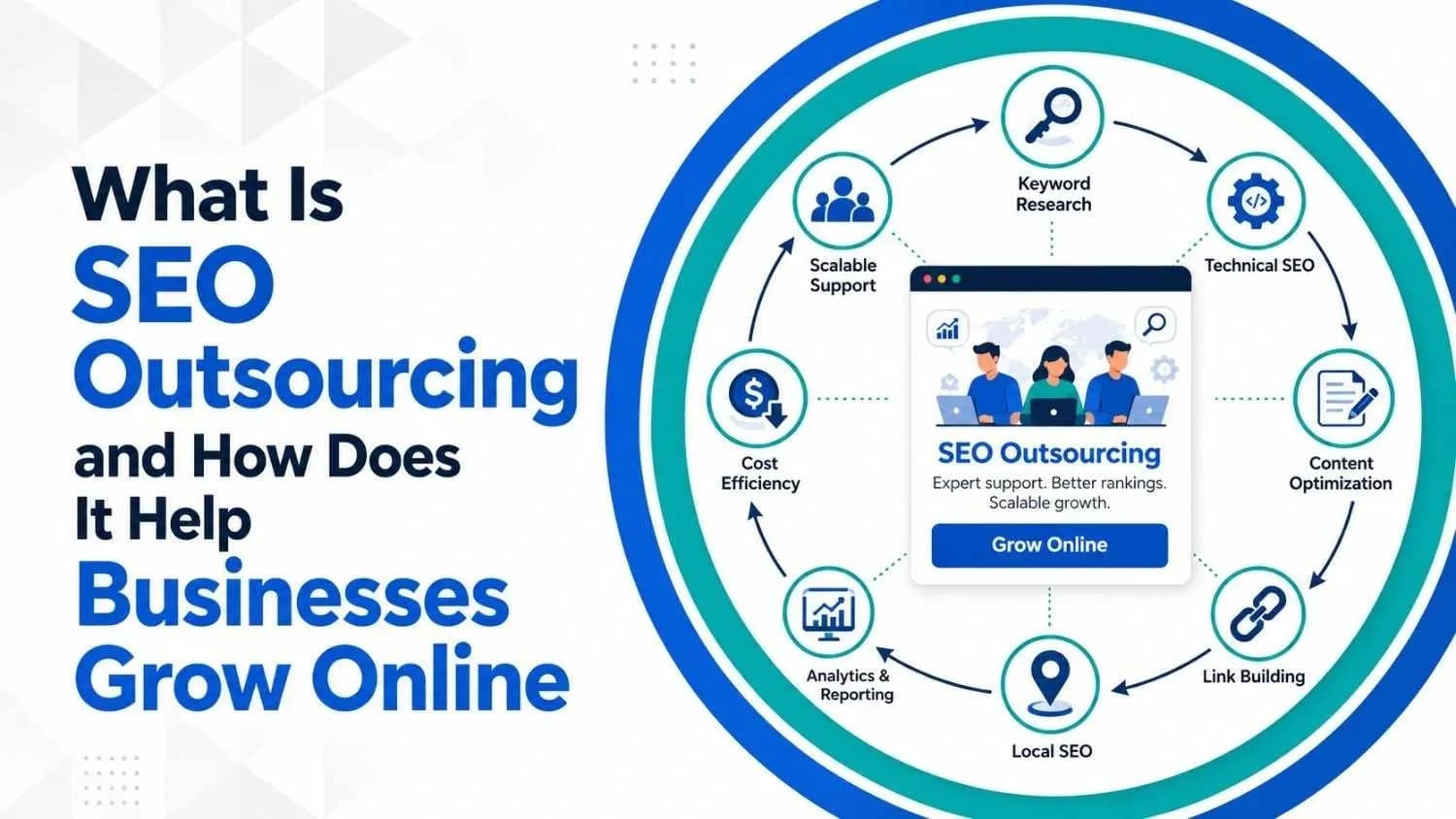
SEO outsourcing is the practice of handing website and search ranking work to an outside agency, freelancer, or specialist team instead of building that skill in-house. The confusion starts when people mix up what can be handed off and what should stay with you.
Here's what most businesses outsource: on-page SEO, technical SEO, local SEO, content writing, link building, keyword research, competitor research, and monthly reporting. What stays with you? Your brand voice, final approvals, and the data access itself.
Now the money side. A mid-level SEO hire in Canada typically costs $75,000 to $100,000 a year based on Glassdoor and Talent.com salary data before benefits, training, and software. Premium tools like Ahrefs, Semrush, and Screaming Frog alone run $5,000 to $12,000 per year. A solid outsourcing partner already pays for those tools and spreads the cost across clients.
The math is simple. For most small and mid-sized businesses, outsourcing delivers more skill, more tools, and more output for less money than building a team from scratch but only if you pick the right partner.
This is the part most blogs skip. In 2026, traditional SEO alone is not enough. You also need Generative Engine Optimization, or GEO. GEO is the practice of writing and structuring content so AI systems ChatGPT, Perplexity, Google AI Overviews, Claude quote your business as a source when people ask questions.
A 2026-ready outsourcing partner should know how to do all of this: write content in a clear question-and-answer format, add real author bios with named experts, include proper citations, and use schema markup that feeds AI systems structured facts. They should also know which searches still drive clicks (local, urgent, transactional like "emergency plumber Mississauga") versus the ones where AI answers steal the traffic ("what is," "how does," "best way to").
According to a November 2025 Semrush study, AI Overviews appeared on nearly 16% of Google queries, and the share jumps much higher for informational topics. Similarweb data shows organic traffic to top news publishers fell from 2.3 billion visits to under 1.7 billion in just one year.
The lesson? If the agency you're talking to can't explain GEO in plain words, they're selling an old product. Keep looking.
Before you spend a single dollar, take this honest self-check. Most failed outsourcing stories begin here, not with a bad agency.
If you answered "no" to more than one, pause. Hiring a partner on a shaky foundation is like pouring concrete on mud. The agency does the work, you pay the bill, and nothing moves.
Fix the basics first. Set up tracking. Write a short brand voice doc. Look at your top five landing pages and note which ones convert. Agree on one or two main goals. Do this in a week, and you save six months of wasted retainer spend later.
Everyone frames SEO as "outsource or hire." In 2026, the smart answer is neither it's hybrid. Keep the things only you can own, and hand off the work that specialists do faster and cheaper.
Keep in-house: your brand voice, strategy approvals, customer insight, and ownership of your analytics accounts. Hand off: technical audits, content production, link building, keyword research, and monthly reporting.
Three patterns work well depending on size. Solo founders usually hand off almost everything and just approve monthly work. Small businesses with five to fifty staff do best by handing off execution while keeping strategy and sign-off. Scaling companies often hire a fractional SEO lead internally and outsource specialist tasks around that person.
The big win of hybrid is that you never become fully dependent on one provider. Your brand voice doc, customer list, and strategy stay with you. If you ever need to switch partners, you lose weeks not years.
This section matters more than any other. In 2026, the biggest risk in outsourcing isn't paying too much it's getting mountains of AI-written filler that slowly hurts your brand.
Here's how to spot it. AI-generated filler usually has generic phrasing, no real examples, repeated sentence shapes, no proper citations, and no named author with real expertise. It reads fine at first and feels hollow when you sit with it.
Other warning signs:
Ask for contract language covering originality, AI disclosure, source verification, and human editor review. Demand the right to know who wrote each piece.
Why does this matter so much? Thin AI content in 2026 doesn't just fail to rank. It damages your E-E-A-T signals the experience, expertise, authority, and trust that Google and AI models use to decide whose work to quote. Once AI systems start linking your brand with shallow content, undoing that takes many months of careful work.
Most SEO outsourcing advice online is written by U.S. or India-based agencies. They skip the Canadian rules you actually live by.
PIPEDA Canada's privacy law applies the moment your outsourcing partner touches customer data, CRM records, or user analytics. A serious partner will have a data handling clause in the contract. CASL, Canada's anti-spam law, matters too. If your partner runs outreach campaigns on your behalf, sloppy CASL practices bring real fines.
GST and HST rules also change your math. A Canadian provider means clean tax handling and easier invoicing. Offshore providers often seem cheaper until you add compliance and time-zone friction. A partner eight or twelve hours behind you means slow Monday mornings and rushed Friday deadlines.
If you serve Mississauga specifically, multilingual local SEO is a real edge. Punjabi, Urdu, Mandarin, Arabic, and Polish community searches keep growing. According to Statistics Canada, the Mississauga-Toronto region is one of the most linguistically diverse metro areas in North America, and that diversity shows up in search behaviour every day.
A Canadian-aware SEO partner plans for all of this. Most offshore agencies cannot.
Skip the "check reviews and case studies" script every blog gives you. Here are the questions that actually separate pros from pretenders on your first call.
Ask each potential partner: Walk me through a GEO or AI Overview optimization project you've shipped in the last 90 days. Who actually writes the content your staff or a subcontractor? What is your AI disclosure policy? Can I see a real client report from last month, with names removed? What happens to our content, links, and access if we end the contract?
If a provider gets uncomfortable at any of these, that's your answer.
Three provider types fit different needs. A full-service SEO agency suits owners who want everything under one roof. Freelancers make sense for narrow jobs like a one-time audit. Fractional SEO leads fit mid-sized companies that want senior strategy without a full-time salary.
A realistic price sanity check for Canadian small and mid-sized businesses: anything under $1,500 a month is usually junk or pure automation. The honest working range sits between $2,500 and $10,000 a month. Always start with a 60- or 90-day paid pilot before signing any 12-month retainer. If you're a newer company weighing options, reviewing a specialist small business SEO offer in Mississauga gives you a sense of what a genuine full-service engagement includes.
The first three months decide whether your partnership grows into a long-term win or fizzles out quietly.
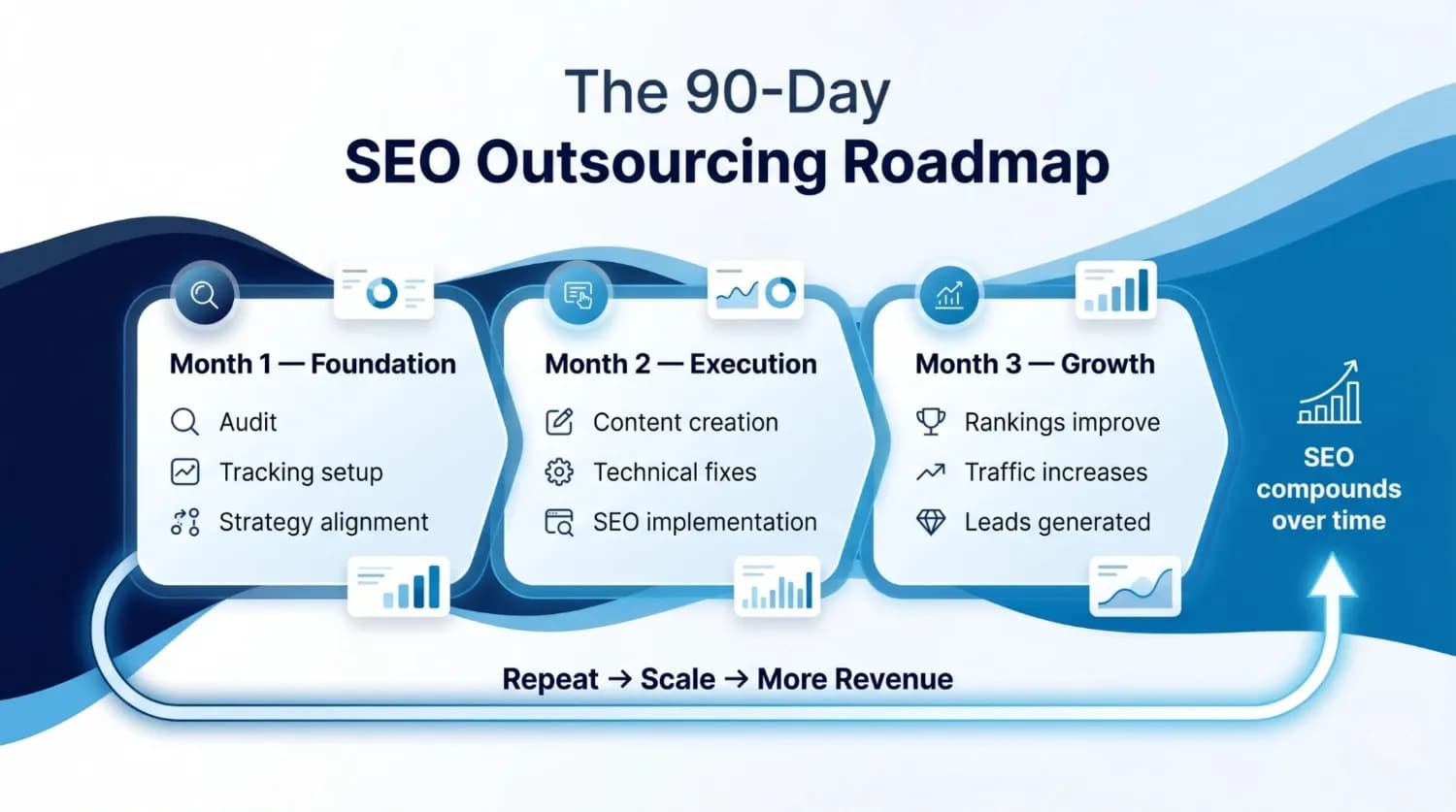
Weeks one and two are about setup, not results. Expect access handovers for Analytics, Search Console, Business Profile, and your content management system. Finish the brand voice document, agree on 90-day goals, and run a proper kick-off call.
Weeks three to six are the heavy work. Your partner should deliver a technical SEO audit, a content gap analysis, keyword research tied to real buyer intent, and baseline reports you can read without a translator.
Weeks seven to twelve bring the first real outputs. New or improved pages get published. Ranking signals shift on low-competition terms. Monthly calls focus on what worked and what to change next.
Good reporting sits in three layers: quick weekly email or Slack updates, a monthly strategy call, and a full quarterly planning session. At day 90, sit down and ask honestly are early wins showing? Should we expand, hold, or replace the partner?
Most owners measure outsourced SEO the wrong way. They obsess over rank positions and total traffic. Neither of those pays the mortgage.
The metrics that matter: branded search growth (are more people typing your business name into Google each month?), non-brand organic conversions (are strangers finding you and becoming leads?), cost per qualified lead, and assisted conversions in Google Analytics 4. SEO often helps close deals without being the last click, so attribution matters.
A simple ROI formula: take revenue from organic search over six months, subtract what you paid the partner, and divide by what you paid. Track it quarterly. If the number isn't moving up by month six, audit the partner not the channel.
What if numbers genuinely aren't working at month six? Don't panic. Ask for a written 90-day recovery plan. If that plan also fails, move on cleanly. Get full content ownership, keep your backlink records, and transfer all access before you end the contract.
Here's how to turn everything above into action over four weeks.
Week one is readiness. Run the self-audit, check your tracking tools, and write down what a 90-day win looks like in one sentence.
Week two is shortlisting. Identify four or five potential partners. Use the interview questions from this guide. Ask each for a sample report and one honest client reference.
Week three is contract review. Look for AI disclosure, originality guarantees, ownership of content and links, clear cancellation terms, and a 60-to-90-day pilot. Agree on two or three KPIs you will actually measure.
Week four is launch. Kick off the engagement, hand over access in a controlled way, share your brand voice document, and lock in the reporting cadence.
At the end of 90 days, answer three questions. Can you name your top three wins? Do you know your cost per lead from organic search? Is your branded search growing month over month? If yes to all three, expand. If no, you have real data to make the next decision with.
AI changed search, but it didn't kill it. Growing Canadian businesses that handle SEO outsourcing smartly in 2026 will scale online visibility faster and cheaper than companies still trying to build everything in-house. Remember the three pillars readiness first, hybrid structure second, an AI-aware partner third. Get those right and organic growth compounds quietly while you run your business.
If you want a straightforward next step, book a free audit or strategy session with a Canadian SEO team that understands both classic search ranking and new AI visibility. Local SEO Mississauga a Mississauga-based firm is one example of a local business that used focused outsource SEO services to grow revenue by 159% and generate 2,780 leads over two years. That's the kind of online growth a serious partner should deliver. Pick carefully, start small, and measure everything.
SEO outsourcing means hiring an outside agency, freelancer, or specialist team to handle your search engine work instead of doing it in-house. It covers the four main SEO types: on-page SEO (improving your pages), off-page SEO (building links and reputation), technical SEO (fixing site speed and crawl issues), and local SEO (winning Google Maps and "near me" searches).
Realistic pricing for Canadian small and mid-sized businesses sits between $2,500 and $10,000 per month for quality work. Anything under $1,500 a month is usually automated or thin. Always start with a 60-to-90-day paid pilot before agreeing to a 12-month commitment.
SEO is not disappearing it is changing shape. Traditional ranking still drives local, transactional, and branded searches. AI search adds a new layer where your content needs to be quoted by tools like ChatGPT and Google AI Overviews. A good outsourcing partner now handles both traditional SEO and GEO, which is harder to build in-house than ever.
ChatGPT and similar tools can help with drafts, keyword ideas, and basic audits. They cannot replace human experts yet. Real SEO involves judgment calls about strategy, brand voice, E-E-A-T signals, and clean link building. AI-only content usually lacks the experience and authority Google now rewards, which is why pure AI SEO often backfires.
For most small and mid-sized businesses, yes. Hiring a senior SEO specialist in Canada costs $75,000 to $100,000 a year plus tools, training, and benefits. A capable outsourcing partner brings a full team, premium tools, and proven systems for a fraction of that as long as you pick carefully using the questions in this guide.
Get a free SEO audit and a clear, prioritized plan for your Mississauga business — no long-term contract required.
Get a Free SEO Audit· 8 min read
See what an HTTP 401 error means, how it differs from 403 and how users or developers can fix authentication problems. Check the steps now.
Read article· 11 min read
Improve brand mentions in ChatGPT, Gemini and AI Overviews with stronger entities, citations and answer-ready content. Use the 2026 checklist.
Read article· 14 min read
Build a keyword plan around search intent, competition and business value, then map terms to the right pages. Follow the step-by-step process.
Read article