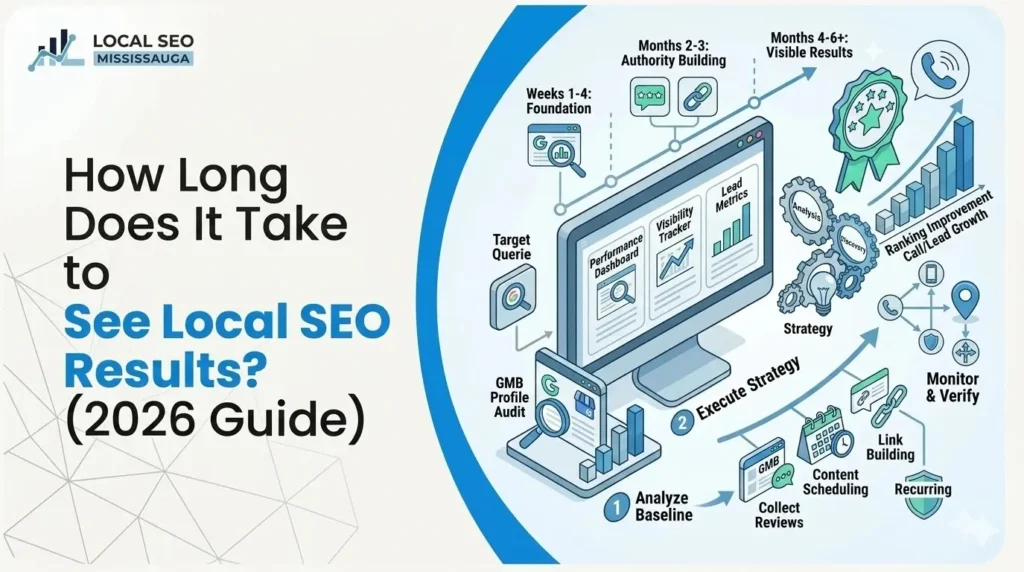
How Long Does It Take to See Local SEO Results? Real Timelines Explained (2026 Guide)
March 13, 2026
| Turab Talha | Reviewed by {acf_subject_expert}
Local SEO can feel slow in 2026 for one simple reason. Trust signals take time to settle. Google needs to see consistency, not a one-week burst of activity.
But local SEO still works when you track the right proof. Not just rankings. You want to watch what real people do, like calls, direction requests, and booked jobs.
Most searches still happen on Google, which is why this matters. In January 2026, Google held 86.7% of the Canadian search engine market share. That is the playing field.
So here is the promise. We will start with the basics, then map out real timelines, clear milestones, and exactly what to do at each stage so you can stop guessing and start steering your progress. If you came here for local SEO results you can measure, you are in the right place.
What Local SEO is and What It is Not
Local SEO helps your business show up when nearby people search, especially in Google Maps results and local organic listings. It is how you get found by people who are ready to pick a business in their area.
Local SEO is not “posting a few keywords” or “setting up a profile once.” It is a system. It is also not a trick. If anyone promises a paid shortcut to higher local rankings, that is a red flag.
What counts as a “result”
A result is not just moving from position 9 to 6. A result is an action that brings you closer to revenue. Think calls, direction requests, website clicks, form fills, bookings, and sales.
Rankings are still useful, but they are a signal, not the finish line. The safest way to think about it is simple: visibility helps, but actions pay the bills.
How Do You Know If You Need Local SEO?
The 60-second self-check
You do not need a long audit to answer, “how do you know if you need local SEO?” Most businesses can spot it in one minute. If you say “yes” to any of the points below, local SEO is not optional.
- People search “near me” or “in [city]” for what you sell
- You want more calls or bookings from nearby customers
- Your Google Business Profile exists but feels quiet
- Competitors show up in Maps, and you do not
- You have reviews, but they do not translate into leads
This is also why local SEO is important. It targets high-intent searches, where people are choosing, not browsing.
The “hidden cost” of skipping it
Skipping local SEO does not just mean “slower growth.” It means you lose the easiest type of customer: the one already looking for exactly what you offer in your area.
When you do not show up, the customer still picks someone. It just will not be you.
How Long Does Local SEO Take To Work?
Why you will never get one perfect number
If you have asked “how long does local SEO take,” you have probably seen answers that feel vague. That happens because timelines depend on your starting point. A business with a clean profile, steady reviews, and a solid website will move faster than a business with messy listings and weak pages.
Your competition matters too. If three strong businesses already dominate your category in your city, you will need more time and better execution to break in.
The two-lane timeline (Maps vs organic)
Local SEO runs on two lanes that behave differently.
Maps / Map Pack often shows movement sooner because changes to your business profile, categories, and local data can impact how you appear for location-based searches.
Local organic usually takes longer because it leans more on your website content, internal linking, and broader authority signals. The upside is that organic growth can become steadier once it starts.
The 2026 expectation ranges
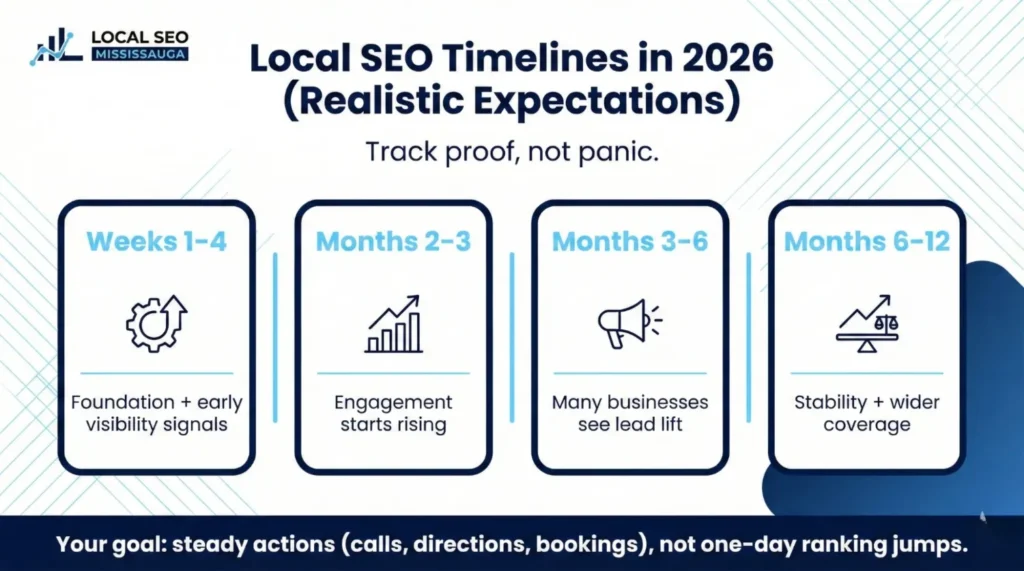
Here are realistic ranges most business owners can plan around.
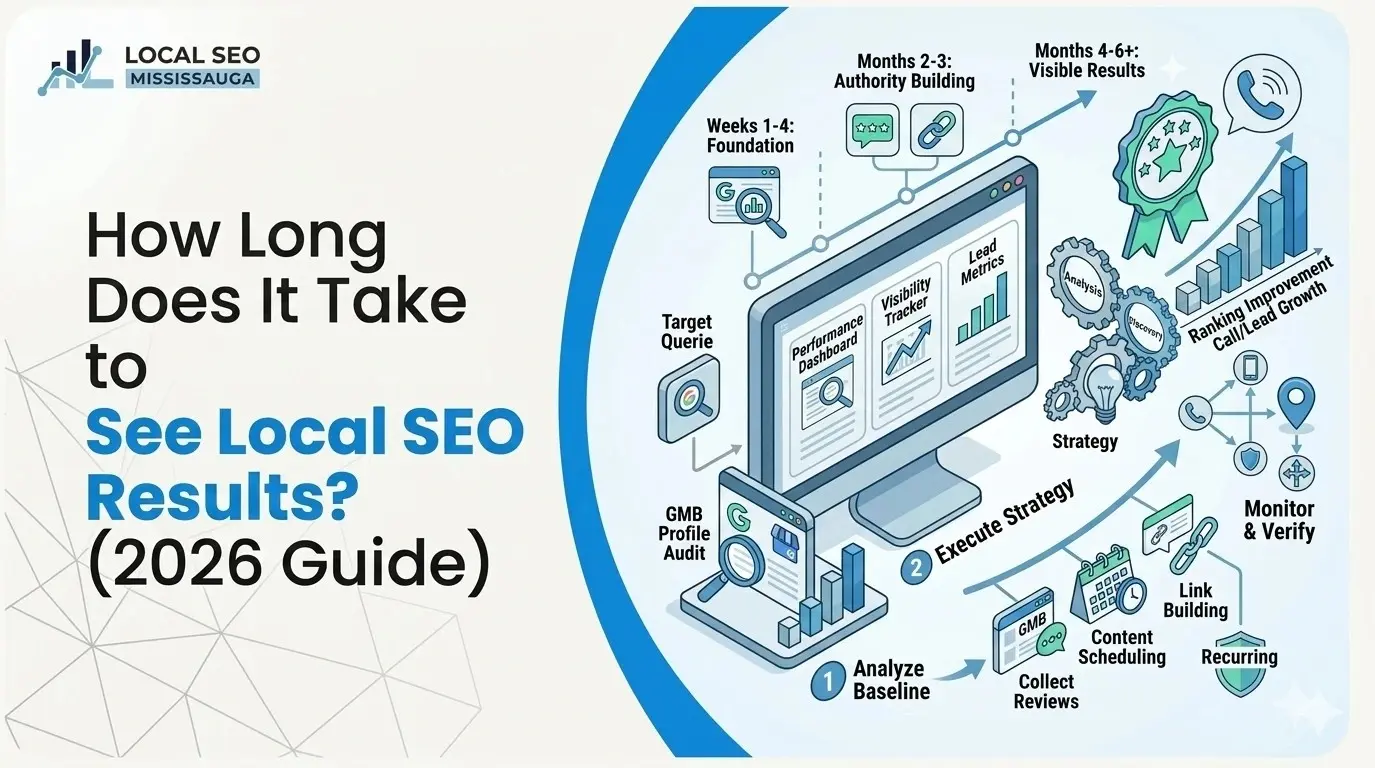
Weeks 1 to 4: foundation work plus early visibility signals.
Months 2 to 3: stronger engagement signals and better consistency across the web.
Months 3 to 6: meaningful lead lift for many businesses, especially if conversions are handled well.
Months 6 to 12: stability plus wider coverage across more parts of your service area.
Why does Google behave this way? Local results are mainly based on relevance, distance, and popularity. You can improve relevance and popularity, but distance is what it is.

The Local SEO Results Ladder
This is where most guides fall short. They talk about “time,” but they do not show you what progress looks like on the way to real results. Use this ladder to track leading indicators, middle indicators, and lagging indicators in the right order.
Step 1: Visibility proof (leading indicators)
In the early stage, you want proof that you are being seen more often. That might look like more impressions in Search and Maps, more profile views, and more discovery-style searches.
This stage tells you your foundation work is being picked up. It does not guarantee leads yet, but it shows you are entering the conversation more often.
Step 2: Engagement proof (middle indicators)
Next, you want proof that people are interacting, not just scrolling past you. This looks like more calls, more direction requests, and more website clicks from local listings. It can also show up as more branded searches, because people see you, remember you, then search your name later.
If you see visibility go up but engagement stays flat, that usually points to a mismatch: wrong category, weak photos, unclear service offering, or a profile that does not look “ready to choose.”
Step 3: Revenue proof (lagging indicators)
Last, you track the business outcomes. Booked jobs, qualified leads, higher close rate, and repeat customers. This stage is where local SEO stops being “marketing activity” and becomes “predictable pipeline.”
The rule that keeps you sane
If you only track rankings, you miss progress and panic too early. If you track proof, you stay in control and you always know what to fix next.
The 2026 Milestone Scorecard: Green, Yellow, Red Checkpoints
Here is the fast way to know if you are on track, behind, or stuck. Use it like a dashboard.
Checkpoint A: End of Week 4
Green means visibility and profile actions are trending up. Yellow means visibility is up but actions are flat, which usually signals a conversion mismatch. Red means flat across the board, which points to foundation issues like categories, listing accuracy, or weak site structure.
Checkpoint B: End of Month 3
Green means calls, direction requests, and forms are trending up. Yellow means lead volume is up but quality is down, which usually means your targeting or service clarity needs tightening. Red means no measurable lift, which means it is time to change the plan, not “wait longer.”
Checkpoint C: End of Month 6
Green means steady leads plus broader local coverage. Yellow means you improved but got stuck in a few pockets, which often points to an authority gap or weak location intent coverage. Red means you are still flat and you need a reset, not another month of the same tasks.
A Quick “Timeline Calculator” That Feels Real
A good timeline estimate starts with inputs, not optimism. Here are the factors that change your timeline the most.
Inputs that change the timeline the most
- New vs established business
- Storefront vs service-area business
- Competition level in your area
- Review profile and review pace
- NAP consistency and duplicate listings
- Website strength (speed, service pages, clear location relevance)
Output readers get from this section
A simple way to think about your likely range is this. If your listings are clean, your profile is strong, and your site clearly matches local intent, you are usually closer to the faster end of the range. If your NAP is inconsistent, you have duplicates, and your service pages are thin, you are usually closer to the slower end.
To shorten the timeline safely, focus on three moves. Fix listing accuracy first. Improve your profile’s “ready to choose” signals next (categories, services, photos, and clarity). Then upgrade one high-intent local page so people have a strong place to land and convert.
What Speeds Up The Results
This section answers “what are local SEO services?” in real terms. These are the services and actions that actually move the needle, without risky tactics. This is also where most businesses see faster local SEO results because the work is tied to proof, not guesswork.
Google Business Profile wins that show sooner
Small profile improvements can create fast gains when they remove friction. Complete your services, tighten your categories, add strong photos that show real work, and make sure your contact options are easy. Keep your business info consistent everywhere.
The goal is not to “look active.” The goal is to look like the obvious choice when someone compares three businesses in 15 seconds.
Reviews that improve trust and conversion
Reviews are not only a ranking signal. They are a conversion signal. A steady review pace matters more than one big spike. Reply to reviews like a real business owner, not like a script. When you respond clearly, you answer the next customer’s doubts before they even call.
Local pages that match intent
Your website should answer what local customers actually ask. Cost range, timing, areas served, what happens next, and what makes you different. When a page answers those questions, it converts better. Better conversion means the same visibility turns into more leads, which makes the whole system feel faster.
What Slows Results Down
Local SEO timelines get wrecked by avoidable problems. The biggest ones are inconsistent business name, address, or phone number across listings. Duplicate profiles or wrong map pins can also split trust and confuse customers.
Category changes without a plan can reset momentum. Website rebuilds that break URLs and internal links can wipe out progress. Thin location pages that repeat the same text can also hold you back because they do not earn trust or engagement.
The fix is not complicated. Keep your data consistent, make changes carefully, and build truly useful pages.
How To Dominate Local SEO Without Risky Tactics
“Dominate” does not mean gaming the system. It means becoming the best match and the safest choice.
Dominate Maps: be the obvious choice
Win Maps by being clear, consistent, and credible. Make sure your primary category matches what you want to be chosen for. Add proof through photos and reviews. Keep your services and descriptions aligned with what people search for, and make it easy to call or book.
Dominate organic: own the local questions
Organic wins come from pages that answer local intent better than anyone else. Pricing expectations, comparisons, neighbourhood-specific questions, and service FAQs are often where you can stand out without stuffing keywords.
Dominate trust: become the business people reference
Local mentions matter because they are a form of public proof. Partnerships, community pages, suppliers, and industry associations can all help when they are real and relevant. This is how you build “popularity” the clean way.
Dominate conversions: turn views into calls
If your listing gets views but your phone stays quiet, conversion is the issue. Tighten your offer, clarify your next step, improve page speed, and remove friction from booking. Small improvements here can double outcomes without needing more traffic.
To stay on the safe side, avoid tactics that violate search spam rules. Google’s spam policies explain that deceptive or manipulative tactics can cause pages or entire sites to rank lower or be omitted from results.
Bing also warns that manipulating inbound links can lead to a site being delisted from Bing’s index.
How To Measure Local SEO Properly In 2026
Measure actions first
Start with actions: calls, direction requests, website clicks, form fills, and bookings. If actions move, you are getting closer to revenue, even if rankings look messy day to day.
Measure coverage, not one-point rankings
Local rankings change by neighbourhood, device, and even time of day. One “rank check” from one spot can lie to you. You want a broader view of coverage across the areas you actually serve.
Tie it to revenue
The best scoreboards are boring but honest: qualified leads, booked consults, closed deals, and lead quality. When those improve, local SEO is working.
If You Are Not Seeing Results, Do This Next
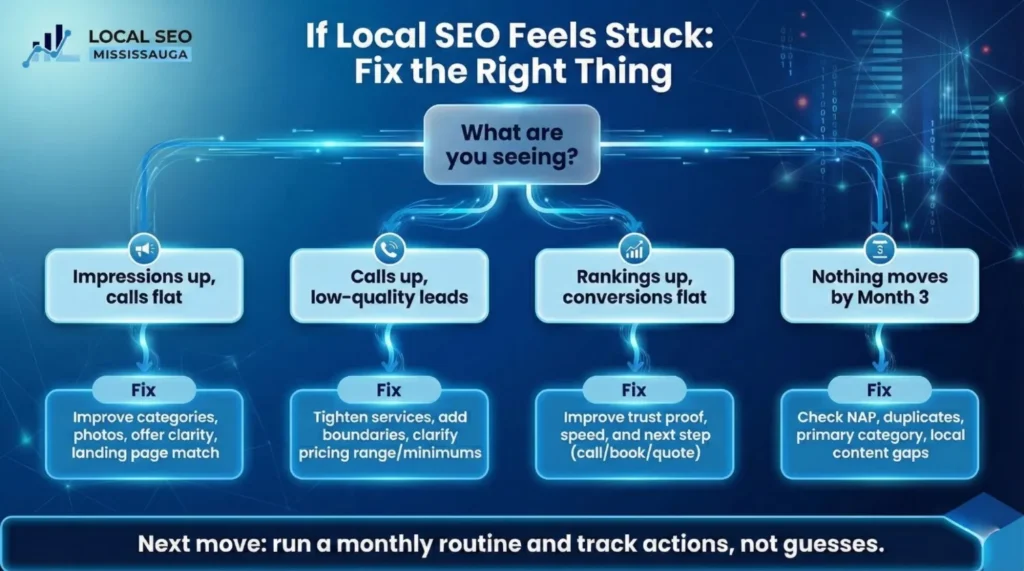
If impressions rise but calls do not
This is usually a “choice problem.” People see you but do not pick you. Fix categories, photos, service clarity, and make sure the landing page matches the search intent.
If calls rise, but lead quality is poor
This is usually a targeting problem. Tighten service focus, add clear boundaries, and explain who you are best for. If needed, include minimums or clear ranges so the wrong leads filter themselves out.
If rankings move but conversions stay flat
This is usually a website problem. Improve trust proof, speed, and the next step. Make calling and booking easy. Add real examples, clear pricing expectations, and simple FAQs.
If nothing moves by Month 3
Do not “wait it out.” Re-check NAP consistency, duplicates, primary category, and local content gaps. If the basics are wrong, time does not fix it.
A Simple Monthly Local SEO Operating System
Week 1: profile health and listing cleanup.
Week 2: reviews and conversion fixes.
Week 3: publish or upgrade one high-intent local page.
Week 4: local authority building through real partners and community mentions.
Run this for three months and your results stop feeling random. You get a routine, a scoreboard, and clear next steps.
Final Note
You do not need a perfect prediction. You need a plan you can trust. Now you have realistic timelines, a proof ladder to track progress, and a scorecard that tells you exactly what to fix next.
If you want this run as a clean, measurable system, Local SEO Mississauga can help you set up the proof-based plan, tighten your profile and pages, and keep everything white-hat so your gains stick.
FAQs
How long does local SEO take to work for a new business?
Often longer than an established business, because you start with less trust proof. Expect foundation work first, then momentum as reviews, listings, and content build up.
Why do Maps results change faster than organic?
Maps can respond sooner to strong profile signals and clean local data. Organic usually takes longer because it depends more on site content and broader authority.
What is the fastest safe win in local SEO?
Fix listing accuracy and duplicates, then strengthen your profile’s conversion signals (categories, services, photos, and clarity). Those two moves often unlock early progress.
How do I know if I am in a highly competitive market?
If the top local results have strong review profiles, consistent listings, and deep service pages, you are in a tougher space. You can still win, but you will need better content, better proof, and steady execution.
What should I track weekly vs monthly?
Weekly: profile actions and lead quality signals. Monthly: trend changes, coverage improvements, and revenue outcomes.
Search Here
More Categories
Latest Posts
March 17, 2026
Turab Talha
March 13, 2026
Turab Talha
March 9, 2026
Turab Talha
March 5, 2026
Turab Talha
March 3, 2026
Turab Talha