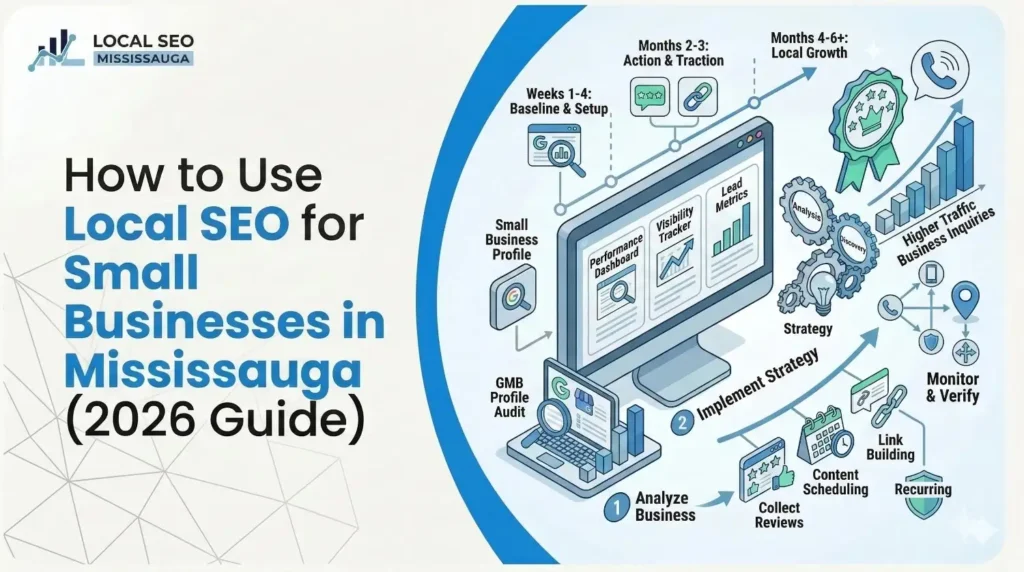
Local SEO for Small Businesses in Mississauga: A Complete Guide (2026)
March 13, 2026
| Turab Talha | Reviewed by {acf_subject_expert}
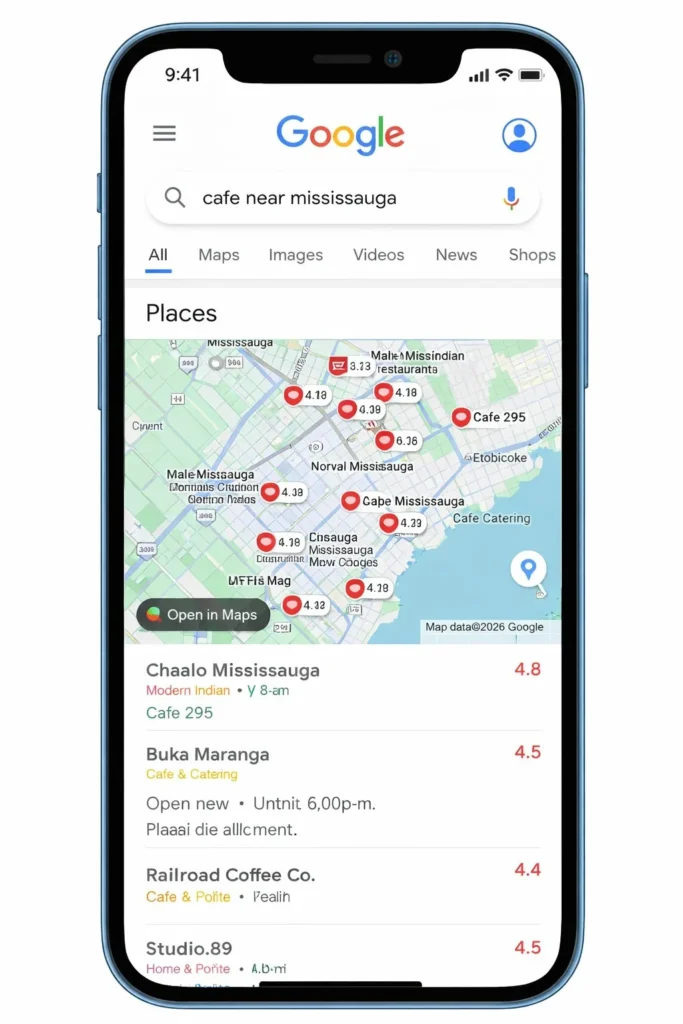
Mississauga is one of Canada’s largest cities, with diverse neighbourhoods like Port Credit, Streetsville, Clarkson and City Centre. In 2026 its population continues to grow, and residents increasingly rely on smartphones and voice search to find nearby shops, restaurants and services. Local SEO for small businesses is about helping people discover you when they search for “coffee shop near me” or “Mississauga physiotherapy.” If your business doesn’t appear on the local map pack or “near‑me” results, you’re invisible to customers.
Experts warn that small businesses that ignore local SEO may struggle to survive because Google’s map pack appears above organic results and 60 % of smartphone users contact a business directly from those local results.
This guide uses real‑world evidence and local context to show Mississauga owners how to build a sustainable local search engine optimization strategy for 2026.
What is local SEO for small businesses?
Local SEO (search engine optimization) refers to the strategies used to make your business appear in the unpaid, location‑based results shown at the top of Google and Bing. It differs from general SEO in one key respect: distance.
Search engines factor in how far a business is from the searcher as well as its relevance and prominence. For small businesses, local SEO means optimizing signals that tell Google and other platforms who you are, what you offer and where you operate. When done well, it gives you a chance to appear in the coveted “map pack” and local finder interfaces and to compete against larger brands on home turf.
Primary ranking factors, Search engines evaluate three primary factors when ranking local results:
| Local ranking factor | Definition (keywords/phrases) | Why it matters |
| Relevance | Alignment between your listing and what searchers want | Ensures your business matches user intent; use local keywords in metadata and content. |
| Distance | Physical proximity of your business to the searcher | Optimizing NAP (name, address, phone) and including neighbourhood names helps you appear in “near‑me” queries. |
| Authority/Prominence | Credibility, backlinks and reviews | High‑quality local links and positive reviews signal trust and improve rankings. |
These factors translate into concrete tasks such as optimizing your Google Business Profile, acquiring reviews, building citations and producing local content. In the following sections you will learn how to put them into action.
Why local SEO is important for small businesses in Mississauga
Increased visibility and targeted traffic
Investing in local SEO gives small businesses greater visibility in local search results. When customers search for services “near me,” optimized businesses appear in the map pack and on mobile devices, leading to more website visits and phone calls. Local SEO allows you to reach a targeted audience, people who are actively looking for services in Mississauga, which means higher conversion rates and a stronger return on investment.
Cost‑effective marketing
Unlike radio or print advertising, local SEO is cost‑effective. Once you claim your online profiles and create high‑quality content, the traffic can continue for years with minimal ongoing costs. For startups and family‑run shops, investing time in optimization often yields more value than expensive ads.
Competitive advantage
Many businesses still neglect local search. By actively optimizing, you can distinguish yourself from competitors who haven’t prioritized local SEO. Appearing ahead of them in the map pack can lead potential customers to call or visit your business first.
Builds trust and credibility
Customer reviews, accurate listings and consistent citations build trust and credibility. Searchers are more likely to choose businesses with positive reviews and up‑to‑date information. Strong local SEO helps your brand appear legitimate and well‑established in the community.
Essential for mobile and voice search
The rise of mobile devices and voice assistants means more users search while on the go. Local SEO ensures your business appears in these mobile searches. If your site isn’t mobile‑friendly or your listing lacks location data, you’ll miss out on this growing audience.
Understanding Mississauga’s local landscape
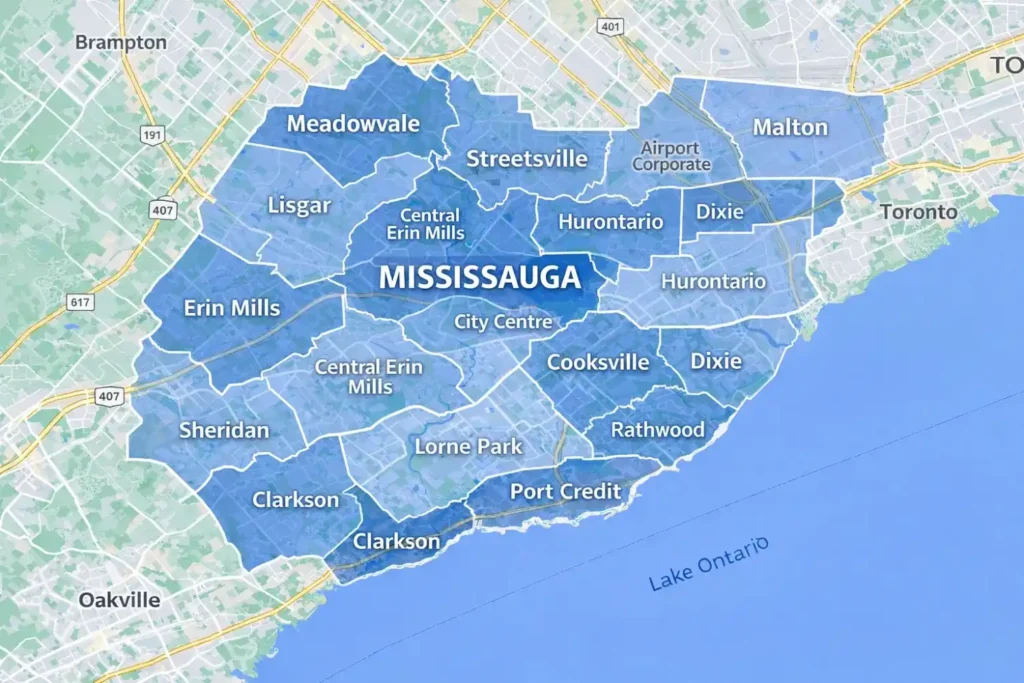
Mississauga is divided into over two dozen neighbourhoods, including Port Credit, Streetsville, Clarkson, Erin Mills, City Centre, Malton and Meadowvale. Each neighbourhood has its own demographics and commercial districts. For example, Port Credit is a waterfront community known for restaurants and marine businesses, while Streetsville retains a historic village feel. When optimizing local SEO, reference neighbourhood names and landmarks in your content to signal relevance.
Climate and seasonality
Mississauga’s climate is humid continental, with hot summers and cold winters. Average daily highs reach about 27 °C (80.6 °F) in July to August and drop to –5 °C (22.1 °F) in January. Snow accumulates most winters, with an average of 108.5 cm. Fog is common along the lakeshore and in the Credit River valley. Understanding the seasons helps you plan content. A roofing company, for example, should emphasize winter emergency repairs in cold months and maintenance tips in spring. Seasonal events like Port Credit’s Buskerfest or Streetsville’s Bread and Honey Festival can also inspire timely content.
Building your local search engine optimization strategy
1. Claim and optimize your Google Business Profile
Google Business Profile (formerly Google My Business) is the foundation of local search. When customers search for services, Google pulls details from your profile to display in the map pack. Follow these steps:
- Verify ownership and fill out every field: Claim your profile and verify it by phone, email or video call. Include your business name exactly as it appears on signage, your physical address, local phone number and business category. Provide operating hours, a detailed description with relevant keywords and a list of products or services.
- Upload photos and videos: High‑quality images of your storefront help customers recognize your location. Add pictures of your products or services (e.g., dishes, merchandise, before/after shots) and update them regularly.
- Use Google Posts: Post updates about special offers, events or blog articles. Frequent updates signal an active business.
- Encourage and respond to reviews: Google favours businesses with positive reviews. Ask satisfied customers to leave a review and respond politely to both praise and criticism. Reviews add contextual information that search engines can pick up.
- Keep NAP consistent: Ensure your Name, Address and Phone number (NAP) are consistent across all listings. Inconsistencies can reduce trust and harm rankings.
Pro Tip: Schedule monthly reminders to check your Google Business Profile. Update seasonal hours, add new photos and respond to any outstanding questions. A complete and fresh profile makes it easier for Google to match your business to the right searches.
2. Manage reviews and reputation
Reviews influence both search rankings and customer decisions. Follow these best practices:
- Ask for reviews ethically: Most platforms allow you to ask for reviews as long as you don’t offer incentives or filter out negative feedback. Request reviews in person, via email receipts or text messages. Capture both third‑party reviews on platforms like Google and Yelp and first‑party reviews on your own website.
- Monitor and respond quickly: Keep notifications on so you can respond promptly. Responding shows you care and can turn dissatisfied customers into advocates.
- Analyze sentiment: Track what people love or dislike about your business. Use the feedback to improve services or highlight strengths.
- Report review spam: Report fraudulent or spammy reviews to the platform. Review spam can harm your reputation and ranking.
- Leverage positive reviews: Feature glowing feedback in your marketing materials and website. Customer testimonials build trust and may appear in AI‑based search results.
3. Localize your website and on‑page SEO
Your website remains the hub of your online presence. Search engines still rely on on‑page signals to determine relevance and location. Key steps include:
- Build essential pages: Even a small local site should include a homepage, contact page, product/service pages, location landing pages (for multi‑location businesses), service area pages and a reviews/testimonials page.
- Implement E‑E‑A‑T principles: Google’s quality raters use the E‑E‑A‑T framework: Experience, Expertise, Authoritativeness and Trustworthiness. Write content based on first‑hand knowledge or authoritative research, have it authored by experts and cite reputable sources. Ensure your site is secure (HTTPS) and includes accurate contact information.
- Optimize page URLs: Use URLs that combine product/service keywords with the city or neighbourhood (e.g., /roof-repair-port-credit).
- Craft unique title tags: Create concise (50 to 60 characters) title tags that reflect search intent and include the location.
- Write persuasive meta descriptions: Meta descriptions (150 to 160 characters) act as mini‑advertisements; they can encourage users to click even if they don’t directly influence rankings.
- Use header tags and structured content: Organize content with clear headings and subheadings; optimize them naturally with local keywords.
- Optimize images with alt text: Describe images using keywords and location; alt text helps search engines understand content and improves accessibility.
- Add location signals: Include your full address, neighbourhood names, phone number and operating hours on the homepage.
4. Conduct local keyword research and create location‑based content
Local keyword research helps you understand how customers search for your services. Hike SEO differentiates between implicit keywords (e.g., “plumber near me”) and explicit keywords that include location names (e.g., “plumber Port Credit”). Use both types:
- Brainstorm seed keywords: List your core services and products. Add neighbourhood or street names (e.g., “hair salon Streetsville,” “accountant near Hurontario”).
- Use keyword tools: Tools like Google Keyword Planner, SEMrush or local rank trackers can reveal search volumes and variations.
- Map keywords to pages: Assign explicit city or neighbourhood keywords to specific location pages. For multi‑service businesses, create separate pages for each service and location.
- Write localized content: Publish blog posts and guides about community events, neighbourhood profiles and seasonal tips. For example, a restaurant could create a “Best patio spots in Port Credit for summer 2026” article, while a home services company might write “Winterization checklist for Lorne Park homeowners.”
- Answer common questions: Create FAQ content that addresses customer queries (see FAQ section below). Search engines now incorporate FAQ snippets into results, making them valuable for voice search and AI answers.
5. Build citations and high‑quality local backlinks
Citations are mentions of your business name and contact information on third‑party websites. They can be structured (on directories like Google, Apple Maps, Bing, Yelp, Facebook or industry‑specific sites) or unstructured (mentions in news articles, blogs or sponsorship pages). Follow these guidelines:
- Get listed on major directories: Create complete profiles on Google Business Profiles, Apple Business Connect, Bing Places, Yelp, Facebook, LinkedIn and local directories. For industry‑specific businesses, also list on sites like TripAdvisor (hospitality) or ZocDoc (medical).
- Ensure NAP consistency: Use the same name, address and phone number across all listings. Inconsistencies can confuse search engines and users.
- Consider manual vs assisted management: You can manually manage listings (maximum control but time‑consuming) or work with an agency to create, verify and maintain citations. Manual management doesn’t scale for multi‑location businesses, while assisted services save time but require investment.
- Acquire local backlinks: Seek links from local news sites, community blogs, neighbourhood associations, event sponsorship pages or industry organizations. Participate in community events, offer guest posts or sponsor local sports teams. Ensure that links come from relevant and reputable sites, and avoid paying for links or engaging in link schemes.
6. Optimize for mobile, performance and user experience
Most local searches occur on mobile devices, so your website must load quickly and display correctly on phones and tablets. Important steps:
- Responsive design: Use a responsive layout that adapts to different screen sizes.
- Fast load times: Compress images, minify scripts and leverage caching to reduce page speed.
- Easy navigation: Make it simple to call your business, get directions or book an appointment with one tap.
- Click‑to‑call buttons: Include clickable phone numbers so mobile users can contact you immediately.
7. Implement schema markup and technical SEO
Structured data helps search engines understand your business and display rich results. Use the LocalBusiness and GeoCoordinates schema types to mark up your address, phone number, opening hours and geo‑coordinates. Benefits include:
- Enhanced search snippets: Schema markup can produce rich results, such as star ratings or operating hours, increasing click‑through rates.
- Eligibility for AI features: AI overviews and answer boxes often draw from content with strong structured data and citations.
Technical SEO tasks also include creating an XML sitemap, implementing HTTPS, ensuring the site is crawlable and optimizing robots.txt.
8. Leverage social media and community engagement
Social media platforms provide another avenue for local visibility:
- Geotag your posts: Tag your location when posting on Instagram, Facebook or TikTok to appear in local feeds.
- Share updates and promotions: Announce events, new products or seasonal specials. Use stories and short videos to engage your audience.
- Join local groups: Participate in community Facebook or Nextdoor groups to answer questions and offer advice without overt selling. Build relationships before promoting your business.
- Encourage user‑generated content: Ask customers to share photos of your business and tag your location. Repost their content (with permission) to showcase social proof.
9. Track performance and adjust your strategy
Monitoring results allows you to refine your strategy over time:
- Analytics and search console: Use Google Analytics and Google Search Console to track website traffic, search queries, click‑through rates and conversions.
- Local rank tracking: Use tools to monitor your rankings in specific neighbourhoods. Track both organic and map pack positions for your target keywords.
- Review monitoring: Track review scores and volume over time. Identify patterns in positive and negative feedback.
- Competitor analysis: Periodically check competitor profiles and websites to see what keywords and tactics they’re using. Look for gaps you can fill with better content or service.
Seasonal and AI considerations for 2026
Seasonal SEO strategies
Mississauga’s weather swings from humid summers to snowy winters. Align your local SEO with the seasons:
- Winter (November to March): Create content about winter services (e.g., snow removal, indoor events) and adjust business hours during holidays. Highlight warm products or indoor experiences. For example, a café might optimize for “winter drinks in Port Credit” or promote holiday catering.
- Spring (April to May): People look for home renovations, garden centers and outdoor activities. Publish guides like “Spring landscaping tips for Clarkson homeowners.” Update Google Business hours after daylight saving time.
- Summer (June to August): The tourism season peaks when temperatures reach around 27 °C. Write about outdoor dining, summer festivals and patio upgrades. Use photos of sunny storefronts.
- Autumn (September to October): Focus on back‑to‑school supplies, fall home maintenance and local festivals. Adjust promotions around Thanksgiving and Halloween events.
Conclusion
Local SEO is no longer optional; it’s a lifeline for small businesses competing in a crowded digital landscape. By optimizing your Google Business Profile, building a robust website, gathering reviews, earning citations and creating localized content, you can climb the map pack and attract customers right when they need you. Remember to adapt your strategy for Mississauga’s unique neighbourhoods and seasons, and use AI tools responsibly, always verifying the information you publish.
Ready to dominate local search and grow your business? Contact the team at Local SEO Mississauga. We help local businesses like yours optimize their online presence, manage reviews and connect with customers across Port Credit, Streetsville, Clarkson and beyond. Let’s ensure your business is the first name people see when they search in 2026 and every year after.
FAQs
Why is local SEO important for small businesses?
Local SEO ensures your business appears when potential customers in your area search for your products or services. It increases visibility, drives targeted traffic and builds trust through reviews and citations. Without local optimization, you may not appear in the map pack or “near‑me” searches, leaving business on the table.
Does AI help with local SEO for small businesses?
AI can assist with keyword research, competitive analysis and content generation, but it must be used responsibly. AI tools are prone to inaccuracies and should not replace human expertise. Combine AI with your local knowledge and review everything before publishing. Focus on building genuine reviews, citations and quality content to earn trust from search engines and AI systems.
How can I improve local SEO for my small business website?
Start by claiming and optimizing your Google Business Profile. Ensure NAP consistency across all listings. Build a website with essential pages and optimize on‑page elements like URLs, title tags and meta descriptions. Produce localized content, gather reviews and acquire citations. Make your site mobile‑friendly and use schema markup for better indexing.
What are the best local SEO strategies for small businesses?
The most effective strategies include:
Claiming and fully optimizing your Google Business Profile.
Maintaining consistent NAP information across directories.
Building a high‑quality website with localized pages and E‑E‑A‑T‑compliant content.
Conducting local keyword research and producing location‑based content.
Acquiring positive reviews and managing your reputation.
Building citations and local backlinks.
Optimizing for mobile users and implementing schema markup.
Search Here
More Categories
Latest Posts

March 17, 2026
Turab Talha
March 13, 2026
Turab Talha
March 9, 2026
Turab Talha
March 5, 2026
Turab Talha
March 3, 2026
Turab Talha