Technical SEO
· 8 min read
HTTP 401 Error: Meaning, Causes & Fixes
See what an HTTP 401 error means, how it differs from 403 and how users or developers can fix authentication problems. Check the steps now.
Read article
Apply practical content, on-page, technical, mobile and authority improvements that support stronger rankings. Use the 12-point checklist.
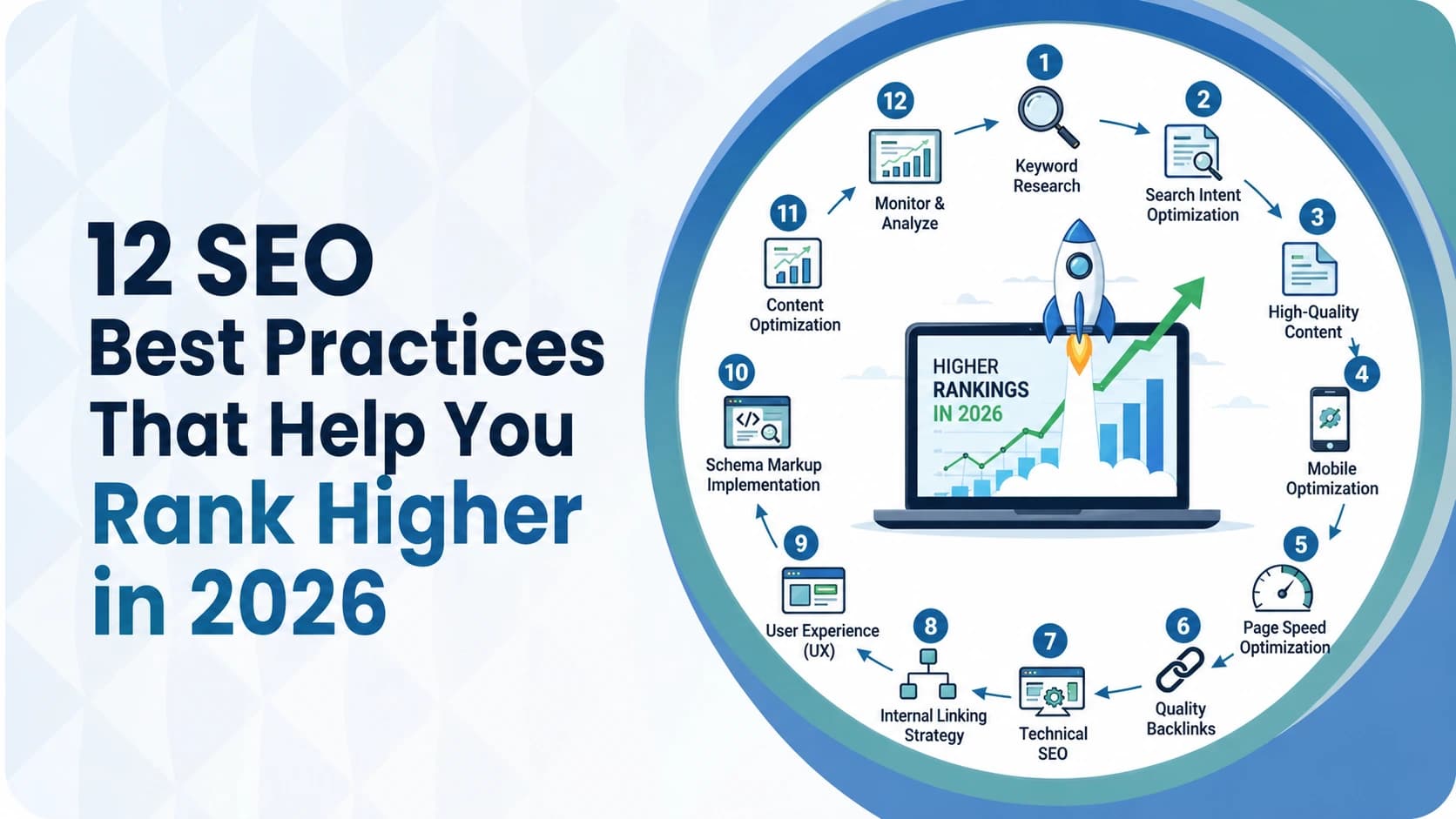
Here is what most people get wrong: ranking in 2026 is not about loading a page with keywords and waiting for Google to notice. The sites sitting at the top right now are doing something different. They are matching the real reason behind every search. They are building pages that are easy to crawl, fast to load, clear to read, and worth clicking on.
Understanding search intent in SEO is at the center of all of it. Before any keyword list, before any backlink campaign, before any meta tag, the question is always the same: what does this person actually want? When your content answers that question more clearly than any other page on the results page, ranking follows naturally.
This guide covers 12 SEO best practices built for how search works right now, not two years ago. Whether you are starting from scratch or trying to break through a ranking plateau, these are the practices that move the needle in 2026.
Most keyword research starts with volume, and that is the first mistake. A keyword with 20,000 monthly searches means nothing if the people behind it are not looking for what you offer. The smarter approach starts with intent, understanding why someone is searching before deciding whether that keyword belongs in your strategy at all.
Group your targets by stage. Informational keywords like "how to fix a crawl error" belong in educational blog content. Comparative keywords like "best SEO tools 2026" belong on pages that help people choose. Transactional keywords like "hire SEO agency near me" belong on service or landing pages. When the page type matches the real goal behind the search, rankings come faster and hold longer.
Keyword gaps are where most sites quietly fall behind. Pull up a competitor's top pages in tools like Ahrefs or Semrush and look for the topics they rank for that your site has not covered yet. These gaps are open doors, especially pre-buying keywords that capture people while they are still deciding. Winning someone's attention at that stage is far more valuable than chasing them after they have already made a choice.
One clarification worth making here: negative keywords are a paid search concept used in Google Ads, not organic SEO. In organic search, the equivalent is simply choosing not to pursue terms that are too broad, too competitive, or irrelevant to your real audience.
On-page SEO covers everything you control directly on every page you publish, and it remains one of the strongest signals in your hands. Start with the URL, short, clean, and descriptive. A URL like /seo-best-practices tells both users and Google exactly what the page is about before anyone clicks.
Your H1 should include the main keyword naturally, not forced. Sub-headings (H2s and H3s) should organize the page in a logical order and include related terms that help Google understand the full topic, not just the surface. Your opening paragraph matters more than most people give it credit for. Get to the point in the first hundred words and tell the reader what they are going to get.
Keyword density is not a fixed formula. There is no magic percentage you need to hit. What matters is that your keyword appears where it makes sense, in the title, the opening paragraph, a couple of sub-headings, and naturally throughout the text where it fits. Forcing it into every third sentence signals low quality. Pages that read naturally hold users longer, and that time-on-page behavior is a real signal that supports rankings over time.
Your meta title and meta description do not directly determine where your page ranks, but they absolutely determine whether someone clicks when they see it. Think of them as your pitch inside Google's results page, a few seconds of prime real estate to convince someone to choose you over every other result around you.
Keep title tags under 60 characters so they display in full without being cut off. Lead with the keyword, then give a reason to click. For meta descriptions, aim for 150 to 160 characters. Research from Backlinko analyzing 11.8 million Google search results found that the top organic result earns an average click-through rate of 27.6%, while results further down the page earn dramatically less. That gap is partly content, partly how well the snippet matches what the searcher expected to find.
Write your meta description like you are speaking to the exact person who typed that query. Confirm that the page answers what they asked. A mismatched snippet loses clicks even when the ranking is strong. According to Google Search Essentials, placing keywords in prominent and natural locations, including titles and descriptions, is a foundational part of how search understands what your page covers. Even when Google rewrites your description for a specific query, a strong original one keeps your content anchored to the right intent.
Keyword stuffing stopped working years ago, but weaker versions of it still appear on pages that should rank better. Repeating the same phrase every few sentences breaks the reading flow and signals to Google that the page is written for an algorithm, not a person. Both readers and search engines notice, and neither responds well.
Strong content answers the main question clearly and then keeps going, covering the follow-up questions a reader would naturally have next. A page about how to improve search engine optimization should not just define what SEO means. It should explain what breaks rankings, what fixes work, and what mistakes to avoid, in a way that leaves the reader with something specific they can actually use.
Original examples and real detail separate useful content from recycled advice. Anyone can say "write quality content." Fewer people explain what quality looks like in practice: depth without padding, clarity without oversimplifying, and answers that leave zero reason for the reader to go back to Google and search again. That last part, making the reader feel like they found exactly what they needed, is what builds topical trust over time.
Internal linking is one of the most overlooked good SEO practices across every kind of site, and it is also one of the lowest-effort, highest-return moves available right now. Every link you add between your own pages passes two signals: relevance and authority. When your blog post on keyword research links to your service page on SEO strategy, you are telling Google that these topics are connected, and you are directing attention toward the pages you want to rank.
Build your site like a web, not a list. Group related content into topic clusters. Link from high-authority pages to the pages you want to push up. Use anchor text that describes the destination clearly, not "click here" or "learn more," but specific phrases that tell both readers and crawlers exactly what they will find. For example, a deep-dive resource on search intent in SEO gives your keyword strategy a direction that volume metrics alone never can.
Check for orphan pages, pages on your site that have no internal links pointing to them. Crawlers often miss them, which means they may never rank, regardless of how solid the content is. Even one or two internal links pointing to an orphaned page can bring it back into the crawl path.
Strong content fails when the technical foundation underneath it is broken. If Google cannot find, crawl, and index your pages without interruption, the quality of what is on those pages does not matter in the slightest. Technical health is not optional; it is the floor everything else stands on.
Start with the basics:
Duplicate content quietly splits ranking signals between pages that should be working together. If your site generates multiple URLs for the same content, filtered category pages, session IDs, print versions, and canonical tags, keep the authority concentrated on the right URL.
For a full breakdown of how these technical SEO issues affect real-world rankings, covering speed, mobile setup, sitemaps, robots.txt, redirects, and indexation control, it is worth reading before you audit your own site. As Google Search Central notes on AI features and your website, appearing in AI-powered results does not require any special extra treatment beyond solid SEO fundamentals applied consistently.
Google uses mobile-first indexing, which means it primarily evaluates the mobile version of your site when deciding where to rank it. A site that looks polished on desktop but loads slowly or breaks on mobile will rank based on the weaker version, every time.
Page speed shapes whether users stay or leave before the page even fully loads. Google's research found that when load time increases from one second to three seconds, the probability of a user leaving increases by 32%. That number becomes even sharper on mobile, where users expect speed and patience runs thinner.
For mobile specifically, three things matter most:
Google PageSpeed Insights goes beyond a score and gives you specific, prioritized fixes. Use it after publishing new pages or running any design update, not just once at launch.
Structured data is not a ranking shortcut; it is a clarity tool. It is a way of labelling your content so Google understands what it means, not just what it says. That distinction matters more as search results get more complex and competitive.
Adding the FAQ schema to a page, for example, allows Google to display expandable questions directly in the search result. That extra real estate makes your result more visible and more useful before anyone clicks. Review schema adds star ratings. Article schema helps Google categorize your content type. Service schema tells local and broader search what you offer and where you offer it. These are practical, not complicated.
Think of structured data as giving your content a proper introduction. Without it, Google is guessing at context from the text alone. With it, you are being explicit. The result is often a richer, more eye-catching search result format, which means more clicks from the same ranking position, not just a better position.
Backlinks remain one of the strongest ranking signals in 2026, but the kind of backlinks matters far more than the number. One link from a relevant, well-regarded publication in your space carries more weight than a hundred links from unrelated low-quality directories.
Relevance is the starting point. A link from a site your target audience actually reads signals to Google that your content belongs in that conversation. A link from a random site with no topical connection is nearly worthless, and if that site is considered spammy, it can actively work against you.
Digital PR is one of the most reliable ways to earn strong links over time. Original data, detailed research, useful free tools, and stories that reporters want to reference all attract links without you having to ask for them. Guest posts on reputable industry sites, honest partnerships, and being featured in curated resources all support a healthy off-page profile. Stay away from any service that promises hundreds of links in a short time, Google's spam detection has grown sharper every year, and those shortcuts cost rankings far more than they ever add.
When two pages on your site carry similar or identical content, search engines have to choose which one to rank, and they often choose wrong, or dilute the authority between both. Canonical tags solve this by pointing Google to the preferred version of a page, so all ranking signals concentrate there instead of splitting.
Use canonical tags on filtered product pages, syndicated articles, or any page that exists in multiple URL variations. The tag goes in the <head> section and takes one line of code. It is a low-effort fix with a meaningful payoff for any site that has grown beyond a handful of pages.
404 errors are not automatically harmful, a 404 just means the URL returns nothing. The real damage happens when previously indexed pages start returning 404s because they were deleted without a redirect in place. Use Google Search Console to identify those broken URLs and set up 301 redirects pointing to the most relevant live alternative. This keeps the traffic and link equity intact rather than letting it vanish completely.
Images are one of the most common causes of slow page load times, and slow pages lose users before the content even has a chance. Compress every image before uploading, tools like Squoosh or TinyPNG cut file sizes by 60 to 80 percent without any visible quality loss. Write descriptive alt text for every image to support accessibility and give search engines a clear text signal about what the image shows.
SSL certification, the HTTPS padlock in the browser bar, is a confirmed ranking signal and a basic trust marker. Sites still running on HTTP in 2026 are sending the wrong signal to both users and Google. If your site has not made the switch, that is the first fix to make before anything else on this list.
User experience signals now carry more weight than they did even a few years ago. Pages that load fast, hold their layout, and deliver exactly what the headline promised earn longer sessions and return visits. Those behavioral signals feed directly back into how Google evaluates the page's value. The better the experience, the clearer it becomes to search engines that users are finding what they came for.
Voice search queries are longer and more conversational than typed searches. Someone might type "SEO best practices 2026," but ask their phone, "What are the most important SEO practices to follow this year?" Your content needs to work for both. Writing answers in full, natural sentences, especially in opening paragraphs and FAQ sections, helps voice-based systems pull your content as a spoken result.
Think about what your audience would actually say out loud, not just type. Use sub-headings phrased as questions and write direct answers in the first sentence under each one. This structure supports voice search visibility and also improves the odds of earning featured snippets in standard search results.
Social sharing does not directly change where you rank, but it extends how far your content travels. When more people see your page and engage with it, the chances of earning organic mentions and editorial links increase over time. Make sharing easy, add share buttons, create images worth saving, and write headlines people actually want to pass along. Wider reach builds the secondary signals that support SEO steadily in the background.
The best search engine optimization best practices in 2026 are not the loudest ones. They are the ones that make pages clearer, faster, more useful, and more trustworthy, for users first, and for Google as a result. Each section in this guide connects to the next because SEO works as a system. Strong keyword research shapes better content. Better content earns stronger links. Technical health makes sure those links count. Speed and structure keep users engaged long enough for all of it to matter.
If you want a team that puts these best practices into real rankings, without the shortcuts that fade, Local SEO Mississauga builds structured, intent-led SEO strategies built around what works in 2026, not what worked before.
The most impactful ones are intent-matched keyword research, clean on-page structure, strong technical health, content that answers follow-up questions naturally, and a relevant backlink profile focused on quality over volume. These work as a system, no single practice carries the full weight on its own.
Start with what you fully control: fix on-page structure, strengthen internal linking, compress images, add structured data where it applies, and create content that genuinely matches what your audience searches for. These changes cost time and attention, not money.
Yes, and more noticeably than before. Google's systems detect unnatural repetition and treat it as a quality signal against the page. Natural placement in meaningful locations, the title, the opening, and a few logical spots in the body, does far more for rankings than forced repetition throughout the text ever could.
Most changes take three to six months to produce measurable ranking movement in competitive spaces. Technical fixes and internal linking improvements tend to surface faster. Content authority builds gradually as pages accumulate signals over time; consistency matters more than speed.
Absolutely. FAQ schema, article schema, and service schema are practical, low-effort additions that help Google present your results more clearly in search. For smaller sites, especially, richer result formats mean more visible listings and stronger click-through rates, which compound over time.
Get a free SEO audit and a clear, prioritized plan for your Mississauga business — no long-term contract required.
Get a Free SEO Audit· 8 min read
See what an HTTP 401 error means, how it differs from 403 and how users or developers can fix authentication problems. Check the steps now.
Read article· 11 min read
Improve brand mentions in ChatGPT, Gemini and AI Overviews with stronger entities, citations and answer-ready content. Use the 2026 checklist.
Read article· 14 min read
Build a keyword plan around search intent, competition and business value, then map terms to the right pages. Follow the step-by-step process.
Read article