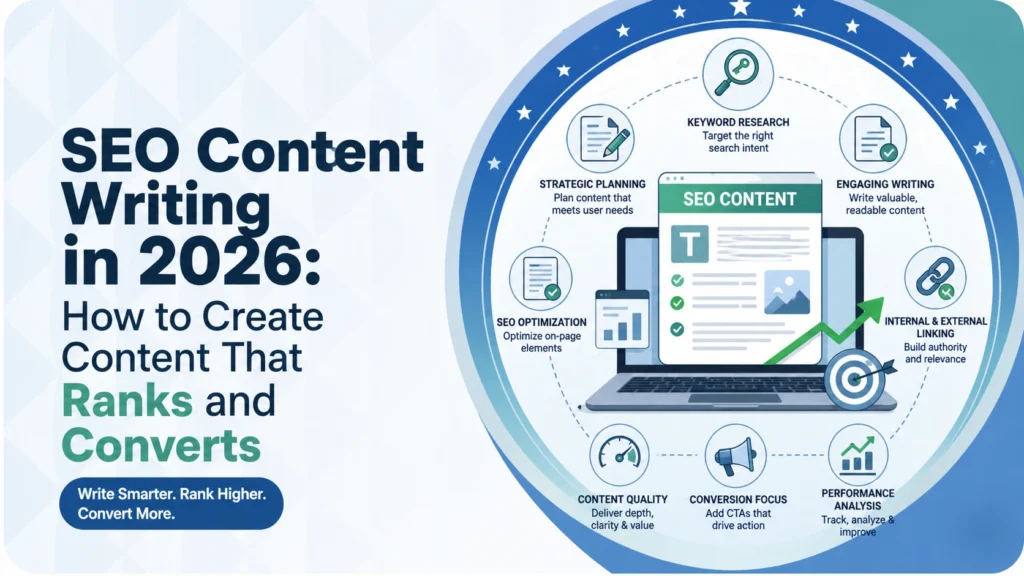
SEO Content Writing in 2026: How to Create Content That Ranks and Converts
April 28, 2026
Ranking on Google is not the win it used to be. You can sit at position three and still watch most clicks go to positions one and two, or vanish into the AI answer box sitting above everything else. In 2026, your title tag and meta description are doing the real work. Those two short lines decide whether a searcher clicks your result or the next one, full stop.
Think about the last time you searched for something. You didn’t read every listing. You scanned, picked the one that looked closest to your answer, and scrolled past the rest. That is exactly what every reader is doing to your page right now. If your metadata doesn’t match their question, you lose a click you already earned with your SEO content writing.
This is where smart on-page SEO Mississauga work quietly pays off, by shaping titles and descriptions that match real search intent, set the right promise, and bring the click home. Let’s walk through how to do it right for 2026.
Why Your Clicks Really Start Inside Search Results
Your title tag is the first impression of your entire website. A searcher sees it before your logo, before your design, before a single line of your page. In a crowded Google results page, that one line is competing against nine other answers, plus ads, AI summaries, and People Also Ask boxes.
Meta descriptions do the second job. They confirm the promise, add details the title couldn’t fit, and build quick trust. A strong description feels like it is speaking to the searcher’s actual problem, not a sales pitch.
Here’s the part most site owners miss: more rankings do not always mean more traffic. According to Advanced Web Ranking’s Google CTR Stats Changes Report for Q4 2025, click-through rates now shift sharply by device, query type, and SERP features, which means a position-one ranking on a mobile informational search can earn a very different click rate than the same position on a desktop commercial search.
Before a user opens your page, Google is already judging relevance. Your title and description are the first signals. If they miss the intent, your ranking alone won’t save you.
How Google Rewrites Titles and Snippets in 2026
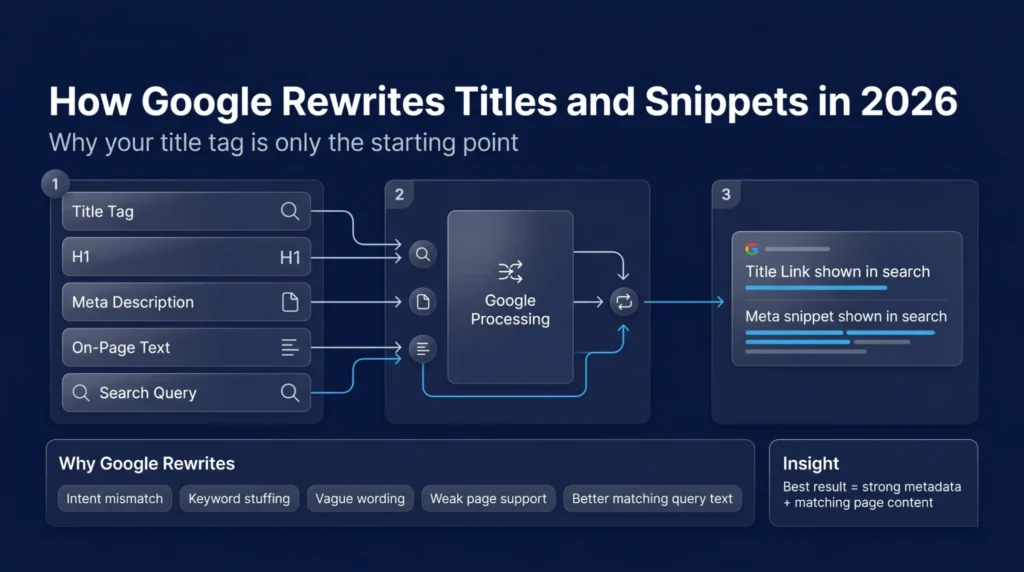
Here is something many site owners learn the hard way: Google does not always show the title you wrote. If your title tag is vague, stuffed with keywords, or disconnected from the page, Google will swap it out. The same goes for meta descriptions. When your snippet doesn’t match the search query well, Google will pull a sentence from your page content instead.
Google has confirmed this openly. It can generate title links using your title tag, H1, og:title, anchor text, structured data, or other prominent text on the page.
Why does this matter for SEO content writing? Because writing a clever title is only half the job. You have to write a page that supports it. If your title says “Best Budget Laptops Under $500” but your H1 says “Cheap Computers” and your intro talks about printers, Google will likely rewrite the title to something closer to the page content.
Search intent also plays a bigger role now. The same page can produce different rewritten snippets for different queries. For 2026, your goal is to write the strongest possible title and description, then back them up with a page that delivers. That is the cleanest way to stop Google from overriding your copy.
Write Metadata by Search Intent, Not Guesswork
Good metadata starts with one question: what does the searcher actually want? Writing for search engine optimization without matching intent is like answering a question nobody asked.
There are four main intents, and each one changes how you write.
Informational intent fits blog posts, guides, and how-to content. Searchers want to learn. Titles here work best when they promise a clear answer, like “How to Fix a Slow WordPress Site in 2026.” The description should hint at the steps or the outcome.
Commercial intent covers research and comparison pages, including service pages and SEO website content writing landing pages. The searcher is close to buying but still comparing. Metadata should lead with benefits and trust signals like years in business, client results, or specific guarantees.
Local intent is place plus service, like “dentist in Mississauga” or “roofer near me.” Titles and descriptions must show the city clearly. Local searchers decide fast, so hours, location, and phone visibility matter more than clever wording.
Transactional intent is for pages built to convert, such as product pages, pricing pages, and booking pages. The copy should be direct. Tell people what they get, remove doubt, and make the next step obvious. This is where SEO copywriting earns its weight.
Use Keywords Without Sounding Robotic
Keywords still matter in 2026. What has changed is how they should feel. Old-school SEO writing crammed the same phrase into every sentence. Today that gets your snippet rewritten and your trust lowered by Google and real readers.
Here is a cleaner way to handle keywords in titles and descriptions:
- Place the main keyword early, ideally in the first 40 characters of the title, so it stays visible on mobile screens.
- Add one related phrase or entity that gives context, not another copy of the same keyword.
- Use natural wording that sounds like how people actually search, including short questions and plain benefits.
- Skip filler like “welcome to our website” that eats space without adding value.
Smart keyword research tells you which phrases your audience types. But your title is for humans first. If reading it out loud sounds strange, rewrite it. SEO and content writing that wins clicks reads like a useful answer, not a keyword checklist. This balance sits at the heart of SEO best practices 2025 and 2026 alike. Clarity earns the click. Trust earns the stay.
Title Tag Formulas That Lift Clicks and Rankings
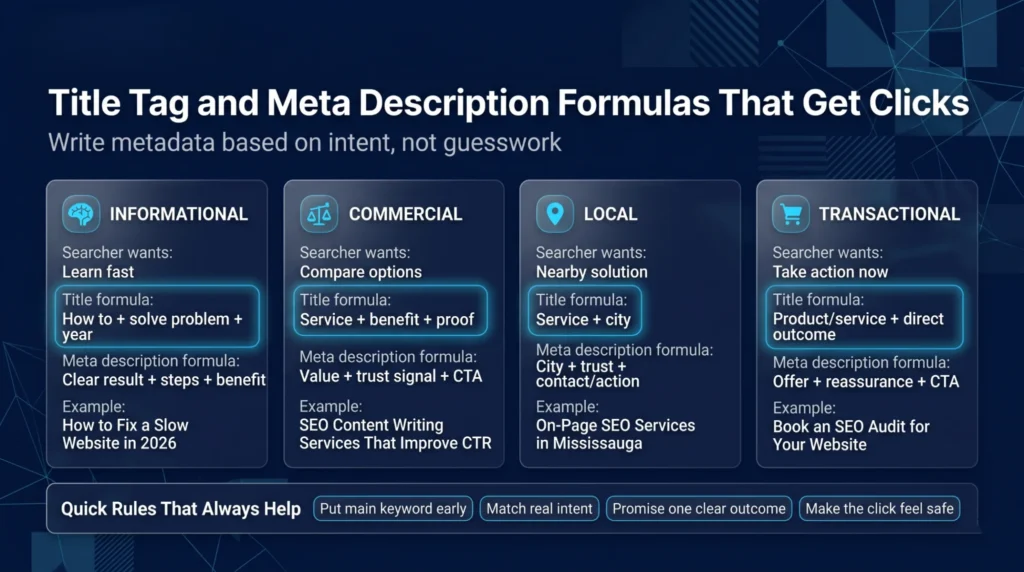
You do not need to invent new titles every time. A few repeatable structures work well because they match how people scan search results.
Benefit-led formulas lead with what the reader gains. Example: “Get More Leads From Your Website in 30 Days.” It tells the searcher the outcome, not just the topic. Number and year structures give the brain something easy to lock onto. “7 SEO Writing Tips That Work in 2026” beats “SEO Writing Tips” almost every time, because numbers promise a clear scope.
Problem-solution titles work well for both informational and commercial intent. Example: “Site Not Ranking? Fix These 5 On-Page Errors First.” This hits because you name the pain and the fix in one line. Local and service-based formulas should include both the location and the service. “Affordable On-Page SEO Services in Mississauga” is stronger than a vague “We Offer SEO Services.”
For blog posts, lean on curiosity plus clarity. For service pages, lead with value plus proof. For long-form articles, use the main keyword plus a promise, like “Writing for Search Engine Optimization: A 2026 Beginner’s Guide.” Whichever formula you pick, read it back and ask one question: would I click this if I didn’t know the brand?
Meta Descriptions That Turn Searchers Into Visitors
The meta description is your second pitch. The title made them look. The description should make them move.
Google does not use meta descriptions as a direct ranking factor, but they heavily shape clicks. A sharp description can raise your CTR without changing a single ranking spot. This is an area where experienced SEO content writers and solid on-page SEO services focus a lot of attention, because small description changes often bring the biggest wins.
So how do you write one that converts a searcher into a visitor? A few rules that always work.
Start with the reader’s need, not your company name. A line like “Struggling with low traffic?” hits harder than “At XYZ Agency, we offer…” Add a clear benefit in the next sentence. Finish with a light call to action such as “See how,” “Learn more,” or “Get a free audit.”
Keep desktop descriptions between 150 and 160 characters, and slightly shorter for mobile. Write in full sentences that sound like one human helping another. Avoid forced SEO copywriting that stacks phrases like “best top leading #1 agency.” It reads like 2012 spam, and buyers in 2026 scroll straight past it. Write the way you would speak to a stressed small-business owner searching at 9pm for a real answer.
Connect Metadata With Page Content and Structure
Your title and description are the front door. The rest of your page has to match. This is where many SEO content writers lose users, and where Google quietly lowers trust.
Start by aligning four elements: the title tag, the H1, the intro sentence, and the main call to action. They should speak to the same user, the same problem, and the same solution. If your title says “Affordable Web Design” but your H1 says “We Are a Creative Agency,” the reader feels a mismatch in half a second and bounces back to Google.
Clean site structure supports this trust. Clear menus, short URLs, and simple category names help search engines understand what each page is about, which improves how your snippets are generated. Internal links pull it all together. Link from your blog post on title tags to your service page on on-page SEO, or to related content like technical SEO guides. This shows topic depth and sends readers deeper into your site. Thinking about featured snippets also sharpens your copy. If your page can answer a question in 40 to 60 words near the top, you can win zero-click attention that still builds brand authority.
How to Test and Lift Your Click-Through Rate
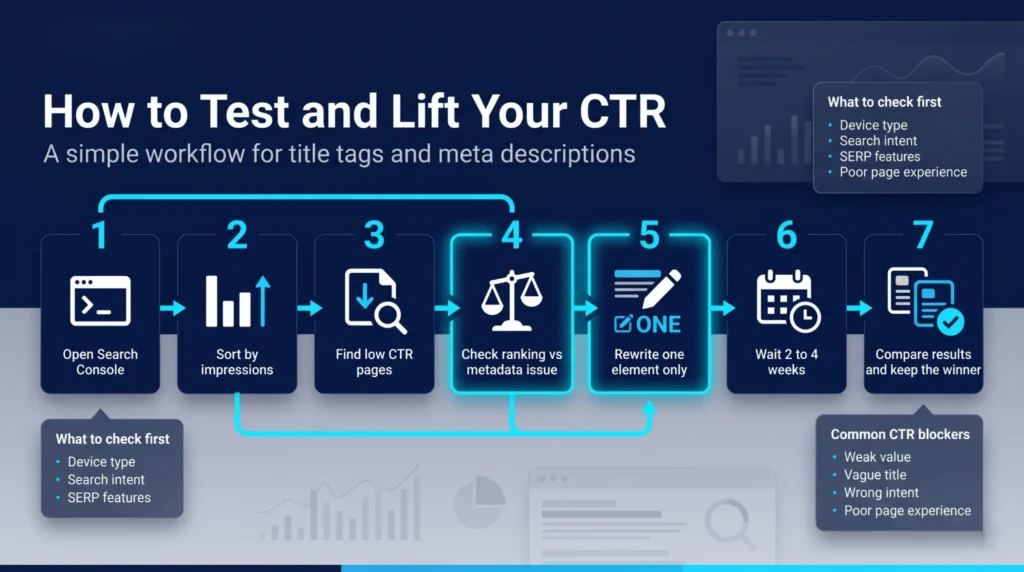
You cannot improve what you don’t measure. Google Search Console is your free starting point. Open the Performance report, sort by impressions, and look for pages with high impressions but low click-through rates. Those are your fastest wins.
Before rewriting anything, split the problem in two. Is the issue ranking, meaning you sit too far down the page? Or is it metadata, meaning you rank well but no one clicks? A page at position three with 1% CTR is a metadata problem. A page at position eighteen with 0.2% CTR is a ranking problem, and no title tweak will save it.
Test titles by audience segment, device, and intent. Mobile users usually need shorter, punchier titles. B2B queries respond to proof and specifics. Local queries need the city name visible. Change one element at a time, give it two to four weeks, and check Search Console again.
How to improve the SEO performance of your clicks also connects to page experience. Slow-loading pages, poor Core Web Vitals, and shaky mobile layouts lower the weight of your entire snippet’s promise. A great title that leads to a broken page still loses the reader.
Mistakes That Quietly Kill Clicks From Search
Some problems are so common they almost feel normal. They are not. Each one costs you clicks every single day.
- Vague titles that do not name a benefit, audience, or outcome.
- Stuffing the same keyword two or three times in one title.
- Misleading snippets that overpromise and make users bounce in seconds.
- Generic descriptions copied across ten pages without changes.
- Leaving old years in titles like “Best Tools 2023” long after they go stale.
- Forgetting the location on local service pages.
A weak title doesn’t just lose a click. It tells Google your page isn’t a strong match, which pulls your future rankings down on the same query. Fixing your metadata is one of the highest-return tasks in any SEO audit, and it usually takes less than an hour per page.
Final Thoughts and a Partner Worth Knowing
In 2026, SEO content writing is not about chasing rankings alone. It is about winning the two-second decision inside a crowded search result. Your title tag sets the promise. Your meta description earns the click. Your page delivers the answer. When those three line up, traffic and conversions follow naturally.
Small and mid-sized businesses often underestimate how much one good title can change a month’s revenue. Audit your top 20 pages this week, rewrite the weakest titles, and track the changes in Search Console. Most big wins are not hiding in new content. They are hiding in pages you already own.
If you run a service business and want proof of how clean, intent-matched website copy brings steady inbound leads without paid ads, teams like Local SEO Mississauga are a useful example of how sharp on-page copy turns ranking into real business. Apply the same approach to your own title tags, meta descriptions, and matched page content, and you’ll turn 2026 impressions into the clicks your site has been missing.
FAQs
1. What is the best length for title tags in 2026?
Aim for 50 to 60 characters. This keeps your title from getting cut off on desktop and most mobile screens. Clarity comes first, length comes second. A clear 45-character title will beat a stuffed 60-character one every time.
2. Do meta descriptions still help with SEO and clicks?
Meta descriptions are not a direct ranking factor, but they strongly shape clicks. A sharp description lifts your CTR, and higher CTR sends positive signals back to Google. So yes, they matter a lot for actual traffic.
3. Why does Google rewrite my title tag or meta description?
Google rewrites them when your metadata does not match the page content, is too long, stuffs keywords, or fails to fit the user’s specific query. Writing tight, honest, intent-matched copy is the fix.
4. Should I use the target keyword in both the title and description?
Yes, but use it once in each, placed naturally. The title should include it early. The description should use it once in a full sentence. Don’t repeat it, because that reads as spam to both Google and the reader.
5. How can I improve click-through rate without changing rankings?
Rewrite titles with clearer benefits, add numbers or years, match search intent more tightly, and write descriptions that speak directly to reader needs. Test changes in Search Console over two to four weeks before judging the result.
Search Here
More Categories
Latest Posts
June 18, 2026
Sanawar Ali
June 15, 2026
Sanawar Ali
June 11, 2026
Sanawar Ali
May 21, 2026
Sanawar Ali
May 19, 2026
Sanawar Ali