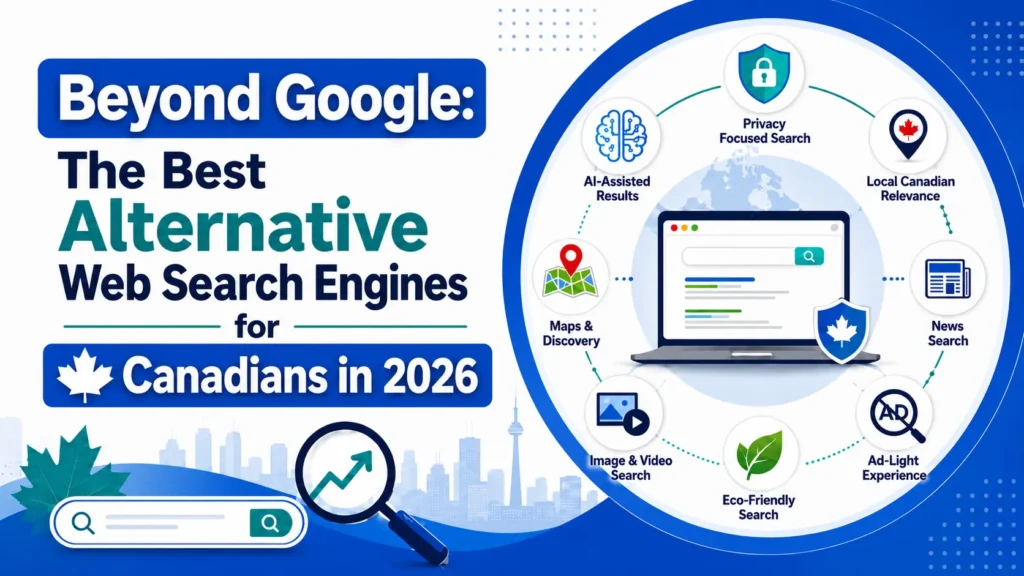
The Best Alternative Web Search Engines for Canadians in 2026 Beyond Google
June 18, 2026
Google is still the biggest search engine in Canada, but it is no longer the only serious option. In 2026, the best alternative web search engines include Bing, DuckDuckGo, Brave Search, Kagi, Ecosia, Startpage, Qwant, Presearch, Perplexity AI, and ChatGPT Search.
Canadians are using these Google alternatives for different reasons: better privacy, fewer ads, AI-powered answers, independent results, eco-friendly searching, and more control over what they see online.
This guide compares the top alternative search engines in 2026 and helps you choose the right one for privacy, research, business visibility, AI search, or daily browsing.
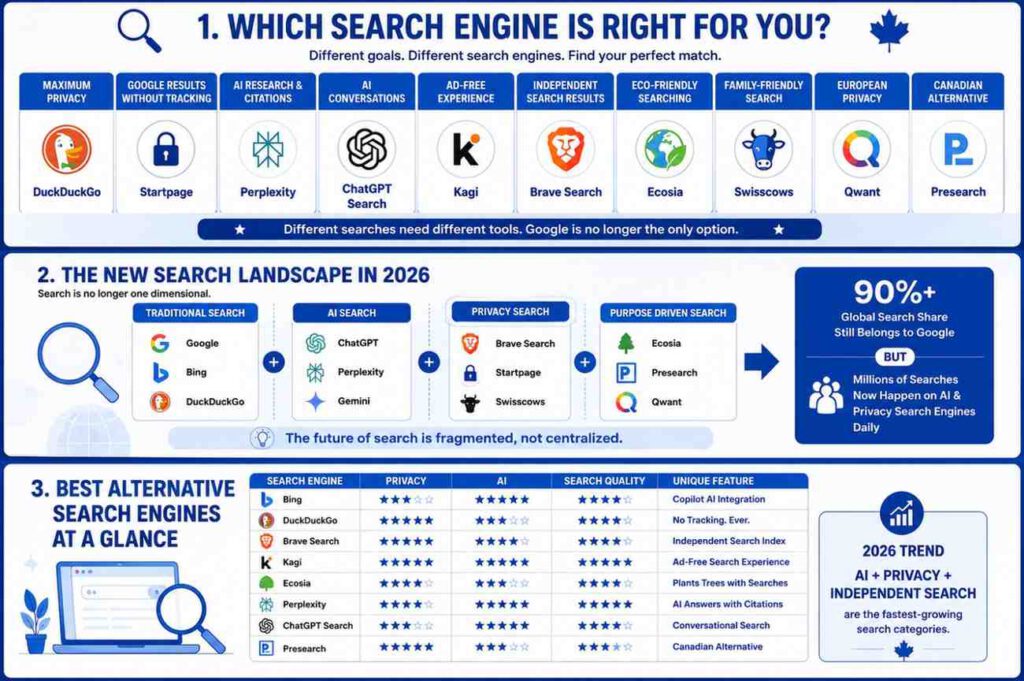
Quick Comparison of Alternative Search Engines
To keep things digestible, here’s a quick comparison of the major alternative search engines, their unique strengths and why Canadians might care. Numbers in the table refer to the most recent data available between 2024 and 2026.
| Search Engine | Key Purpose/Feature | Usage Stats & Notes |
| Microsoft Bing | Strong at image search and integrated with Windows; now an AI‑powered engine with Microsoft Copilot. | 900 million daily searches; holds ~10 % of Canadian market. Great for image and video search and the default on many devices. |
| DuckDuckGo | Privacy‑first metasearch engine; uses !bangs to query specific sites. | Handles 100 million searches per day and processes over 36 billion queries annually. Minimal tracking and no personalized results. |
| Brave Search | Independent index with built‑in ad blocker and optional AI answers via Brave’s “Goggles” and “AI Answers.” | Serves over 20 billion queries per year, with 50 million daily queries and more than 15 million AI‑generated answers per day. A good pick for ad‑free searching. |
| Kagi | Subscription‑based ad‑free search with customizable ranking, Lenses and integrated AI assistant. | Ad‑free, user‑funded model; you get 150 free searches then a low monthly fee. Allows users to promote or block specific websites and uses multiple AI models. |
| StartPage | Combines Google’s search results with privacy by stripping identifiers; includes Anonymous View proxy. | Operates from the Netherlands (strict privacy laws) and offers a proxy so you can visit websites anonymously. Slower than Google but private. |
| Ecosia | Eco‑friendly search: profits fund tree‑planting; powers itself with 200 % renewable energy. | Reached 250 million trees planted by April 2026; uses Bing index but encrypts searches and doesn’t permanently store personal data. |
| Qwant | French search engine focusing on privacy and European data protection; offers Flash Answer and Chat IA (AI chat). | Doesn’t retain search history and is hosted in Europe. Provides quick AI‑generated answers and chat without requiring an account. |
| Presearch | Decentralized, Canadian‑born search engine powered by a network of community‑run nodes; lets you query multiple engines and stake tokens. | Launched in 2017; uses a distributed network to keep user data private. Allows users to choose search providers (Google, Bing, DuckDuckGo) and stake tokens to promote websites. |
| Perplexity AI | AI‑powered search engine that cites sources; focuses on providing concise answers with references. | Had 45 million monthly active users and 780 million monthly queries by mid‑2025. Projected to reach 1.2–1.5 billion queries per month by mid‑2026. |
| ChatGPT Search / Gemini | Conversational AI search; summarises results in chat. | ChatGPT dominates the AI search market with 55–60 % referral share while Google’s Gemini holds 18–21 %. However, click‑through rates are only 0.84–1.3 %, nearly 96 % lower than Google’s traditional search. |
| You.com | Modular search engine offering AI chat, code snippets, video modules and app integrations; emphasises customizable results. | A rising AI‑driven platform that integrates a search API used by developers for real‑time results. |
| Mojeek | One of the few truly independent search engines with its own crawler‑built index; free from personalization. | Hosts its index in eco‑friendly data centres and allows emotion‑based search. |
| Swisscows | Swiss search engine with its own index; family‑friendly results and strong privacy. Offers products like Swisscows Pro and VPN. | Provides anonymous, family‑friendly searches with no tracking. Cooperates with Brave and uses semantic search for precise results. Offers Swisscows Pro for complete anonymity. |
Why Canadians Should Use Multiple Search Engines
Modern search isn’t one‑size‑fits‑all. Using two or more search engines can actually improve your results. Here are some reasons to diversify your searches (and some jokes to prove we’re not robots):
- Privacy matters: If you’re tired of feeling like a commodity, DuckDuckGo, Swisscows or StartPage will stop the digital paparazzi. They don’t store your IP or search history.
- Independent indexes: Engines like Brave and Mojeek run their own crawlers, meaning you’re not just getting Bing results in a new wrapper. Think of them as the indie bands of search: less polished, more authentic.
- AI‑enhanced answers: ChatGPT and Perplexity summarise the web using large language models, but they also reduce click‑through. If you need quick answers without wading through 10 blue links, these tools are handy. Just remember their 0.84–1.3 % click‑through rate means they often satisfy your query without sending traffic back to websites.
- Eco‑friendly choices: Want your searches to plant trees? Ecosia uses profits to fund reforestation and hit 250 million trees planted by 2026. Searching with Mojeek or Swisscows uses eco‑friendly data centres. Mother Nature says thanks!
- Canadian values: Presearch is literally a Canadian alternative. It allows community‑run nodes and pays you in tokens for using and promoting the search platform. That’s more polite than apologising after every query.
- Research and specialisation: Kagi offers a Small Web curated by real people, while You.com lets you tailor results with different modules. Use them when you need research papers or code snippets instead of influencer recipes.
Using multiple search engines is like carrying both a hockey stick and a snow shovel – you never know which tool you’ll need until winter hits.
Deep Dive into the Top Alternative Search Engines
1. Microsoft Bing: The comeback kid
Microsoft Bing has spent years as the butt of jokes, but 2026 is its glow‑up. With around 900 million searches per day and 4.22 % global market share, Bing is a serious contender. It boasts beautiful image and video search, integrated visual tools (like AI‑generated images) and the Microsoft Copilot assistant, which will answer your questions, summarise documents and draft emails. Bing’s share in Canada hovers around 10 %, partly because Windows default settings quietly direct millions of queries their way.
2. DuckDuckGo: Privacy in plain sight
If privacy is your north star, DuckDuckGo is your compass. This Pennsylvania‑based engine processes about 100 million searches every day, with annual queries exceeding 36 billion. DuckDuckGo doesn’t log your IP address or search history and refuses to create user profiles. It uses Bing’s results with some own crawling. The famous !bang shortcuts let you jump directly to specific sites – typing !wiki snowy owl takes you straight to Wikipedia without any fluff.
Despite a small global market share (0.71 %), DuckDuckGo’s Canadian usage is growing because our privacy laws align with its ethos. It has also launched DuckAssist, a generative AI summary tool. While it’s not as chatty as ChatGPT, it summarises websites quickly so you can decide whether to click.
Pro tip: Use DuckDuckGo when you’re shopping or researching sensitive topics, and take advantage of the !bang commands. For example, !yt searches YouTube, !ca searches Canadian websites, and !amazonca leads to Amazon Canada, you’re welcome.
3. Brave Search: Independent and ad‑free
Brave’s search engine is the rebellious cousin of the Brave browser. Unlike many privacy search engines that rely heavily on Bing’s index, Brave builds its own independent index. It processes over 20 billion queries per year and serves more than 50 million user queries every day. The interface feels like a clean Google result page, but without ads. Brave introduced AI‑generated answers (Brave AI) and Goggles, which are custom filters created by the community to reorder search results according to specific criteria (e.g., show only tech blogs or exclude major media outlets).
Canadian angle: Brave has gained traction with privacy‑conscious Canadians. Its Web Discovery Project encourages users to contribute anonymized data to improve results, but participation is voluntary.
4. Kagi: Premium search for power users
Kagi turns search into a subscription service, proving that sometimes paying a few loonies can improve your online life. Instead of profiting from ads, Kagi is funded by users. After 150 free searches per month, you pay a small monthly fee. In return, Kagi gives you ad‑free results, the ability to block or boost specific websites and Lenses for customizing your search. It also offers the Kagi Assistant, which lets you access multiple AI models while keeping prompts private.
5. StartPage: Google results, no Google tracking
StartPage uses Google’s search index but removes all identifying information. It is based in the Netherlands, benefiting from strict EU privacy laws, and offers Anonymous View, a proxy that lets you visit websites without exposing your IP address. StartPage is slower than Google because of the extra privacy steps, but for users who want Google‑grade relevancy without being tracked, it’s worth the wait.
6. Ecosia: Search for the planet
Imagine if every search planted a tree. Ecosia does just that. This non‑profit search engine uses its profits to plant trees around the world and had planted 250 million trees by April 2026. Ecosia uses Bing’s search index and encrypts your searches. It does not permanently store personal data and invests in solar farms to power its infrastructure.
For Canadians with environmental guilt, Ecosia provides a painless way to offset your carbon footprint. It may not rank your favourite hockey scores as accurately as Google, but you can feel smug about each click.
7. Qwant: Europe’s privacy champion
Qwant is a French search engine built on the principle that you are a user, not a product. It does not store your search history or sell your data. In 2025 and 2026 Qwant rolled out Réponse Flash (Flash Answer) and Chat IA, AI features that provide quick answers and a chatbot experience without requiring an account. Because Qwant is based in Europe, it must comply with GDPR, offering strong data protections.
8. Presearch: Decentralized and proudly Canadian
Presearch might be the most Canadian thing since poutine. Originally founded in Ontario, Presearch is a decentralized, privacy‑focused metasearch engine launched in 2017. It runs on community‑operated nodes that process search queries, reducing centralized data collection. Users can select which engine (Google, Bing, DuckDuckGo) to use for results and can stake PRE tokens to promote websites. Presearch also offers “Frontier Intelligence,” an independent search index aiming to surface human‑first content and avoid commercial bias.
9. Perplexity AI: Citation‑first answers
Perplexity positions itself as the citation‑first AI search engine, delivering concise answers with footnotes. It had 45 million monthly active users and 780 million monthly queries as of mid‑2025, and is projected to hit 1.2–1.5 billion queries per month by mid‑2026. Its growth has been remarkable thanks to partnerships like Airtel Pro in India. However, as giants like ChatGPT and Google’s Gemini grow, Perplexity’s market share has declined from around 12 % to 3–5 %.
When you ask Perplexity a question, it provides a succinct answer and cites sources using footnotes, great for research or when you need to show your homework. You can click the citations to verify the information. It’s like having an AI librarian that always adds a bibliography.!
10. ChatGPT Search and Gemini: Conversational search giants
ChatGPT Search (powered by OpenAI) and Google’s Gemini (formerly Bard) dominate the AI chatbot search market, controlling approximately 86 % of global AI search traffic. ChatGPT alone captures 64.5–78 % of AI chatbot market share while Gemini holds 18–21.5 %, having quadrupled its share since early 2025. However, these platforms have very low click‑through rates (0.84–1.3 %) compared with Google’s 29.2 % because they provide answers directly in the chat.
As a result, businesses must adapt their SEO strategy. Being cited in an AI answer can boost organic clicks by 35 % and paid clicks by 91 %. But the overall increase in zero‑click results means you need to appear in those AI responses rather than only focusing on traditional 10 blue links.
11. You.com: Modular and developer‑friendly
You.com integrates AI chat, code snippets, news and video modules into one interface. It also offers APIs that developers can use to build chatbots and research tools.
You.com is not yet widely adopted in Canada, but its modular design appeals to researchers and tech enthusiasts. The search results include citations and interactive widgets, making it more like an app store for information than a simple list of links.
12. Mojeek: Independent, eco‑friendly and emotional
Mojeek is a U.K.‑based search engine that runs its own crawler and indexes sites independently. It’s one of the few truly independent search engines left.
Mojeek hosts its servers in environmentally friendly data centres and even allows emotion‑based searching, letting you filter results by moods like “happy,” “sad” or “angry.” While its market share is tiny, its independence appeals to users who want results that aren’t influenced by big tech or advertisers.
13. Swisscows: Family‑friendly Swiss precision
Swisscows offers anonymous, family‑friendly search with its own index. The company promotes privacy by not storing any personal data and doesn’t display violent or explicit content. It collaborates with Brave for high‑quality results and uses semantic technology to provide accurate answers.
Swisscows’ revenue comes primarily from its secure products (VPN, email, cloud storage) rather than targeted advertising. For absolute anonymity, Swisscows Pro guarantees that no data (not even IP addresses) is stored.
Choosing the Right Search Engine for You
Picking the best alternative search engine depends on your goals:
- Privacy first: DuckDuckGo, StartPage, Swisscows or Presearch. They keep minimal logs and avoid profiling.
- AI & research: Perplexity, ChatGPT, Gemini or You.com. These are great for summarizing information quickly, but citations and critical thinking are essential.
- Ad‑free & customization: Kagi and Brave. If you’re tired of ads and want to customize results, these are worth paying for or joining.
- Eco‑friendly: Ecosia or Mojeek. Help plant trees or use green data centres with each search.
- Kids & families: Qwant Junior or Swisscows (family filter). They keep explicit results out of the search page.
- Canadian proud: Presearch. Support a local innovation and earn tokens while searching.
How to add an alternative search engine in your browser
Want to give one of these a try? Here’s how to set a custom search engine in Chrome (similar steps work for Firefox and Edge):
- Click the three dots in the top‑right corner and select Settings → Search engine → Manage search engines.
- Click Add and fill out:
- Search engine name: e.g., “Mojeek” or “Ecosia.”
- Shortcut: a keyword to trigger it, like eco.
- URL: visit the site and perform a search. Copy the search URL and replace the search term with %s (e.g., https://www.ecosia.org/search?q=%s).
- Save. Next time you type your shortcut in the address bar, you’ll search with your new engine.
Experiment with multiple engines. You might set Kagi as default for research, Ecosia for casual browsing and Presearch for your daily news, variety is the spice of life!
AI Search’s Impact on SEO and Digital Marketing
As AI search grows, SEO strategies must evolve. In Q1 2026, Google’s AI Overviews appeared in 13–25 % of queries. When AI Overviews are present, organic click‑through rate drops 61 %, and paid click‑through drops 68 %. With AI mode, zero‑click rates soar to 93 %, meaning users find answers without leaving the search page. Generative AI chatbots like ChatGPT dominate AI search share, capturing 55–60 % of referral traffic.
For businesses, this means:
- Optimize for citations: Being cited in AI Overviews can increase organic clicks by 35 % and paid clicks by 91 %.
- Focus on trusted content: AI models emphasise authoritative sources. Producing high‑quality, evidence‑backed content improves your chances of being cited by ChatGPT, Perplexity and Gemini.
- Diversify traffic sources: Relying solely on Google is risky. By targeting Bing, DuckDuckGo and other engines, you reach audiences that AI chat may not satisfy.
- Monitor AI search results: Regularly search your brand and competitors in AI chat tools to understand how they summarise your content and where your citations appear.
Frequently Asked Questions (FAQ)
What’s the most private search engine?
Privacy‑focused engines like DuckDuckGo, StartPage, Swisscows and Presearch are designed not to log your search history or sell your data. StartPage even offers an Anonymous View that lets you visit sites through a proxy.
Are alternative search engines better than Google?
It depends on your priorities. Google still delivers the broadest index and fastest results. However, alternatives excel at specific tasks: Bing is great for images and integrated AI; DuckDuckGo protects privacy; Ecosia plants trees; Kagi is ad‑free. Many people use multiple engines for different needs.
Do alternative search engines have fewer results?
Some, like Mojeek and Presearch, have smaller indexes than Google, meaning obscure pages might be missing. However, engines like Brave and Kagi combine their own crawling with third‑party results, offering competitive coverage. You might notice differences primarily on long‑tail queries or niche topics.
Will my Canadian business benefit from using alternative search engines?
Absolutely. Canadians drive millions of searches outside Google; Bing holds roughly 10 % market share in Canada, and privacy‑oriented engines resonate with our strict privacy culture. Diversifying your SEO strategy ensures you reach users wherever they search.
How do AI chatbots affect SEO?
Generative AI chatbots can reduce click‑through rates, but they also reward authoritative content. Brands cited in AI answers receive more clicks. Focusing on quality content and citations is key. Our team can help you adjust your strategy for AI search.
Conclusion and Call to Action
The search landscape of 2026 is more diverse and dynamic than ever. Canadians don’t have to stick with Google; there’s a search engine for every need, from privacy to AI‑powered answers to environmental activism. With so many options, the smartest strategy is to use the right tool for the right job.
Curious about how alternative search engines can improve your digital presence? Local SEO Mississauga is here to help. With 4.8/5 stars from 138 reviews and a team specializing in SEO, web design and lead generation, we can guide your business through the evolving world of search. Book a call today and let’s ensure your brand shines across every search engine, not just Google.
Search Here
More Categories
Latest Posts
June 18, 2026
Sanawar Ali

June 15, 2026
Sanawar Ali
June 11, 2026
Sanawar Ali
May 21, 2026
Sanawar Ali
May 19, 2026
Sanawar Ali