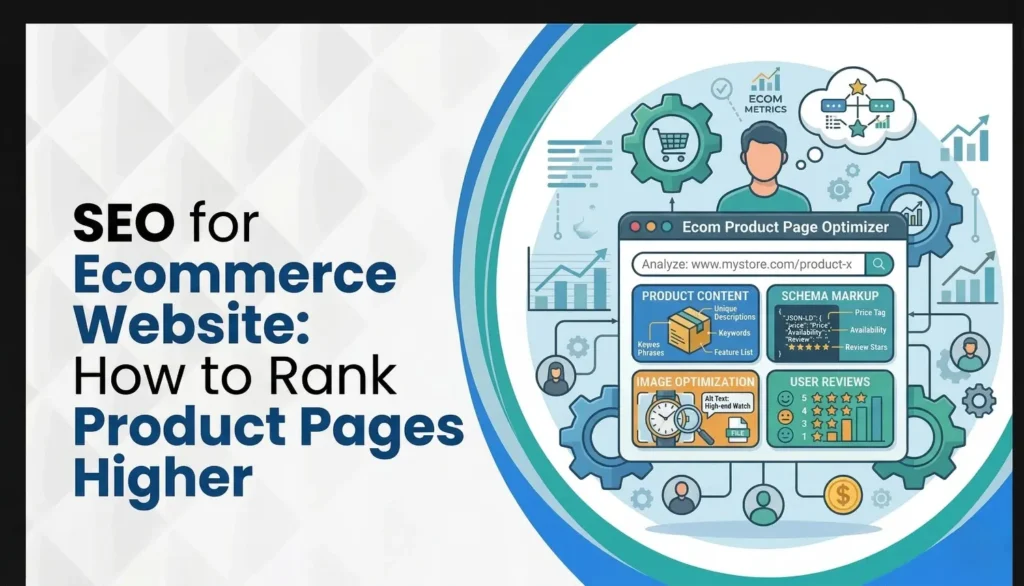
SEO for Ecommerce Website: How to Rank Product Pages Higher
April 7, 2026
For online merchants, your product pages are the storefront. Shoppers rarely scroll past the first results page, so mastering SEO for ecommerce websites is essential. A well‑optimized store not only drives more organic traffic but also converts visitors into customers.
This guide draws from official best‑practice documentation (Google’s SEO Starter Guide and leading ecommerce platforms) and industry insights to show how to rank your product pages higher and grow your online business in 2026.
The Foundations of Ecommerce SEO
Understand Search Intent and Do Comprehensive Keyword Research
Keyword research underpins every successful SEO strategy for ecommerce websites. Start by identifying primary keywords (high‑volume product terms), long‑tail phrases and synonyms relevant to each item. Tools like Google Keyword Planner, Ahrefs or local research can reveal what your customers are searching for. Avoid keyword stuffing, Google’s SEO starter guide states that excessively repeating keywords is against spam policies.
Pro tip: Create a spreadsheet of primary, secondary and local keywords for every product. Track search volume and competition to prioritize efforts.
Incorporate Keywords Naturally in Titles, Meta Tags and Headings
Google uses titles and snippets to understand page content. Product titles should be clear, concise and include primary keywords. Place your main keyword in the page title (H1), meta title and meta description, and sprinkle secondary keywords throughout the description and image alt text. Unique and descriptive meta tags improve click‑through rates.
Structure Matters: Site Architecture and URLs
A logical site structure helps search engines crawl and users navigate. Use clear URL structures; avoid random parameters and ensure each slug is descriptive and consistent with your product names. Implement breadcrumb navigation to display hierarchy. Breadcrumbs help users retrace their steps and improve internal linking. Organise products into categories and sub‑categories, and implement canonical tags to prevent duplicate content issues.
Create Unique Product Descriptions
Copying manufacturer text can hurt rankings. Google’s guidelines discourage duplicate content. Effective descriptions answer questions such as “Who is this for?” and “How does it solve the customer’s problem?” Unique copy also avoids duplicate‑content penalties.
Checklist for great product descriptions
- Use a conversational tone that reflects your brand.
- Address features and benefits – show how the product improves the customer’s life.
- Break up text with bullet points for readability.
- Incorporate secondary keywords naturally.
- Include a clear call‑to‑action encouraging purchase.
Use High‑Quality Images and Descriptive Alt Text
Visuals sell products, but search engines can’t “see” images. Add descriptive alt text to each product image. Google’s SEO guide notes that alt text explains the relationship between the image and your content and helps search engines understand your image. Include relevant keywords, but describe the image accurately (e.g., “blue cotton kurta with embroidery” instead of “blue shirt”).
Image optimization tips
- Compress images and use next‑gen formats (WebP) to reduce file size.
- Serve responsive images (different sizes for mobile and desktop).
- Use descriptive file names (e.g., red-leather-wallet.jpg instead of IMG_0012.jpg).
Implement Structured Data (Schema Markup)
Adding structured data (schema.org) helps search engines understand your products and makes pages eligible for rich results like review stars, price and availability snippets. Google’s SEO guide notes that valid structured data makes pages eligible for special features in search results. Use Product schema and FAQ schema where relevant.
Pro tip: Tools like Google’s Rich Results Test can validate your markup. If you use Shopify or WooCommerce, install apps/plugins that automate schema generation.
Earn Trust with Reviews and Ratings
User‑generated content not only persuades shoppers but also boosts SEO. Adding customer reviews and ratings builds trust and provides fresh content; Wix notes that high‑quality reviews can improve ranking. Encourage satisfied buyers to leave reviews. Implement review markup so ratings appear in search results.
Optimize Site Speed and Core Web Vitals
Page speed is a direct ranking factor. Research shows that even a few seconds of delay can increase bounce rates and reduce conversions. Google’s Core Web Vitals measure loading performance, interactivity and visual stability; slow pages can hurt rankings. Use tools like Google PageSpeed Insights to identify bottlenecks.
Ensure Mobile Optimization and Responsive Design
Google uses mobile‑first indexing. Ensure tap targets (buttons and forms) are large enough; optimize images for high‑resolution screens; simplify checkout on mobile; run Google’s Mobile‑Friendly Test to audit issues. Fast loading on mobile reduces friction and signals quality to search engines.
Improve Internal Linking and Navigation
Internal links help search engines crawl and index your content and guide users to related products. Use breadcrumb navigation and create contextual links in product descriptions. Maintain a logical hierarchy:
category → sub‑category → product.
Build Quality Backlinks and Promote Your Products
Backlinks remain a powerful ranking signal. Engage in guest blogging, influencer collaborations, digital PR and outreach to industry sites. Share your products on social media and encourage bloggers to review them. Avoid link schemes, focus on earning natural, relevant links.
Write Compelling Meta Descriptions and Title Tags
Meta descriptions and title tags influence click‑through rates. Craft unique meta descriptions (< 160 characters) that highlight the product’s value proposition, include the primary keyword and include a call‑to‑action (e.g., “Shop now for free delivery in Mississauga”). For product pages serving local markets, mention the city to attract geo‑targeted searches.
Use Clear URL Slugs and Avoid Keyword Stuffing
Instead of dynamic IDs or long query parameters, use short slugs containing the product name (e.g., /mens-leather-jacket rather than /productid=1234). Avoid stuffing keywords in the domain or URL path; Google states that keywords in domain names alone have little impact beyond breadcrumbs.
On‑Page SEO Checklist for Ecommerce Product Pages
| Element | Best Practice |
| Title (H1) | Include primary keyword and product name. Be concise and human‑readable. |
| Meta Title | Under 60 characters; use primary keyword and a unique value proposition. |
| Meta Description | 120–155 characters; describe benefits and include a call‑to‑action. |
| URL Slug | Short, descriptive, uses hyphens. |
| Product Description | Unique, benefit‑oriented, includes secondary keywords naturally. |
| Images & Alt Text | High‑resolution images; descriptive file names; alt text with keywords. |
| Schema Markup | Use Product schema with brand, price, availability, SKU, image URL, shipping. Include FAQ schema if a question section exists. |
| Reviews/Ratings | Display genuine customer reviews and ratings on product page. |
| Breadcrumbs & Internal Links | Show navigation path; link to related products and categories. |
| Page Speed | Optimize images, enable caching, minimize JavaScript, use CDN. |
| Mobile Optimization | Responsive design; large tap targets; quick checkout; compress CSS/JS. |
Off‑Page SEO Techniques for Ecommerce Websites
While on‑page elements ensure your product pages are search‑friendly, off‑page SEO builds authority and drives referral traffic.
- Link Building: Pursue backlinks from reputable blogs, influencers and publications relevant to your niche. Guest posting, expert round‑ups and partnerships can earn valuable links.
- Social Proof and User‑Generated Content: Encourage customers to share photos of their purchases on social platforms and tag your store. Share testimonials on your site and social channels.
- Local SEO: If you ship locally or have a physical store, create a Google Business Profile. Include accurate NAP (Name, Address, Phone) details and encourage local reviews. Optimize for local keywords (e.g., “buy laptops in Karachi”).
- Influencer Partnerships: Collaborate with influencers who align with your brand to create authentic reviews and unboxings. Influencer endorsements often lead to quality backlinks and brand exposure.
Technical SEO and Performance Tuning
Technical SEO ensures your ecommerce site is crawlable, indexable and secure.
- HTTPS Everywhere: Use SSL certificates; Google treats HTTPS as a ranking signal.
- XML Sitemap: Submit an updated sitemap to Google Search Console to help crawlers discover new products.
- Robots.txt: Allow search engines to access important resources (CSS, JS) while blocking private areas (e.g., checkout pages). Don’t inadvertently block image or script files that are needed for indexing.
- Canonical Tags: Prevent duplicate content by canonicalizing identical products with different variants (e.g., color options). Duplicate content is not penalized but inefficient; canonical tags help consolidate ranking signals.
- Pagination and Faceted Navigation: Use rel=”next”/”prev” or canonical tags to handle paginated category pages and faceted filters.
- Error-Free Crawl: Monitor Search Console for crawl errors (404s, redirects, server errors) and fix them promptly. Use 301 redirects for discontinued products to pass link equity.
Content Marketing and Generative Engine Optimization (GEO)
Generative AI search and voice assistants increasingly influence how shoppers discover products. To position your ecommerce store in AI‑generated answers, publish content that directly answers user questions. FAQ sections, buying guides, comparison posts and blog articles can capture long‑tail queries and generative search slots.
Use conversational language and anticipate the questions people ask. This approach, called Generative Engine Optimization (GEO), complements traditional SEO and ensures visibility across AI‑powered search channels.
Ready to implement a comprehensive SEO plan for your ecommerce website? Whether you need strategic guidance, SEO services for ecommerce websites, or a tailored SEO checklist for an ecommerce website, our team can help. Contact us today for a free consultation and let’s start turning your product pages into high‑ranking, high‑converting assets.
FAQs: Answering Common Ecommerce SEO Questions
How long does it take to see results from ecommerce SEO?
SEO is a long‑term investment. Google notes that some changes may take effect within hours, while others take weeks or months. Monitor your analytics and iterate.
Do I need to use the keywords meta tag?
No. Google Search does not use the keywords meta tag, so focusing on high‑quality content and relevant keywords in visible areas (titles, headings, descriptions) is more important.
What word count should my product description have?
There is no magic word count; Google states that content length alone doesn’t determine ranking. Focus on delivering complete, unique information rather than hitting a specific number.
Is duplicate content penalized?
Google clarifies that content accessible under multiple URLs is inefficient but not penalized; copying others’ content is a problem. Use canonical tags to consolidate duplicate pages and avoid copying manufacturer descriptions.
Do I need separate mobile and desktop sites?
No. Responsive design ensures your site adapts to different devices. Google uses mobile‑first indexing, so ensuring a seamless mobile experience is critical.
Search Here
More Categories
Latest Posts
June 23, 2026
Sanawar Ali
June 18, 2026
Sanawar Ali
June 15, 2026
Sanawar Ali
June 11, 2026
Sanawar Ali
May 21, 2026
Sanawar Ali