Listen Blog
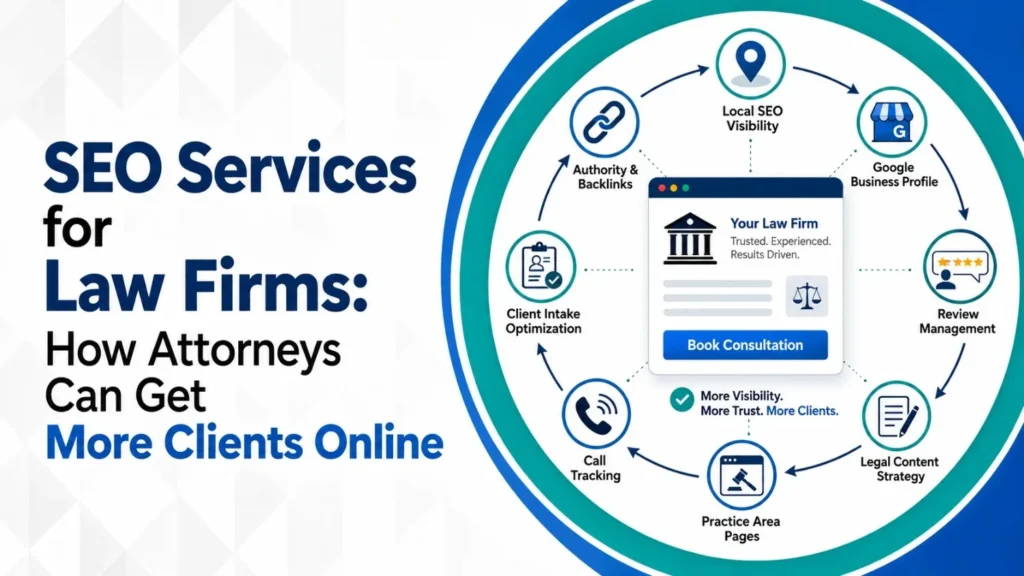
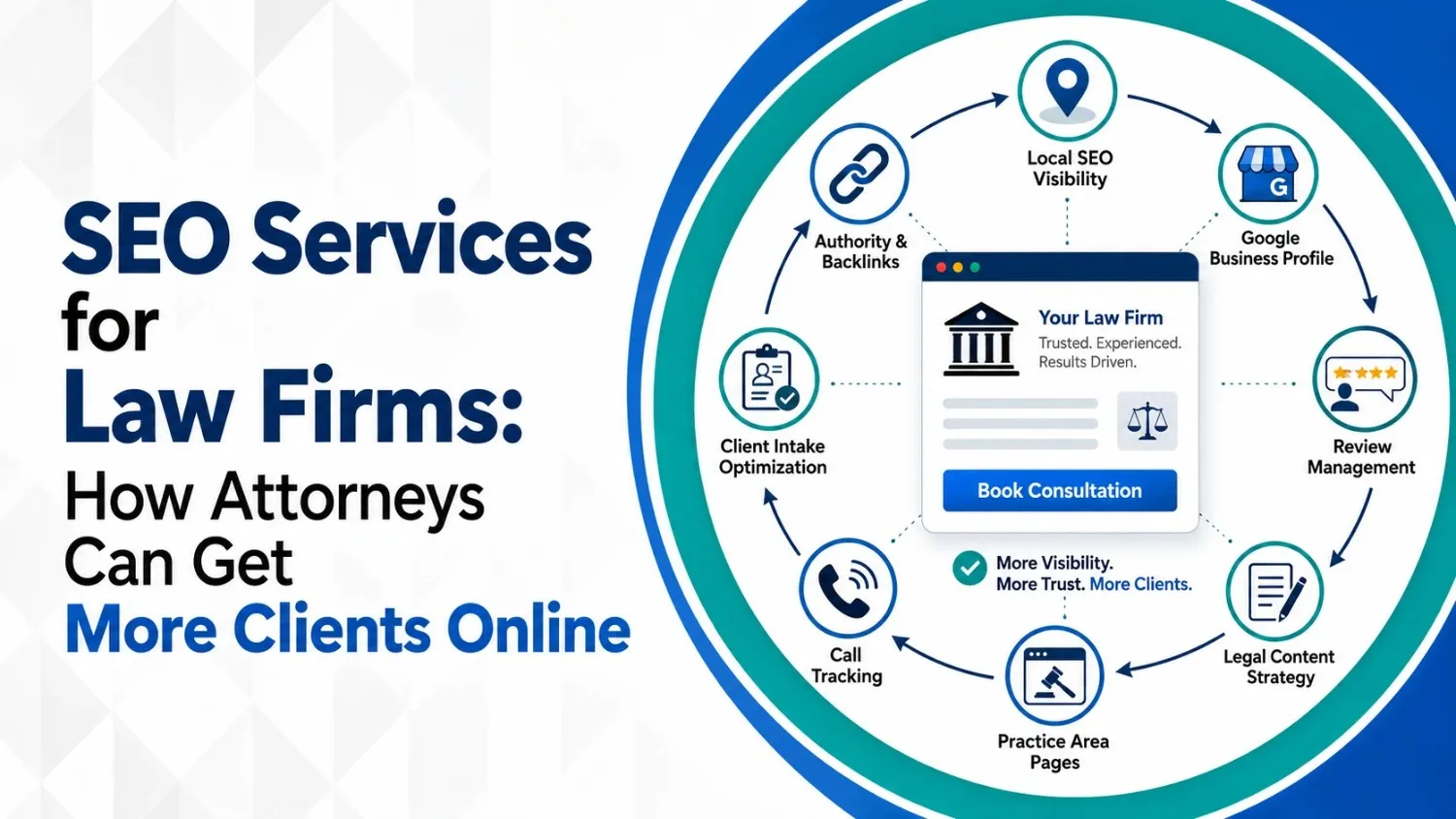
SEO Services for Law Firms: How Attorneys Can Get More Clients Online
May 11, 2026
Imagine a family lawyer in Mississauga sipping her morning coffee. She watches Google show an AI Overview answering “how does child custody work in Ontario” in three clean bullet points. The answer came from a blog her team spent 12 months building. But nobody clicked through. Her phone rings once all morning. Meanwhile, every firm around Port Credit is still running the same 2021 SEO checklist and wondering why the pipeline dried up.
This guide is different. You won’t find recycled tips here. What you’ll get is a 2026-ready roadmap for SEO services for law firms that matches how Google, ChatGPT, and real legal clients actually work today. The real scoreboard isn’t traffic or rankings alone anymore. It’s consults booked, retainers signed, and fees paid. Whether you run a solo practice or a mid-size firm, this piece breaks down law firm SEO and legal marketing moves that pull clients off their phones and into your office.
Why Law Firm SEO Looks Different in 2026
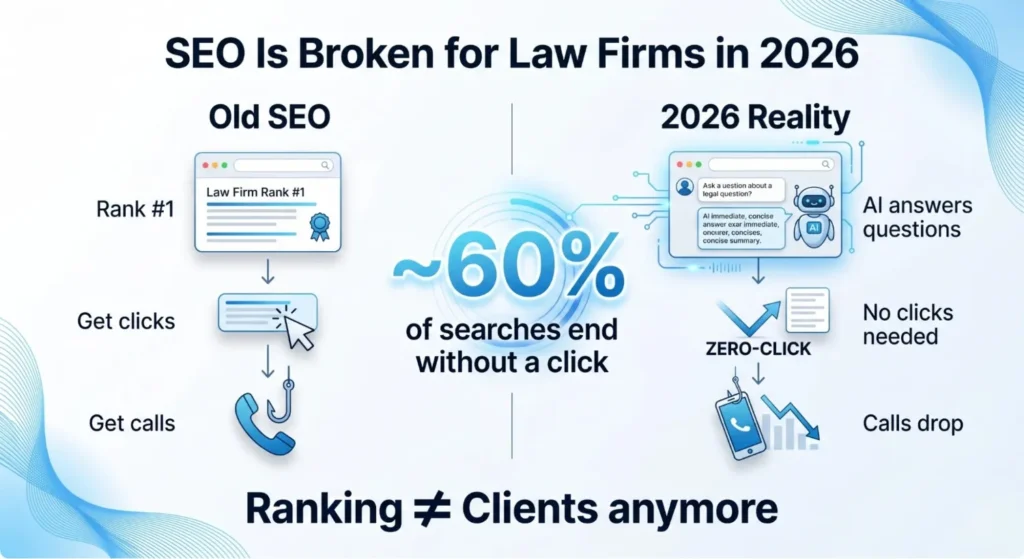
2026 broke the old rules. Google’s AI Overviews now answer legal questions right at the top of the page. Someone searching “what to do after a car accident in Ontario” reads a summary, gets their answer, and never clicks a single firm’s site. This is called zero-click search, and it’s crushing firms that still chase “Position #1” like it’s 2020.
Most Ontarians now start their legal research on ChatGPT or a Google AI summary. They read three or four sources before picking up the phone. By the time they contact a lawyer, they’re already 70% educated on their own matter. The firm that gets the call is usually the one mentioned inside those AI answers, not the one buried on page one.
Every law firm today fights three rivals, not one. The first is other lawyers. The second is legal directories like FindLaw or LawyerLocate that sometimes outrank firms for their own brand name. The third is AI itself, handing out free answers your website used to earn clicks for.
What hasn’t changed? Legal searches are high-trust and high-urgency. Someone Googling “bail hearing lawyer Mississauga” at 2 a.m. needs help fast. Done right, law firm SEO still wins those retainers. You just have to play a sharper game. For current direction, Google Search Central’s guidance on AI features is worth reading before touching your website.
The 60-Minute Foundation for Law Firm SEO
Before any clever strategy, you need clean basics. Skip these, and everything else falls apart.
- Google Business Profile optimization: Claim it, verify it, fill every field. Pick the right categories, such as Personal Injury Attorney, Family Law Attorney, Immigration Attorney, or Criminal Defense Lawyer. Add photos of your office, staff, and lobby. Set your hours and answer FAQs inside the profile.
- NAP consistency: Your Name, Address, and Phone must match word-for-word across legal directories, local listings, and every social profile. Even a missing suite number hurts rankings.
- Site basics: HTTPS, mobile-first design, and Core Web Vitals that pass. If your site loads slowly on a phone, you have already lost the caller.
- Schema markup: Add LegalService, Attorney, and FAQPage schema so search engines and AI understand your pages.
- Practice area pages: Each area needs its own page with the lawyer’s name, photo, bar admission number, years of practice, and bio. This is critical E-E-A-T (Experience, Expertise, Authoritativeness, Trust) because legal content is YMYL (Your Money or Your Life).
Treat this section as table stakes. If any item fails, fix it first. No backlink strategy saves a firm with broken basics.
How AI Overviews Reshape Legal SEO Today
The biggest shift in 2026 is simple: AI answers a huge chunk of legal questions without sending clicks. Research from SparkToro shows roughly 60% of Google searches now end with zero clicks to any website. For law firms, that number often sits higher because legal questions tend to have short, factual answers.
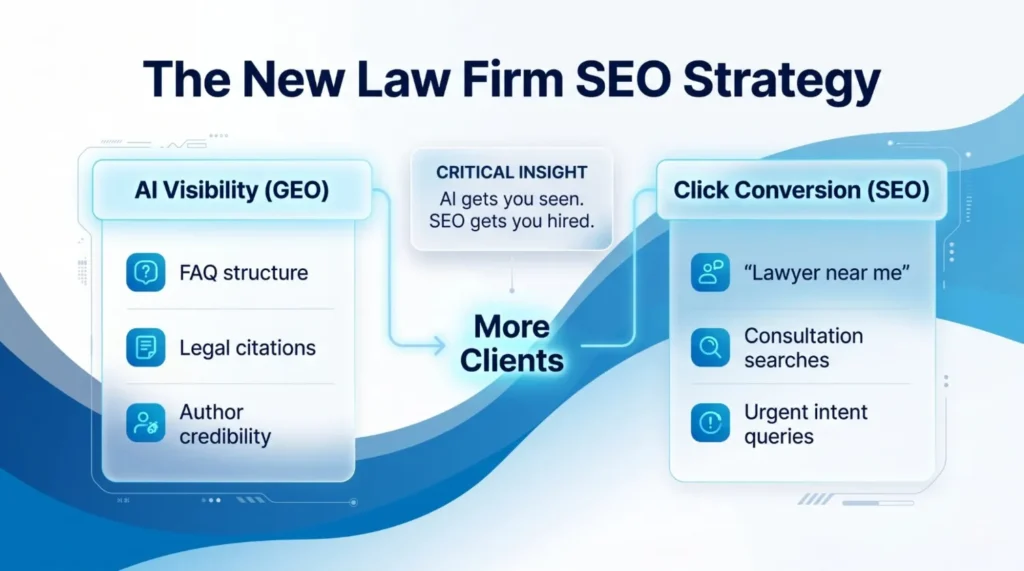
The response is Generative Engine Optimization, or GEO. It’s not magic. GEO means structuring content so AI systems like ChatGPT, Gemini, and Google’s AI Overview cite your firm as a source. Your page becomes the footnote, not the lost click.
AI answers love three things: clear question-and-answer structure with FAQ schema, author bios showing real credentials and bar admission, and citations to actual statute, case law, and regulators. Audit your content right now. Ask yourself: if an AI read my page, would it quote me? If the answer is no, rewrite with shorter sentences, direct answers first, and real source links.
Some queries still send clicks. “Personal injury lawyer near me,” “duty counsel right now,” and “free 30-minute consultation Mississauga” all stay click-heavy because they’re action-based, not informational. Focus legal content marketing there. The winning formula in 2026 is being cited in AI answers and being clickable for high-intent searches. One without the other leaves money on the table.
Law Society Compliance Baked Into Your SEO
US-focused SEO blogs skip this part entirely. Ontario lawyers can’t afford to. The Law Society of Ontario has strict rules on legal advertising under Rule 4.2, and breaking them triggers real complaints.
You can’t call yourself “the best personal injury lawyer in Mississauga” unless you’re properly certified. Terms like “specialist” and “expert” are restricted too. Guarantees of outcome are off-limits. Comparative claims against other firms get you in trouble fast.
Testimonials need extra care. You can use them, but you can’t cherry-pick or edit them in misleading ways. You also can’t offer discounts, gift cards, or anything of value in exchange for a review. That’s where the FTC Reviews Rule from October 2024 comes in. It bans incentivized reviews, fake reviews, and review suppression. LSO conducts rules stack on top.
Referral fees are capped in Ontario. When you hire a marketing partner, make sure the contract respects those caps and doesn’t dress up fees as something else.
Run this quick check on every piece of copy before publishing:
- Any superlatives that need certification?
- Any outcome guarantees or success promises?
- Any testimonial used without written consent?
- Any reviewer getting paid, thanked with a gift, or pressured?
Firms cutting corners collect complaints. Firms doing it right build a compounding moat of trust and rankings. The LSO’s Rules of Professional Conduct Chapter 4 covers the full list and belongs in every firm’s bookmarks.
Practice-Area SEO Playbooks That Win Retainers
Generic “lawyer SEO” is a mistake. Every practice area has its own search pattern, client emotion, and path to a signed retainer.
Personal Injury is high-ticket and brutally competitive. Case-result pages and accident-location landing pages pull in clicks. “Slip and fall Square One lawyer” converts better than a broad “Mississauga personal injury attorney” page.
Family Law and Divorce have long research cycles. Clients spend weeks reading before they call. Process guides explaining separation agreements, child support math, and court timelines build trust. Cost transparency pages crush the competition because most firms hide fees.
Criminal Defense runs on urgency. Someone searching at midnight for “bail hearing lawyer Brampton” needs answers now. A 24-hour phone line is both a ranking signal and a conversion tool.
Immigration rewards bilingual content. Punjabi, Urdu, Arabic, Tagalog, and Mandarin landing pages pick up long-tail searches native English sites never rank for. OINP and IRCC-related terms are goldmines.
Real Estate and Wills/Estates are checklist-friendly. Pages like “what to bring to your real estate closing” or “documents needed for an Ontario will” get shared and bookmarked. Business and Corporate Law sit on a long sales cycle. LinkedIn thought leadership and whitepapers on shareholder agreements work better than generic blog posts here.
Each area needs its own keyword research, intent mapping, and conversion path. One-size-fits-all SEO packages fail every practice at once.
Local SEO Wins That Bring Mississauga Clients
Mississauga isn’t one market. It’s six or seven. A firm optimizing only for “Mississauga lawyer” leaves money on the table. Real local searches happen in Port Credit, Square One, Erin Mills, Meadowvale, Cooksville, and Streetsville. Build a neighbourhood page for each zone you actually serve.
Courthouse-proximity keywords convert at shocking rates. “Lawyer near Peel Courthouse,” “Ontario Court of Justice Mississauga lawyer,” and “Landlord Tenant Board hearing representation” pull in people who already have a court date. They don’t need convincing. They need a phone number and directions.
Multicultural intent is the Mississauga secret weapon. A huge share of residents speak a second language at home. Punjabi immigration lawyer searches, Urdu family lawyer searches, and Arabic real estate lawyer searches all have thin competition and high buyer intent. Build bilingual landing pages with proper hreflang tags and native-speaker copywriters.
None of this pays off without bilingual intake. SEO traffic dies at the front desk if your receptionist can’t speak the caller’s first language. Hire staff who match your incoming traffic, or outsource after-hours calls to a bilingual service. For firms wanting a deeper dive into the time frame for local SEO results, this guide is worth reading to have a clear picture of the time frame.
Mapping the Consultation-to-Retainer Funnel
Most firms track the wrong numbers. Impressions and clicks feel good. They don’t pay the rent.
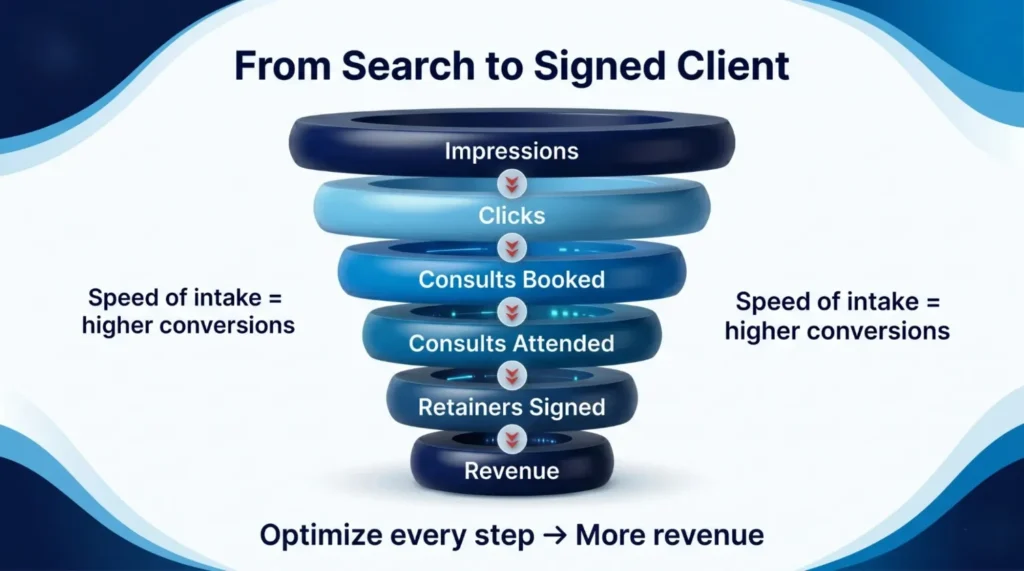
The real funnel looks like this: impression → click → consult booked → consult attended → retainer signed → fee collected. Every stage leaks. Your job is to find where and plug it.
A firm might earn 10,000 impressions a month, 400 clicks, 40 consult bookings, 25 consults attended, 10 retainers signed, and $45,000 in fees. That’s a working funnel. Another firm with the same top numbers might sign only 2 retainers because intake is broken or fee quotes scare people off.
Set up Google Analytics 4, Google Business Profile Insights, call tracking software like CallRail, and a legal-compliant intake CRM. Track cost-per-retainer, not cost-per-lead. Track consultation conversion rate, not bounce rate.
Content and landing pages should match each funnel stage. A “what is collaborative divorce” blog is top-funnel. A “book a free 30-minute consult with a Mississauga divorce lawyer” page is a bottom-funnel. Don’t cram both jobs onto the same page. Lead generation and retainer generation are not the same thing. Firms that grasp the gap win quarter after quarter.
Intake Speed That Turns Clicks Into Clients
You can rank first and still lose. The silent killer is slow intake. The well-known Harvard Business Review study on lead response found that firms responding within 5 minutes are 100 times more likely to qualify a lead than those responding after 30 minutes. Legal matters amplify that gap because the client is scared, rushed, or facing a court date.
Set clear benchmarks. Urgent matters like bail, emergency custody, and injury cases need a callback inside 5 minutes. Non-urgent matters need a response inside 1 hour during business days.
Your intake stack should include click-to-call buttons on every mobile page, SMS backup for missed calls, live chat during business hours, and after-hours intake handled either by staff or a legal answering service. Criminal, family, and bail work doesn’t wait until Monday. Neither should your phone.
In Mississauga, bilingual intake is both a ranking signal (Google reads the languages listed on your GBP) and a conversion lever. A Punjabi-speaking caller who hits only English voicemail hangs up and calls the next firm.
Connect your intake with a legal CRM like Clio Grow or Lawmatics. This closes the loop between your website and signed files. You’ll see exactly which blog post, ad, or GBP listing generated the retainer. The fastest-responding firm with decent SEO beats the best-ranked firm with slow intake every single time.
Precedent Content That Earns Links and AI Citations
Here’s the highest-ROI content play in 2026: precedent content. It means publishing clear, everyday-language breakdowns of recent Ontario decisions, new legislation, and rule changes the moment they happen.
Think about what news-worthy legal moments pull attention: Ontario landlord-tenant rule changes, family law amendments on property division, sentencing guideline updates from the Supreme Court of Canada, and immigration policy shifts from IRCC.
Write a 600 to 900 word breakdown within 48 hours of the news. Include the full citation, a summary, who it affects, and what people should do next. Other lawyers link to it because it saves them research time. Legal journalists pick it up because it’s authoritative. AI Overviews cite it because it hits every E-E-A-T signal.
Your 30-day precedent workflow looks like this. Week one, set up news alerts for CanLII, Ontario Court of Appeal, SCC, and provincial ministry announcements. Week two, draft pieces with a licensed attorney reviewing every line. Week three, publish with FAQ schema, author bio, and source links. Week four, send to legal journalists, post on LinkedIn, and pitch to law podcasts.
One precedent piece can earn more backlinks than a year of generic blog posts. Do this monthly and your attorney website optimization compounds quarter after quarter.
Ethical Reviews and Online Reputation Management
Reviews are half the game. The other half of getting more clients online isn’t content. It’s reputation.
Build a review workflow that respects both FTC and LSO rules. Ask for a review only after the matter closes, never mid-file. Send a plain-text message with no pressure, no template wording, and no incentives. A simple line like “If you had a good experience, a Google review would mean a lot” is enough.
Handle negative reviews with extreme care. A one-star from a disappointed client is survivable. An unprofessional response from the firm is not. Never confirm you represented the person. Never share case details. Protect solicitor-client privilege above everything. A short, respectful note like “We take feedback seriously and would prefer to discuss this privately” works well.
Monitor your whole SERP, not just Google Maps. Run branded searches monthly. Check your knowledge panel. Audit third-party directories for outdated information. Correct or remove listings that damage your brand.
Strong review signals lift your Google Business Profile optimization scores. More reviews plus higher ratings plus keyword-rich review content equals better local pack visibility. This is also where hiring proper SEO services for law firms pays off. Reputation is fragile, and one careless response can undo a year of ranking work.
Your 30-Day Growth Sprint for Law Firms
Here’s the entire guide compressed into four weeks of action.
- Week 1 — Foundation: Audit your Google Business Profile, run an LSO compliance review on every page, clean up NAP across every directory, and fix Core Web Vitals issues. Finish every foundation item before touching anything fancy.
- Week 2 — Practice Pages: Pick your top three revenue-earning practice areas. Rewrite each page with intent-matched content, FAQ schema, attorney bios, bar admission numbers, and clear consult CTAs above the fold.
- Week 3 — AI and Local Wins: Publish one precedent-content piece, add courthouse-proximity content for every court you serve, and launch your ethical review generation workflow with proper templates.
- Week 4 — Funnel and Tracking: Install call tracking on every page, connect GA4 with your intake CRM, and build a retainer-per-100-visitors dashboard your team reviews weekly.
At day 30, answer two questions. What is your current cost-per-retainer? What is your AI Overview citation rate? If you can’t answer either, your tracking needs another week. This is the first cycle, not the whole race. Proper attorney SEO compounds over quarters, not weeks.
Finally
AI search rewrote the rules, but the payoff for attorneys who adapt is bigger than ever. The three pillars hold up: compliance-first foundations, AI-citation content, and funnel tracking that measures retainers instead of traffic. Firms that master all three will sign more clients in 2026 than in any year before.
If you want a free audit or a strategy call with a team that understands both legal marketing and Mississauga’s unique neighbourhoods, partnering with a specialist law firm SEO agency saves months of trial and error. For accounting, trust account handling, and tax planning that pairs well with your growth plan, Local SEO Mississauga is a name Mississauga professionals rely on when scaling their practice responsibly.
Start with your foundation this week. Ship one precedent piece next week. Measure cost-per-retainer by month’s end. That’s how attorney SEO built on proven SEO services for law firms turns search into signed files.
FAQs
1. What are SEO services for law firms, and how do they bring new clients?
They’re a set of moves that help your firm show up when someone searches for legal help online. That includes Google Business Profile optimization, practice-area content, local citations, schema markup, and reputation management. New clients arrive through high-intent searches like “divorce lawyer Mississauga” or “personal injury consultation near me” where the searcher is ready to call.
2. How long do SEO services for law firms take to show results?
Expect 3 to 6 months for early ranking lifts and 9 to 12 months for steady retainer growth. Local SEO moves faster than blog content. Fixing your GBP alone can bring new calls inside 30 days.
3. How much should a law firm pay for SEO services per month?
Most quality engagements in Canada run between $1,500 and $5,000 per month. Firms in competitive practice areas like personal injury pay more. Anything under $500 usually wastes money because the work needed can’t fit that budget.
4. Are SEO services for law firms worth it in the age of AI search?
Yes, but the strategy has shifted. Firms focused only on blog traffic are losing. Firms optimizing for AI citations, local intent, and conversion get more signed files than ever.
5. Can lawyers ask clients for Google reviews under LSO and FTC rules?
Yes, as long as you don’t offer incentives, don’t write the review for them, and don’t cherry-pick only five-star requests. Ask after the matter closes, use simple wording, and accept whatever rating you get.
6. Does SEO work for law firms, or are Google Ads a better investment?
Both work for different jobs. Ads give fast, expensive leads. SEO gives slower, compounding leads that cost less over time. The smart answer is to run both, measure cost-per-retainer on each, and shift budget toward whichever wins.
7. Which practice areas benefit most from SEO services for lawyers?
Personal injury, family law, immigration, and criminal defense see the strongest returns because search volume is high and urgency is built in. Real estate and wills also benefit, especially with checklist-style content.
Search Here
More Categories
Latest Posts

May 11, 2026
Sanawar Ali

May 7, 2026
Sanawar Ali

May 5, 2026
Turab Talha

April 30, 2026
Turab Talha

April 28, 2026
Turab Talha