Listen Blog
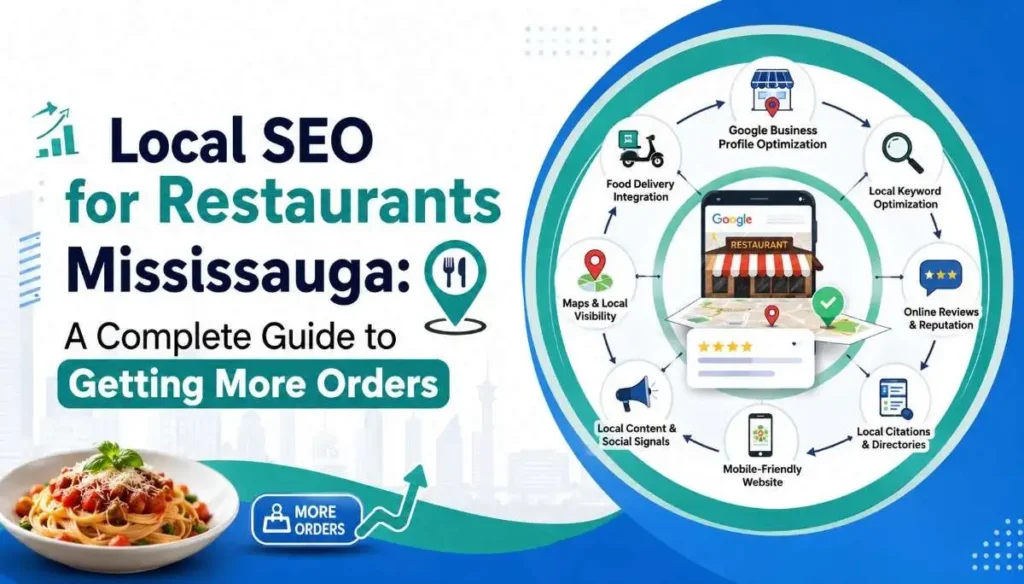
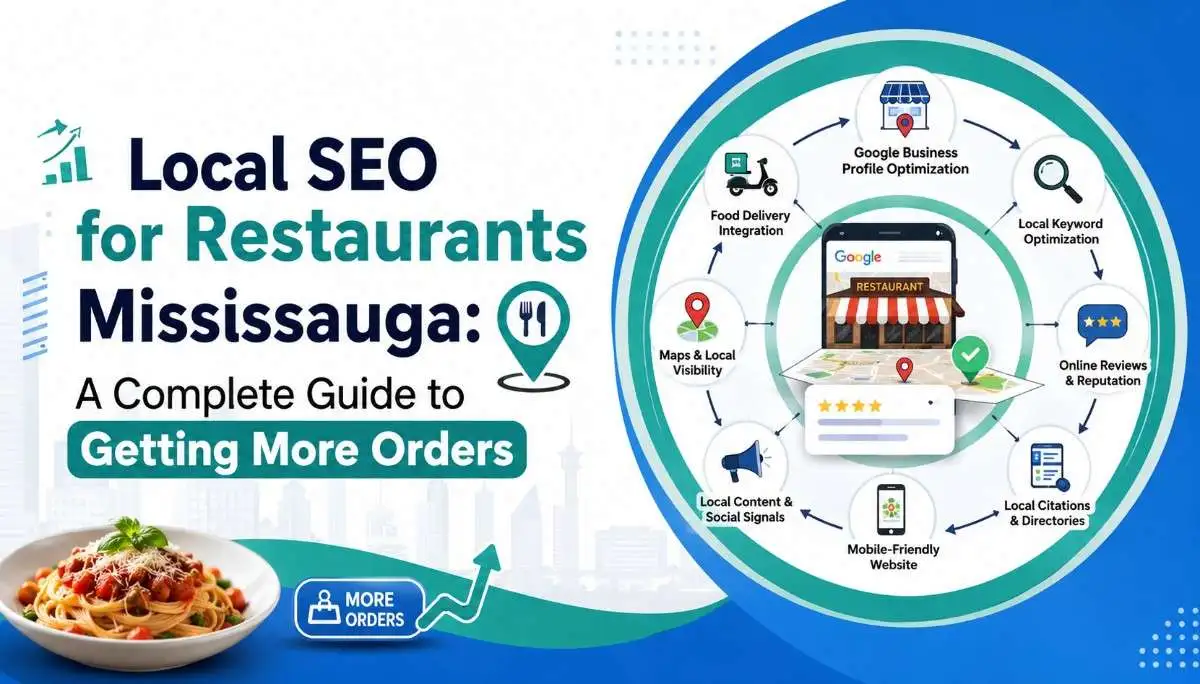
Local SEO for Restaurants Mississauga: A Complete Guide to Getting More Orders
May 7, 2026
Picture this: a Port Credit café owner stares at the sales dashboard on a Tuesday morning. Skip the Dishes took a 30% cut from every order last week. The restaurant’s own Google listing sits quietly on page two where nobody looks. Reservations are slow. Walk-ins are slower. And the chef’s food is genuinely excellent.
This is the story playing out across Mississauga right now, from Streetsville diners to Cooksville kitchens. The food is not the problem. The plates are not the problem. The missing piece is how people find you on Google Search and Google Maps before they ever taste the food.
Most restaurant SEO advice online is recycled from American blogs that know nothing about Meadowvale or Churchill Meadows. This guide is built differently. We are walking through a real, neighbourhood-by-neighbourhood playbook for local SEO for restaurants that brings you more online orders, more reservations, and more walk-ins. No fluff. No filler. Just what works for local SEO for restaurants in Mississauga in 2026.
Why Mississauga Restaurant Search Looks Different in 2026
Mississauga is not one market. It is more than 11 neighbourhoods, each with its own search habits, its own food culture, and its own buying pattern. A dinner search in Lorne Park looks nothing like a lunch search in Malton. A family in Erin Mills searches for “halal biryani near me.” A couple in Port Credit searches for “best patio dinner.” Same city. Completely different intent.
Then there is the cultural layer. South Asian, Chinese, Polish, Arab, Filipino, and Latin American communities each type queries in different ways mixing English with cuisine-specific terms that most restaurant marketing guides never cover. Missing these queries means missing entire neighbourhoods of hungry customers.
On top of that, you are competing in a three-way race: other restaurants, delivery apps, and Google’s own AI, which sometimes never sends a click your way at all. According to Restaurants Canada, commercial foodservice sales rose 6.9% in the first seven months of 2025, but 74% of Canadians said they reduced discretionary spending, with 56% cutting back on dining out Restaurants Canada. The customers are out there, but they are choosy. Visibility is the currency now. Zero visibility means zero orders, no matter how good your biryani or pad thai is.
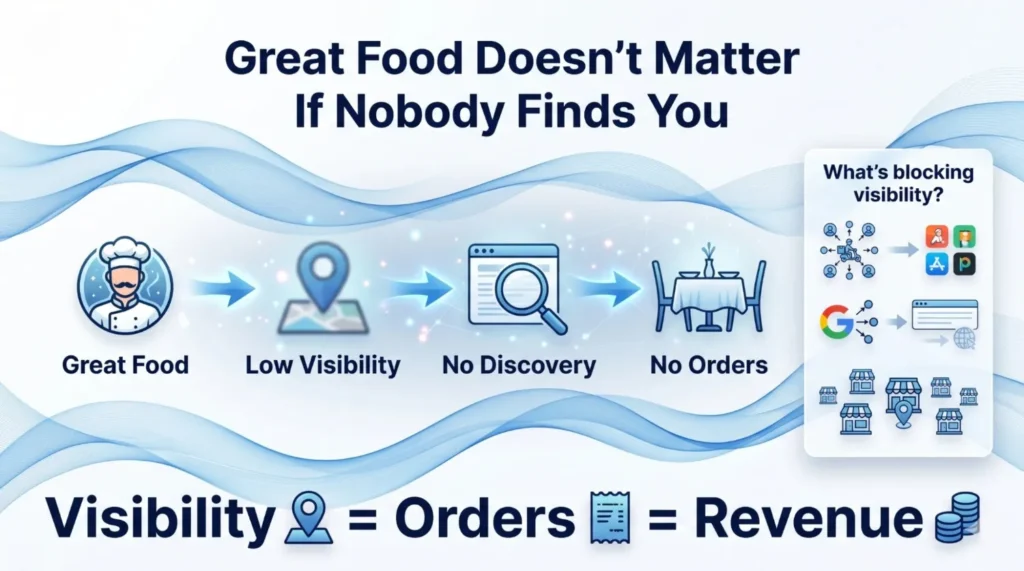
The 60-Minute Local SEO Foundation Every Restaurant Needs
Before we get to the fun stuff, your basics need to be tight. Think of this as the one-hour pre-flight check. Skip it, and everything else falls apart.
Start with your Google Business Profile. Claim it. Complete every field. Verify it with a postcard, phone call, or video. Your business name must match your signage exactly no adding “Best Pizza Mississauga” at the end, because that gets your listing suspended. Your NAP (Name, Address, Phone number) must be identical on Yelp, Facebook, TripAdvisor, and every other directory where you appear. One wrong phone number across the web tells Google you cannot be trusted, and your map ranking sinks.
Next, your menu. Upload it as a real HTML page on your website, never as a PDF. Google cannot read PDFs properly, which means your dishes never rank. Add basic restaurant schema markup so search engines understand your cuisine type, hours, and price range. Check the official Google Business Profile Help Center for current menu and attribute setup rules they update these more often than most owners realize.
Finally, set a 30-second rule for online reviews: every single review, positive or negative, gets a reply within 30 seconds whenever you are near your phone. If you run a ghost kitchen or share a commercial space with another brand, be especially careful these setups trigger suspensions faster than anything else. This is table stakes. The real wins start next.
Winning the Map Pack Across Mississauga Neighbourhoods
The map pack is the top three listings that show up with a little map on Google. 42% of people who do a local search click on results inside the Google Maps Pack Backlinko. If you are not in those three spots for your neighbourhood, you are almost invisible.
Here is what most owners miss: proximity rules the map pack. Your restaurant might rank #2 for “Italian restaurant Port Credit” but completely disappear when someone searches from Malton or Meadowvale. Distance to the searcher matters more than anything else. The solution is not to pick one location and hope for the best. The solution is to build a system that shows up across the neighbourhoods you actually serve.
Mississauga’s core search zones you should prioritise: Port Credit, Streetsville, Square One and City Centre, Meadowvale, Erin Mills, Malton, Cooksville, Lorne Park, Clarkson, Churchill Meadows, Heartland, and Mississauga Valley. You cannot realistically target all 12 in your first 90 days. Pick the top three based on where your customers actually come from, search volume for your cuisine, and how crowded the competition is.
For each priority neighbourhood, build a dedicated page on your website not a shallow copy-paste page, but one with real local proof (photos of your dishes, stories from local customers, landmarks nearby). If you want a proper step-by-step on this, read our guide on how to create high-performing location pages for local SEO in 2026. These pages feed the signals that push your maap ranking up in each zone: fresh GBP activity, review velocity, and category precision.
Cultural Cuisine Keywords That Convert in Mississauga
Most restaurant marketing guides completely miss Mississauga’s biggest keyword goldmine: cultural and cuisine-specific search terms. These are often low-competition, high-intent queries that your competitors are not even tracking.
Look at what people are actually typing:
- Halal biryani Erin Mills
- Authentic Sichuan Streetsville
- Polish pierogi Port Credit
- Afghan mantu Mississauga
- South Indian dosa Cooksville
- Filipino breakfast Malton
Each of these combines a specific dish, a cuisine marker, and a neighbourhood. The person typing that query is hungry and ready to order or book within the hour. You can own these searches if you build them into your menu descriptions, GBP services section, and neighbourhood pages.
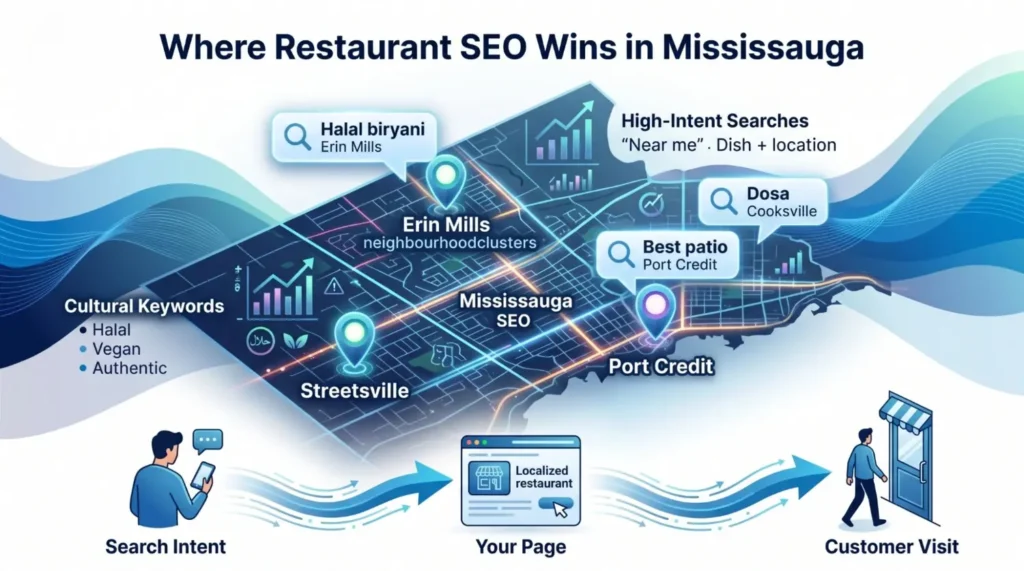
The cultural calendar is another open door. Ramadan iftar menus, Diwali catering, Lunar New Year feasts, Easter brunch, Eid takeout trays, Vaisakhi specials each of these has search spikes every single year. Most restaurants scramble to post a last-minute promotion. Smart operators plan content two months ahead so their pages already rank when the search volume arrives.
Finally, certification keywords matter more than most owners realize. “Halal-certified,” “kosher-certified,” “veg-only kitchen,” “gluten-free menu” these are trust signals that push conversion. Add them to your GBP attributes and your on-page copy. They do not just bring traffic. They build customer engagement that turns into branded search growth over time.
Outrank Third-Party Apps Dominating Your Branded SERP
Here is an experiment that will likely upset you. Google your own restaurant name right now. Take a screenshot. Count how many of the top ten results belong to you versus Skip, DoorDash, Uber Eats, TripAdvisor, and OpenTable.
Most Mississauga restaurants find that delivery apps and directories own 60 to 80 percent of their own branded SERP. That is a problem. Every time a regular customer Googles your name to check hours or grab a phone number, they land on a third-party page that charges you commission on the very order you already earned.
The counter-play has three moves. First, add rich schema markup to your homepage organisation schema, local business schema, and FAQ schema. This helps Google pull your own site into rich results and knowledge panels. Second, build out a real FAQ section on your homepage answering the ten most common pre-call questions: hours, parking, reservations, dietary options, and group bookings. Third, monitor your branded SERP every month. When a review site outranks you, that is a signal to publish fresh content on your own site to push it back down.
The win here is huge. When you own your branded results, regular customers come straight to your own ordering page, your reservation widget, and your contact form. Commission savings are nice. Long-term restaurant visibility is the real prize.
Turn First-Party Ordering Into an SEO Growth Engine
Now the hidden one. Look at your Google Business Profile right now and check where the “Order Online” button points. If it points to Skip, DoorDash, or Uber Eats, you are handing your brand-search growth to them every single day.
Every time someone orders through that link, the third-party platform earns the signal not you. Switch that link to a direct-ordering page on your own domain (Toast, ChowNow, Flipdish, or any first-party system). The effect compounds: your own domain starts ranking for queries like “order pad thai Mississauga” or “order shawarma Cooksville.” Over 12 months, that branded search volume quietly builds a moat competitors cannot easily cross.
A simple math check most owners skip: first-party orders multiplied by your average ticket, minus the 25–30% you would have paid in commission, equals real monthly savings. But the SEO side is where the compound interest lives. First-party ordering pages are indexable assets. Each one becomes a page Google can rank for dish-level and neighbourhood-level queries. 60% of mobile users have reached out to a business directly using search results Backlinko which means if your own ordering page ranks, those users order directly from you, not from an app.
Transit-Proximity SEO Near GO Stations and LRT Stops
This is one of the most overlooked opportunities in Mississauga restaurant SEO. Every weekday, thousands of commuters pull out their phones at GO stations searching “lunch near Cooksville GO” or “dinner near Port Credit GO” or “patio near Streetsville GO.” Almost no restaurant is targeting these queries on purpose.
Mississauga’s GO stations you should map: Cooksville, Port Credit, Clarkson, Streetsville, Meadowvale, Erindale, and Lisgar. The Hurontario LRT is also opening new stops along the corridor, and early-mover restaurants can lock in rankings before competitors catch on.
Weave transit proximity into your location pages naturally. A section titled “How to find us from Cooksville GO” that gives a three-step walking route is a small addition that ranks for a surprising amount of commuter traffic. Think about intent patterns: morning coffee rush, weekday lunch, post-work dinner, weekend event spikes. Each has its own query set and its own opportunity.
This is the kind of granular seo tip for restaurants that larger chains usually ignore because their marketing is run from the head office. Independent Mississauga restaurants can move faster and own these micro-markets.
Dish-Level SEO for Dine-In, Takeout, Delivery, Catering
Restaurants actually have four revenue streams, each with a completely different search intent. Treating them as one bucket is a common mistake.
Dine-in searchers want ambience, reservations, and parking. Takeout searchers want speed and pickup windows. Delivery searchers want ETA and minimum order values. Catering searchers want pricing tiers and booking lead times. Each intent needs its own landing page, its own keyword set, and its own GBP attributes.
Catering is the most under-optimized revenue stream in Mississauga. Corporate lunch clients, office events, baby showers, small weddings the volume is enormous and the competition online is thin. A dedicated catering page with a booking form can outperform three months of dine-in marketing.
At the dish level, map individual high-demand items to their own search queries:
- Butter chicken Mississauga
- Pho Streetsville
- Poutine Square One
- Karahi Malton
- Dim sum Cooksville
Use the menu feature inside your Google Business Profile and add menu schema on your website so Google can read each dish separately. Then layer in dietary wins “gluten-free Mississauga,” “vegan Erin Mills,” “halal Churchill Meadows.” Dietary searches have lower volume but convert at two to three times the rate of generic queries.
Seasonal, Event-Tied, and Local Voice Search Tactics
Mississauga weather shapes search behaviour in ways global restaurant blogs never discuss. Winter is when “delivery restaurants Mississauga,” “hot pot near me,” and “cozy dinner Cooksville” spike. Summer flips everything “patio dining Port Credit,” “rooftop restaurant near Square One,” and “ice cream Streetsville” take over.
Local events drive another layer of search volume. Carassauga, the Mississauga Food Truck Festival, Celebration Square concerts, and Square One seasonal promotions all drive thousands of people to search for nearby food. If your Google Posts are scheduled around these events with specific offers (“20% off show-your-ticket dinner from Celebration Square”), your profile becomes the answer.
Voice search is the quieter shift. “Hey Google, where should I eat near me right now” is how a growing number of diners phrase it. AI Overviews in Google Search now answer these queries by pulling from FAQ schema, reviews, and clear, conversational content. Structure a short FAQ on every location page with natural-language questions and direct, one-line answers. That format is what AI citations pull from.
A simple Google Posts rhythm that covers all of this: one seasonal post every two weeks, one event-day post whenever a major Mississauga event happens, and one dish-highlight post weekly. That cadence keeps your profile fresh and signals to Google that you are active which matters more in 2026 than in any previous year.
Local Backlinks and Review Mining for Hidden Keywords
Generic advice says “reach out to local blogs.” That is not useful. Here are the actual Mississauga sources worth pursuing: InSauga, Modern Mississauga, Mississauga News, Tourism Mississauga, the Port Credit BIA, Streetsville BIA, and Cooksville BIA. Each one covers restaurant openings, seasonal features, and community round-ups.
Community partnerships are the other angle. University of Toronto Mississauga student groups, Sheridan College culinary program partnerships, local charity sponsorships, and neighbourhood sports team sponsorships all produce natural backlinks from .edu and community .org domains the kind Google trusts most.
A quick outreach angle that works: offer a 10% off card for a BIA newsletter feature, or a free catering tray for a local charity event. Most owners overthink outreach. A short, honest email usually works.
Now the sharpest tactic nobody teaches. Export your last 200 Google reviews and read them. Customers describe your dishes in words your menu does not use. They call your biryani “fragrant” when your menu says “aromatic.” They call your pizza “New York style” when your menu just says “thin crust.” Mine those words. Feed them back into your menu descriptions, your location pages, and your FAQ answers. This doubles as customer engagement research you learn exactly how your diners think.
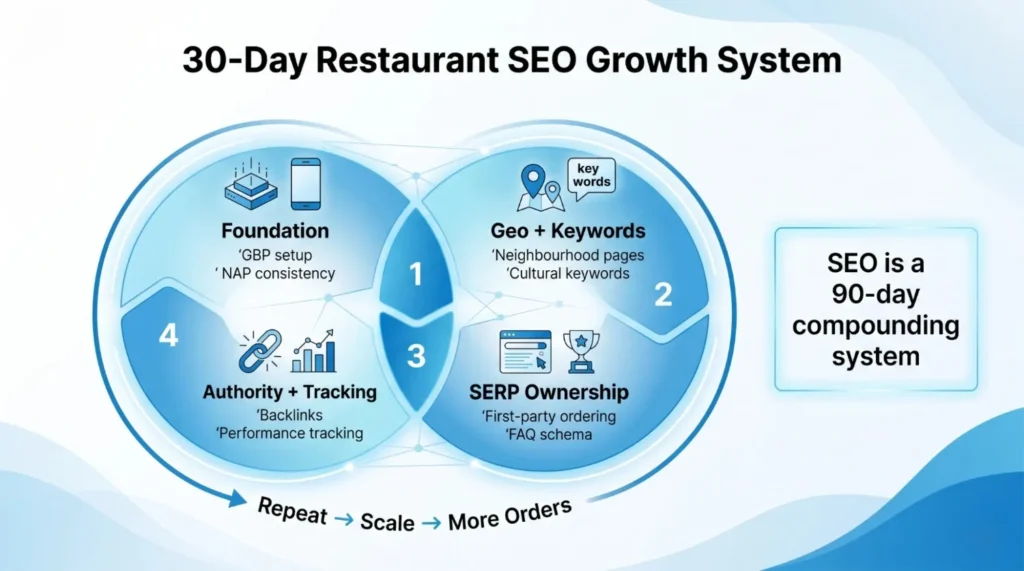
Your 30-Day Mississauga Restaurant SEO Action Sprint
Here is the full plan packaged into four focused weeks. Run it once, then repeat the cycle every quarter.
- Week 1 Foundation: GBP tune-up, NAP cleanup across every directory, citation audit, mobile speed fix, and HTML menu upload.
- Week 2 Geo + Keywords: Build out top-three neighbourhood pages, add cultural keyword clusters, implement menu schema for dish-level search.
- Week 3 SERP Ownership: Swap the GBP order link to first-party, audit third-party SERP competitors, add FAQ schema, launch review response workflow.
- Week 4 Authority + Tracking: Begin local backlink outreach, lock in a Google Posts cadence, set up dashboards tracking calls, direction requests, and reservation clicks.
At the end of 30 days, run a simple test: can you name your top three neighbourhood rankings, and has your branded search volume gone up compared to last month? If yes, the system is working. If not, go back to Week 1 and tighten the foundation. Real Google Business Profile optimization is a 90-day build, not a weekend project.
In Short
Mississauga restaurants do not need a bigger marketing budget. What works is a neighbourhood-first local SEO system that gets your profile ranking, your menu indexing, and your reviews answering the questions customers ask before they ever call.
The three promises we opened with more online orders, more reservations, more walk-ins all come from the same place. Own your branded SERP. Build pages for the neighbourhoods you actually serve. Speak the cultural and cuisine languages your diners use. Monitor, adjust, and compound the wins month after month.
If this sounds like a lot to run alongside an actual kitchen, local Mississauga businesses regularly work with specialists. The same team behind local SEO Mississauga restaurants also helped Local SEO Mississauga lift conversions by 30% and revenue by 50% in one year proof that the right local SEO system works across industries when it is built for the neighbourhood, not a generic template.
FAQs
What is local SEO for restaurants, and why does it matter in 2026?
Local SEO is the work of making your restaurant show up when someone nearby searches for food on Google or Maps. In 2026, it matters more than ever because AI Overviews, map packs, and voice search now handle most decisions before a customer ever visits your website.
How long does local SEO take to show results for a Mississauga restaurant?
Most restaurants see the first real movement in 30 to 60 days. Meaningful ranking in the map pack for competitive neighbourhoods takes 90 to 120 days of consistent work. Reviews and GBP activity produce the fastest wins.
Should I invest in local SEO or Google Ads for my restaurant?
Both, but in the right order. Google Ads give you instant visibility while SEO builds. Once your organic rankings stabilise around month four, you can scale Ads back and let local SEO carry the load at much lower cost per order.
Does local SEO actually work for independent, non-chain restaurants?
Yes, and honestly better than for chains. Independent restaurants can move quickly, target neighbourhood keywords, and build community backlinks that big chains cannot replicate. The map pack rewards specificity, not brand size.
Which local SEO tactics deliver the fastest wins for restaurants?
Fix your NAP across every directory, switch the GBP order button to a first-party link, respond to every review within 24 hours, and publish one Google Post every week. These four alone can lift calls and direction requests within 30 days.
Search Here
More Categories
Latest Posts

May 11, 2026
Sanawar Ali

May 7, 2026
Sanawar Ali

May 5, 2026
Turab Talha

April 30, 2026
Turab Talha

April 28, 2026
Turab Talha