Technical SEO
· 8 min read
HTTP 401 Error: Meaning, Causes & Fixes
See what an HTTP 401 error means, how it differs from 403 and how users or developers can fix authentication problems. Check the steps now.
Read article
Find why competitors outrank you on Google Maps by comparing profiles, reviews, keywords and backlinks in 7 steps. Book a free competitor review.
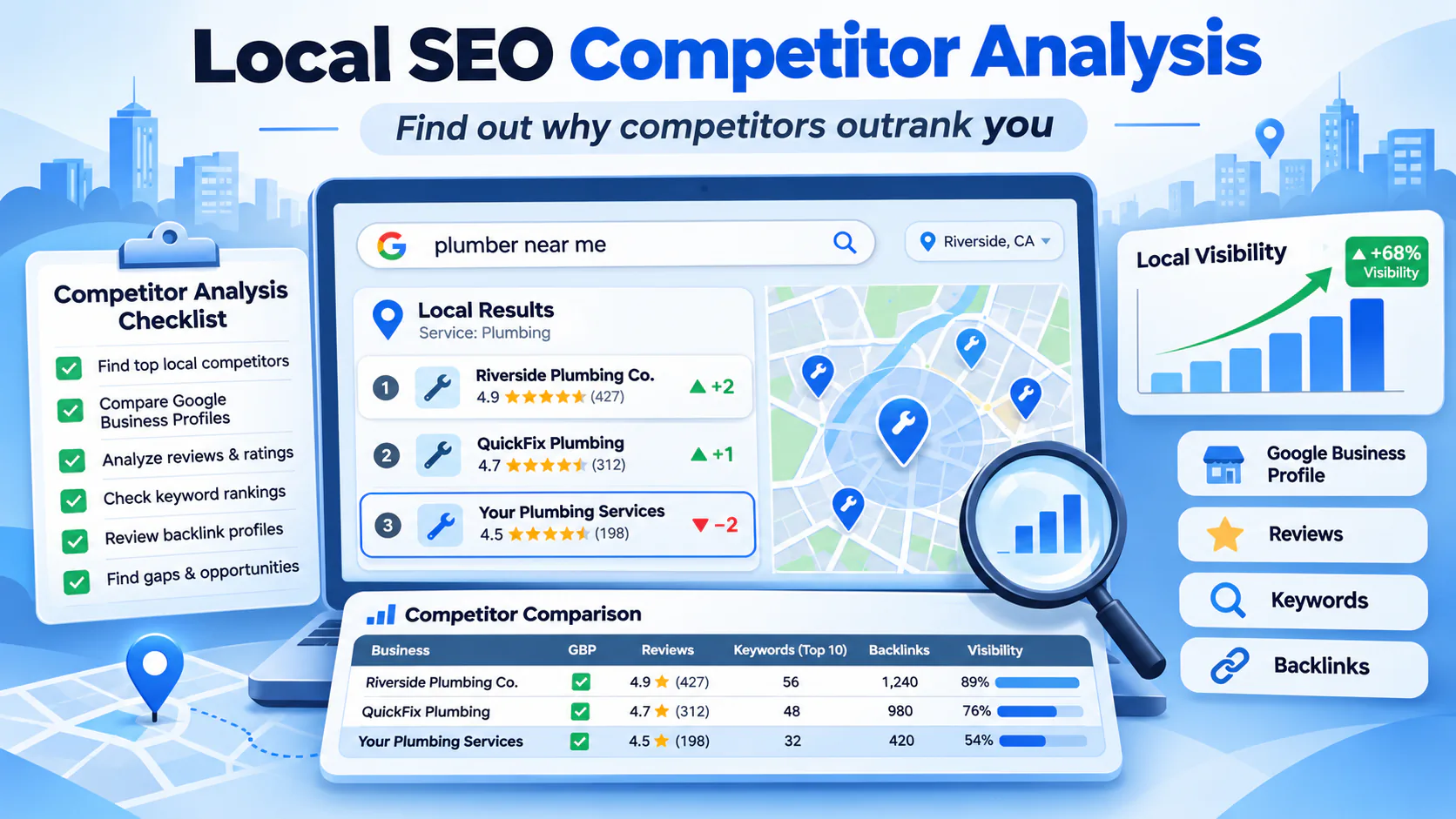
Why does a competitor appear above your business on Google Maps when you offer similar services, similar prices and similar quality? The answer usually sits in the details that Google can see, not in the service itself.
A local SEO competitor analysis helps you find those details. You compare your business with the ones ranking above you to see what they do well, where they fall short and what you can improve.
The comparison covers four main areas: Google Business Profiles, local keywords, customer reviews and backlinks. The seven steps below show you how to check each one, with a Mississauga commercial cleaning company as a running example.
Local SEO competitor analysis is the process of studying the businesses that compete with you in local search results. Traditional competitor analysis looks at national websites ranking for broad keywords. A local analysis looks at the businesses that win searches in your area, such as “office cleaning near me.”
Your competitors can differ by result type:
A business can rank well in one and poorly in another, so you need to check all three.
Google ranks local results on three main factors: relevance, distance and prominence. Relevance is how well your profile matches a search, distance is how close you are to the searcher, and prominence is how well known your business is online.
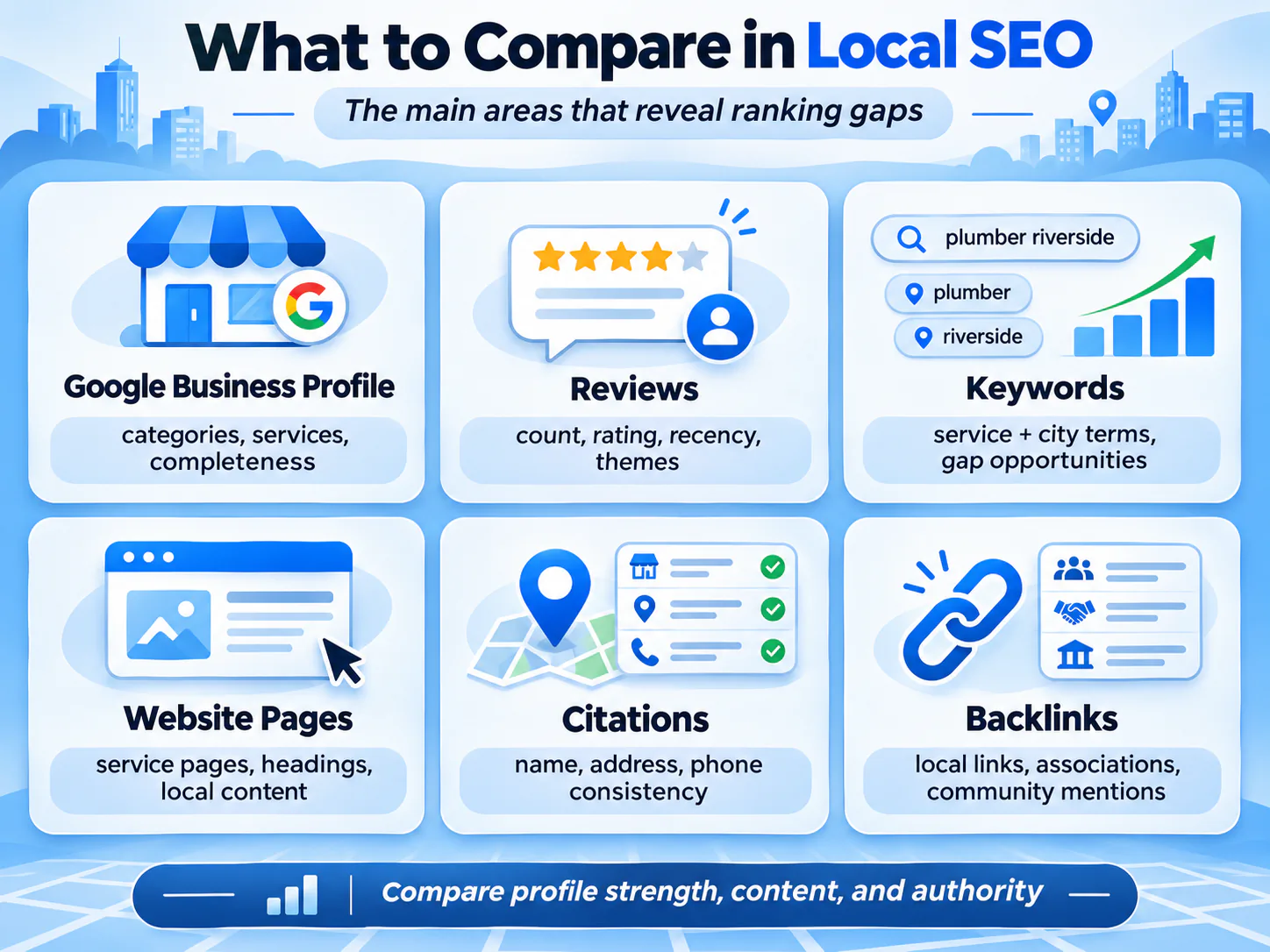
You cannot change your distance from a searcher, but you can improve the other two. A competitor analysis helps you find:
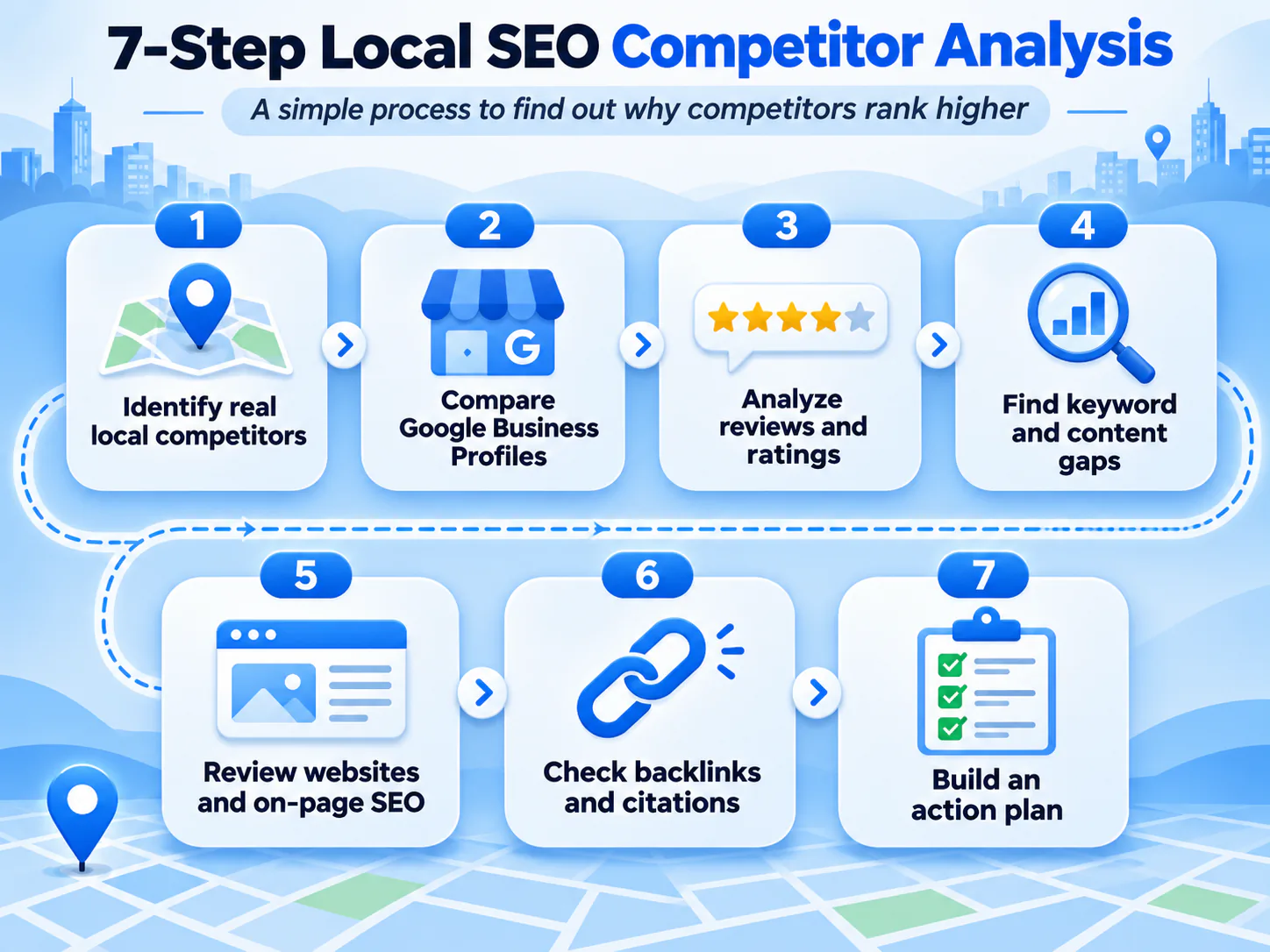
Good local SEO competitor research follows the same order every time, so your results stay comparable from one review to the next. Record your findings as you go in a simple template like this one:
| Area | Your business | Competitor 1 | Competitor 2 | Competitor 3 |
|---|---|---|---|---|
| Primary category | ||||
| Secondary categories | ||||
| Review count and rating | ||||
| Reviews in last 3 months | ||||
| Common praise and complaints | ||||
| Service and location pages | ||||
| Key on-page gaps | ||||
| Local links and citations |
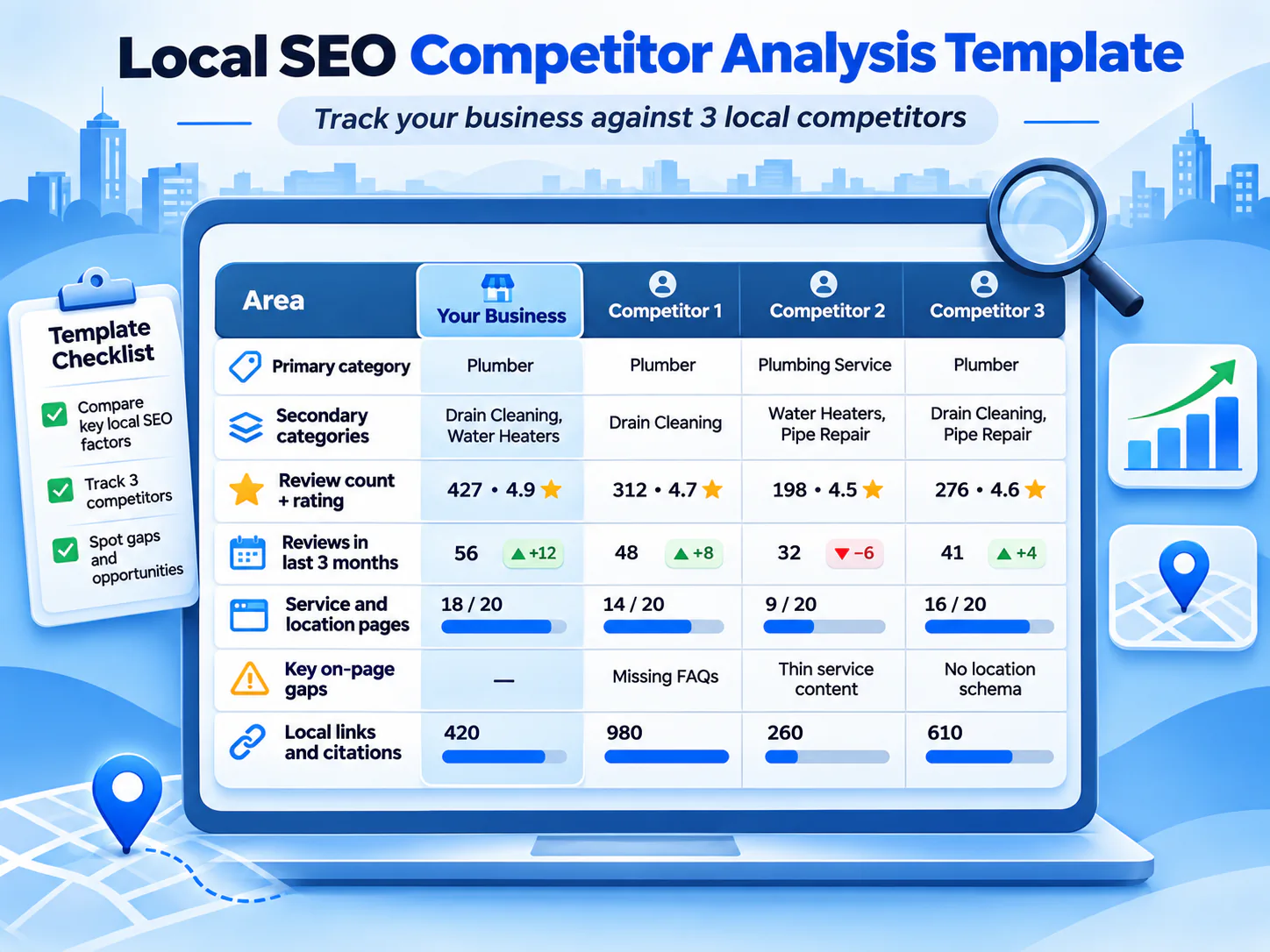
Your real competitors are the businesses that appear for your target searches, not always the ones you think of as rivals. To find them:
Example: A commercial cleaning company in Mississauga searches for “commercial cleaning Mississauga” and “office cleaning near me” from three parts of the city. Two cleaning companies appear in the local pack in every search, so they become the main competitors to study.
A Google Business Profile competitor analysis shows how complete and well matched each listing is. Search each competitor's name, open its profile and check:
The primary category deserves the closest look, because it tells Google what your business is. If competitors use a more specific category than you, choosing the right Google Business Profile categories is often the quickest fix you will find.
A side-by-side table makes the gaps easy to see:
| Profile element | Your company | Company A | Company B |
|---|---|---|---|
| Primary category | Cleaning service | Commercial cleaning service | Commercial cleaning service |
| Secondary categories | None | Janitorial service, Window cleaning service | Carpet cleaning service |
| Services listed | 3 | 12 | 8 |
| Online quote requests | No | Yes | Yes |
| Photos added in last 3 months | 0 | 10 | 6 |
Competitor reviews show how prominent each business looks and what local customers value. Compare these points for each competitor:
Repeated themes matter more than a single review. Complaints about pricing, availability or service quality point to customer experience gaps you can fill, and to topics your website should address.
Example: Several reviews for both competing companies complain about missed cleanings and a different crew every visit. If you assign a regular crew to each client, you can make that benefit clear on your website and in your profile.
A competitor keyword analysis shows which searches your competitors target and which ones you miss. Look for:
A simple keyword gap check might look like this:
| Keyword | Your company | Company A |
|---|---|---|
| commercial cleaning Mississauga | Page 1 | Page 1 |
| office cleaning Mississauga | Mentioned on homepage | Dedicated page |
| post-construction cleaning Mississauga | No page | Dedicated page |
| medical office cleaning Mississauga | No page | No page |
In this example, the company needs office cleaning and post-construction cleaning pages. Neither business covers medical office cleaning, which makes it an opportunity.
A competitor website analysis checks the basics that help pages rank locally. For each ranking page, review:
You do not need a full technical audit at this stage. Focus on what the top pages have that yours lack.
Backlinks and citations are different. A backlink is a link from another website to yours, while a citation is any online mention of your business name, address and phone number, with or without a link. Businesses that invest in local link building usually build both at the same time.
To find your competitors' local links and citations, look at:
Searching a competitor's phone number in quotation marks is a quick way to find its listings. Check your own listings at the same time, because different addresses or phone numbers across sites weaken trust in your business information.
Your research only helps if you turn it into a short list of changes. Start with this checklist for each competitor:
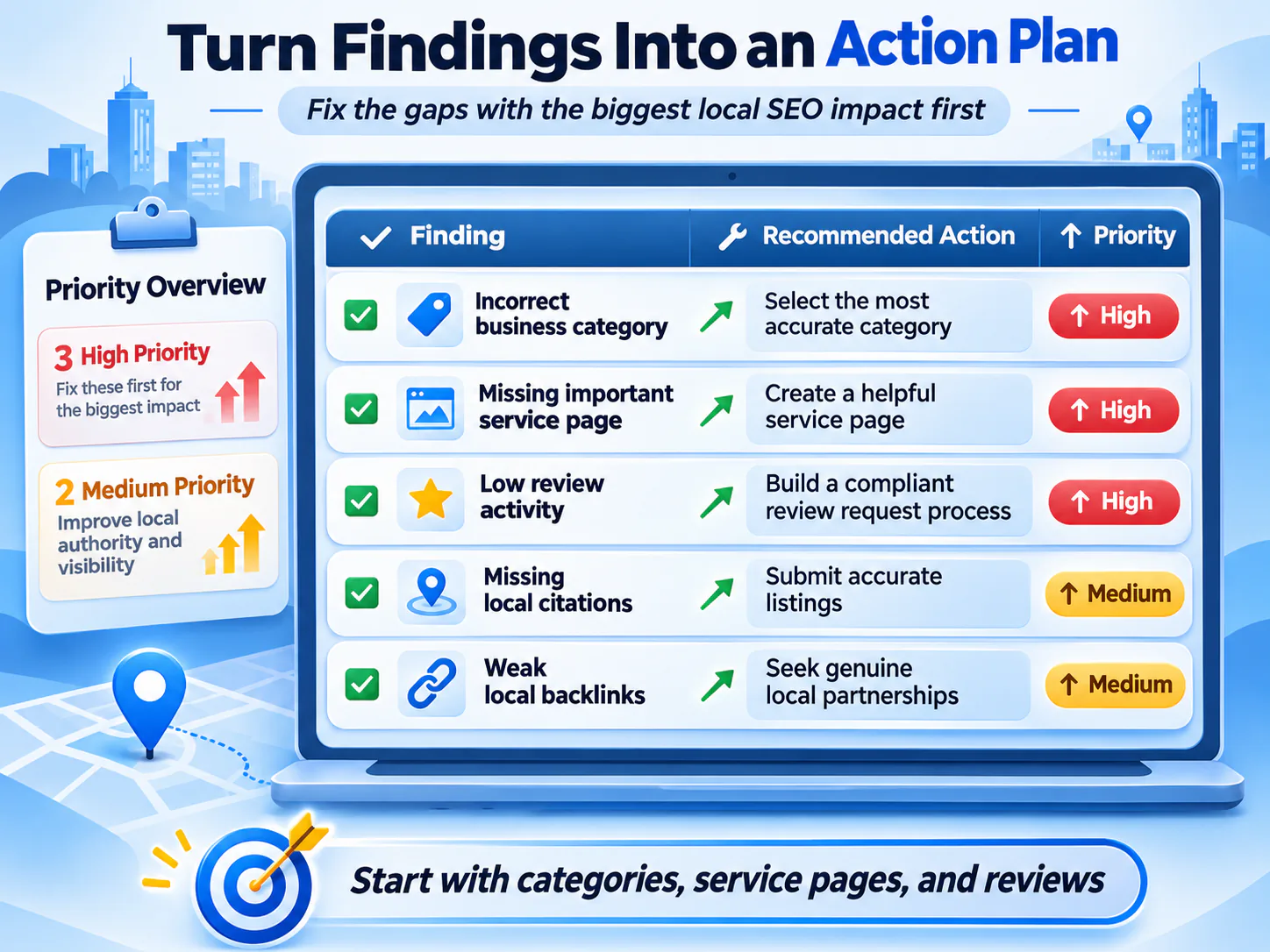
Then rank each finding by its likely impact:
| Finding | Recommended action | Priority |
|---|---|---|
| Incorrect business category | Select the most accurate category | High |
| Missing important service page | Create a helpful service page | High |
| Competitors have more customer feedback | Develop a compliant review request process | High |
| Missing relevant local citations | Submit accurate business listings | Medium |
| Competitors have stronger local links | Seek genuine local partnerships | Medium |
The Mississauga company finds that both competitors use “Commercial cleaning service” as their primary category, accept online quote requests and add around five reviews a month, while it adds one. It changes its primary category, adds janitorial service as a secondary category, builds an office cleaning page and starts asking every client for a review. The citation and link work waits until those changes are live.
These priorities are a practical starting point, not Google's ranking-factor weights, which Google does not publish. If you want a second opinion on where to start, a local SEO audit includes a full competitor comparison.
You can do most of a local competitor analysis for free, and paid tools save time on the larger tasks.
| Tool | What it is useful for | Cost |
|---|---|---|
| Google Search and Maps | Finding local competitors and checking their profiles | Free |
| Google Business Profile | Managing and assessing your own listing | Free |
| Google Search Console | Measuring your own site's organic performance | Free |
| Semrush or Ahrefs | Researching competitors' keywords and backlinks | Paid |
| BrightLocal | Local ranking tracking and citation research | Paid |
| Outscraper | Collecting and analyzing competitor review data | Paid |
Google Search Console shows data for your own website only. It cannot show your competitors' traffic or rankings.
Paid tools also take time to learn and set up. At Local SEO Mississauga, our team works with advanced tools for map rank tracking, backlink research and citation audits. You get a detailed view of your competition without paying for multiple subscriptions. You can speak with a local SEO consultant to see what that analysis would show for your business.
Check your priority rankings and competitors' reviews every month, and run a full competitor review every three to six months. Busy markets with many new businesses need the shorter cycle.
Measure progress by more than rankings alone. Track your local visibility across your service area, organic traffic, enquiries such as calls and bookings, and how many of those enquiries become customers.
Search your main services with your city name in Google Maps, from a few points in your service area. The businesses that appear in the top three most often are your local SEO competitors.
Yes, you can check profiles, reviews, websites and citations with Google Search, Google Maps and free tools such as the Rich Results Test. Paid tools mainly help with backlink research and tracking rankings across many locations.
Start with the primary and secondary categories, then compare services, hours, attributes, photos, posts and reviews. Note anything they list that is missing from your own profile.
Paid tools such as Semrush or Ahrefs list the keywords a competitor's website ranks for. Without them, search each of your services with your city and note which competitor pages appear, then review their page titles and menus for services you have not covered.
Reviews can help. Google says that more reviews and positive ratings can help your local ranking, but they are one signal among many, so a high review count alone does not guarantee a top spot.
A basic review of three competitors using the steps in this guide can usually be done in a few hours. The work takes longer if you offer many services or cover several neighbourhoods, because you need to check more searches and locations.
A local SEO competitor analysis turns guesswork into a clear list of fixes. By comparing profiles, reviews, keywords, pages and links, you see exactly why other businesses win the searches you want.
Start with three competitors that rank for your most valuable searches. Compare them step by step, then act on the gaps with the biggest impact first, such as categories, service pages and a steady flow of reviews.
If you would rather have an expert do the comparison, Local SEO Mississauga offers a free 30-minute strategy call that reviews your visibility against your top local competitors. Book your free call to see where you stand.
Disclaimer: The information provided in this blog is for general informational purposes only. For professional assistance and advice, please contact experts.
Get a free SEO audit and a clear, prioritized plan for your Mississauga business — no long-term contract required.
Get a Free SEO Audit· 8 min read
See what an HTTP 401 error means, how it differs from 403 and how users or developers can fix authentication problems. Check the steps now.
Read article· 11 min read
Improve brand mentions in ChatGPT, Gemini and AI Overviews with stronger entities, citations and answer-ready content. Use the 2026 checklist.
Read article· 14 min read
Build a keyword plan around search intent, competition and business value, then map terms to the right pages. Follow the step-by-step process.
Read article