Technical SEO
· 8 min read
HTTP 401 Error: Meaning, Causes & Fixes
See what an HTTP 401 error means, how it differs from 403 and how users or developers can fix authentication problems. Check the steps now.
Read article
Need local backlinks in Mississauga? Earn links from directories, sponsors, partners, local media, and city data. Book your free SEO audit today.
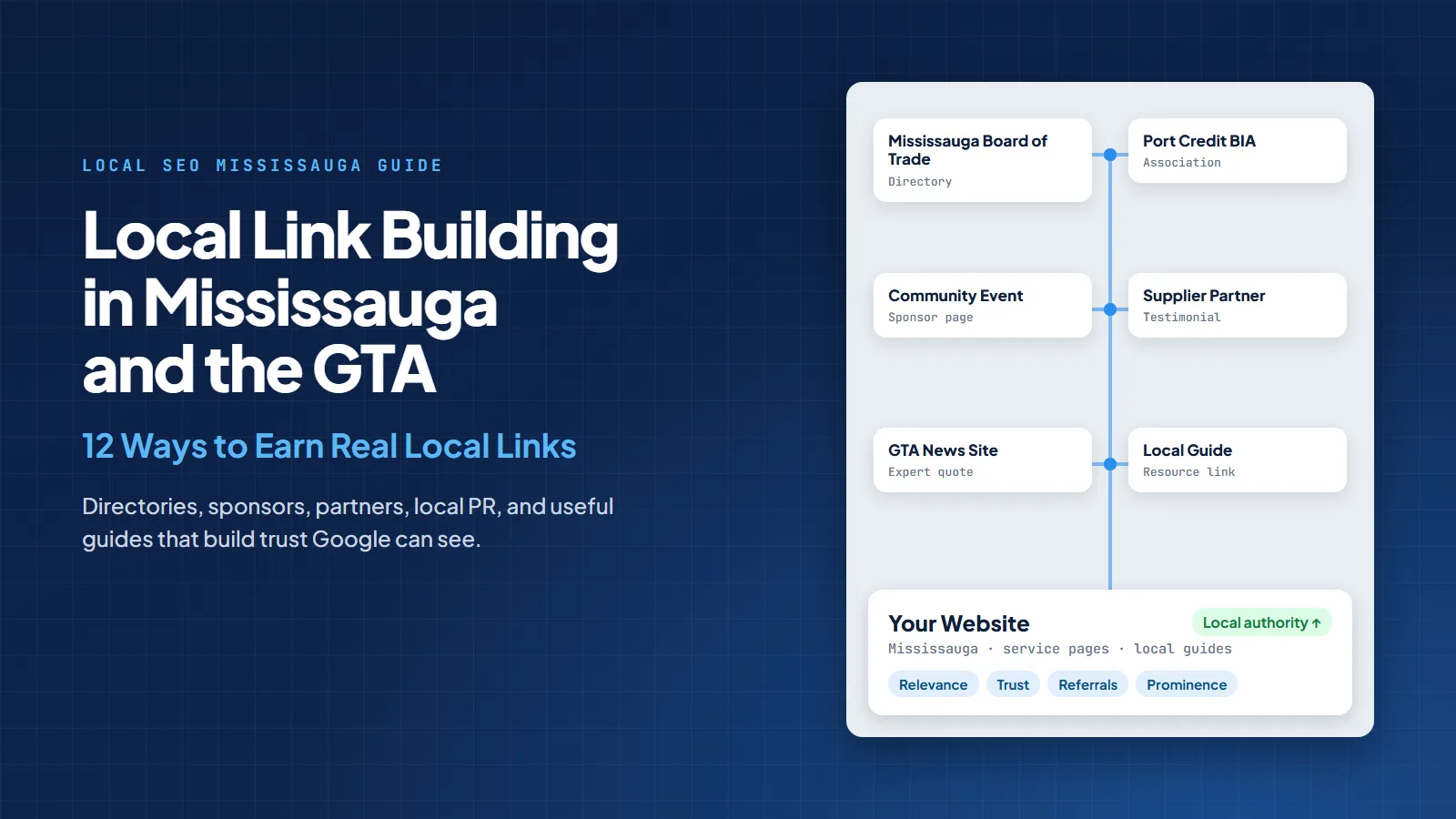
Local link building means earning links from websites that are relevant to your city, service area, industry, customers, or community. For a Mississauga business, that could mean a supplier page, a local business association, an event sponsor page, a neighbourhood guide, a GTA publication, or a partner feature.
It is not about begging random blogs for a backlink like a raccoon outside a restaurant window. It is about becoming visible in the places your buyers, partners, and search engines already trust.
This matters because Google uses more than your website text to understand local trust. Google says local rankings are mainly based on:
Prominence can include information Google knows about a business from across the web, such as links, articles, and directories. That is why local links are not decoration. They are proof.
For Mississauga and GTA businesses, the opportunity is real. The City of Mississauga describes the local economy as a major business hub, and Mississauga Open Data lists more than 13,600 businesses in its business directory. That means your competitors are not just fighting for clicks. They are fighting for trust signals across a busy local market.
Here is the boring truth nobody puts on a billboard: links work better when the page deserves them. If your service page is thin, slow, confusing, or has no local proof, even a good link can land visitors on a page that does not convert. That is like sending wedding guests to a venue with no chairs. Technically, they arrived. Emotionally, everyone is upset.
Before outreach, make sure your target page has:
If you are not sure whether your pages are ready, start with an SEO audit in Mississauga. A good audit shows which pages deserve links, which pages need repair, and which links are already helping or hurting you.
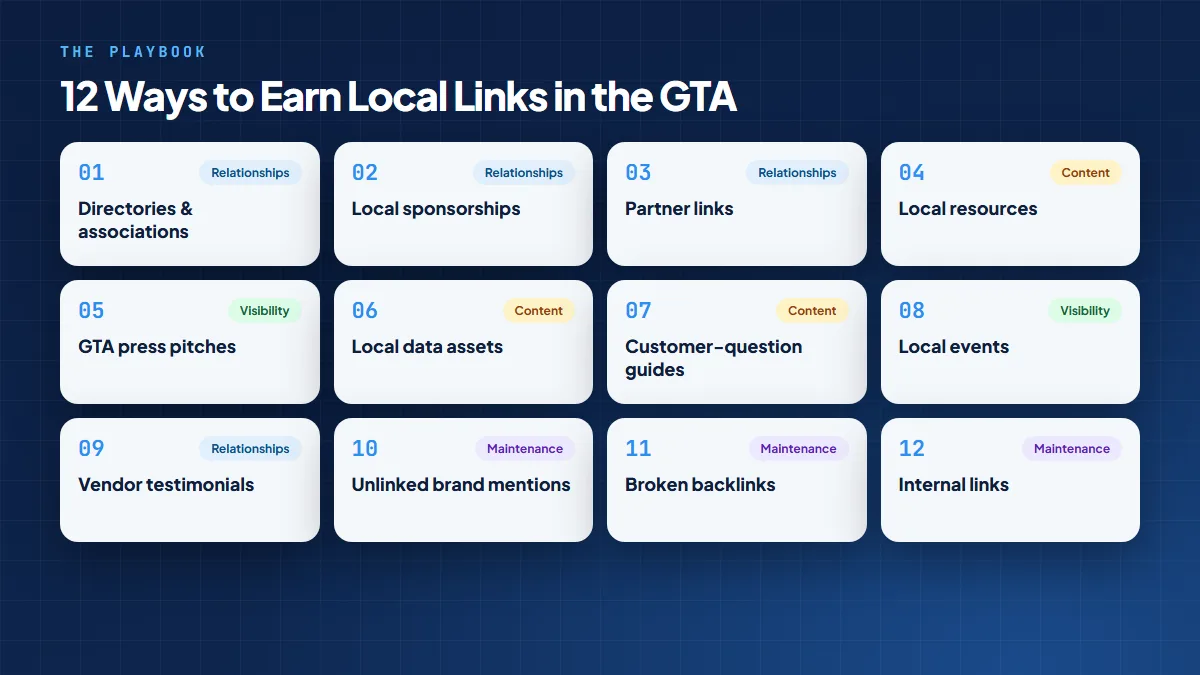
The easiest local links are often the ones businesses forget to claim. Start with legitimate local and industry directories, not spammy directories that look like they were designed during a power outage in 2009.
Examples include the Mississauga Board of Trade member directory, local BIAs, industry associations, supplier networks, and trusted Canadian business directories. MBOT’s directory exists for member visibility, and the City’s business resources point business owners toward directories and local support.
Fix: Make sure your business name, address, phone number, website, category, and description are consistent everywhere. Link quality drops when your business information looks like it has five different personalities.
Good link targets:
Sponsorship can earn a relevant local mention, but only when it is genuine. The City of Mississauga offers sponsorship and advertising opportunities for City-run events, programs, and facilities. Local festivals, sports teams, school fundraisers, non-profits, and community groups may also publish sponsor pages.
This is not “pay $50 for a link.” It is “support something real, then make sure the website credit includes your correct business name and link.”
Fix: Choose sponsorships your customers would recognize. A dental clinic sponsoring a youth sports team, a contractor supporting a community build, or a restaurant supporting a local food event makes natural sense. A plumber sponsoring a crypto forum in another country does not.
Good link targets:
Most businesses already have link opportunities hiding in their inbox. Suppliers, vendors, agencies, distributors, accountants, software partners, venue partners, and referral partners may have partner pages, case studies, testimonials, or client galleries.
The best part? These relationships already exist. You are not cold emailing strangers. You are asking people who know your work to represent the relationship properly online.
Fix: Make a list of 20 companies you work with. Check whether they have partner, client, testimonial, or project pages. Then ask for a simple mention that explains the relationship and links to the most relevant page on your site.
Good link targets:
Useful local content earns links because it saves people time. This is where many businesses can beat bigger competitors. You know the local questions customers ask every day. Turn those into a resource.
A mortgage broker could publish a “Mississauga first-time buyer checklist.” A contractor could build a “permit questions for basement renovations in Mississauga” guide. A clinic could publish a “new patient checklist for families moving to Port Credit.”
Fix: Do not create a thin listicle and call it a resource. Add local details, examples, maps, checklists, timelines, downloadable PDFs, or original photos. The page should be useful enough that a local group, blogger, association, or partner would feel comfortable sharing it.
Good link targets:
Digital PR is link building with a story. Local publications need helpful business angles, expert comments, seasonal advice, local data, community stories, and human-interest pieces. Your job is not to say, “Please link to my page.” Your job is to bring a useful angle.
For example, a tax firm can comment on year-end tax planning. A roofer can explain storm damage season. A restaurant can share a local food trend. A law firm can explain a common local legal question in plain English.
Fix: Write a short pitch with one useful angle, one local hook, and one credible expert quote. Keep it human. Journalists do not need a 900-word essay. They need a useful source who does not sound like a press release wearing a tie.
Good link targets:
Data earns links when it answers questions people already care about. Mississauga has public data sources, including Open Data Mississauga and business directory information. You can also collect your own first-party data from customer questions, quote requests, bookings, surveys, or service trends.
A linkable asset could be “most requested home services in Mississauga by season,” “average wait times for appointments,” “GTA moving checklist,” or “local business website mistakes found in 100 audits.”
Fix: Keep the data honest. Say what you measured, the date range, sample size, and limitations. Original data does not need to be massive. It needs to be useful and transparent.
Good link targets:
People link to answers that remove confusion. If your sales team answers the same local question every week, that question probably deserves a guide.
Examples: “Do I need a permit for this project in Mississauga?” “Which neighbourhoods do you serve?” “How fast can you reach Meadowvale?” “What documents do I need before booking?” These pages can attract links from community sites, partner pages, and related blogs because they are useful beyond selling.
Fix: Add FAQs, short examples, a service-area note, and a clear next step. Then internally link the guide to your main service page. Local SEO Mississauga’s guide to high-performing location pages explains why unique local details beat copy-paste city pages.
Good link targets:
Events are natural link magnets when handled well. Workshops, webinars, open houses, charity drives, networking events, lunch-and-learns, and training sessions often get listed on event calendars, association sites, venue pages, and partner websites.
The City of Mississauga and Visit Mississauga maintain event-related resources, while MBOT runs business events and programs. Not every event listing will include a followed link, and that is fine. The goal is visibility, credibility, and local context, not chasing one magic blue hyperlink.
Fix: Create a clean event landing page on your site first. Then partners have a proper URL to link to. After the event, update the same page with photos, takeaways, and resources instead of letting it die quietly in a dusty website corner.
Good link targets:
Vendors love testimonials because they help sell. You love testimonials because they can earn a relevant link. This is one of the simplest link tactics, and it does not feel awkward because everyone wins.
Write a specific testimonial about a product, service, or collaboration. Mention the business outcome, not just “great service.” If the vendor publishes it, ask them to include your business name and website link.
Fix: Send a polished 80 to 120 word testimonial with your preferred business name, role, city, and target URL. Make it easy for them to publish. The easier you make it, the faster it happens.
Good link targets:
Sometimes websites already mention your business but forget to link. That is low-hanging fruit. Search your brand name, founder name, product name, old event names, and campaign names. Look for mentions without a link.
Then send a short, friendly request: thank them for the mention, point to the page, and ask whether they can add the link for readers who want more context.
Fix: Do this once a quarter. Brand mentions often appear after events, podcast interviews, sponsor lists, local awards, vendor pages, and community announcements.
Good link targets:
A broken backlink is like someone recommending your shop, then giving directions to an empty parking lot. If other sites link to old pages that now return 404 errors, you are wasting authority and frustrating users.
Use Google Search Console, Ahrefs, Semrush, Screaming Frog, or similar tools to find external links pointing to broken pages. Then restore the page, redirect it to the most relevant live page, or ask the linking site to update the URL.
Fix: Do not redirect every broken backlink to the homepage. Map it to the closest relevant page. If the link was to an old “Mississauga SEO audit” guide, send it to your current audit page, not your homepage.
Good link targets:
Internal links are not backlinks, but they make backlinks more valuable. When a local link points to one useful guide, internal links can pass attention toward your money pages, location pages, case studies, and booking page.
Google’s link best practices recommend natural, descriptive anchor text. The same applies inside your site. Do not use “click here” twenty times like it is 2004. Use clear anchors such as “local SEO services in Mississauga,” “SEO audit,” or “Google Business Profile optimization.”
Good link targets:
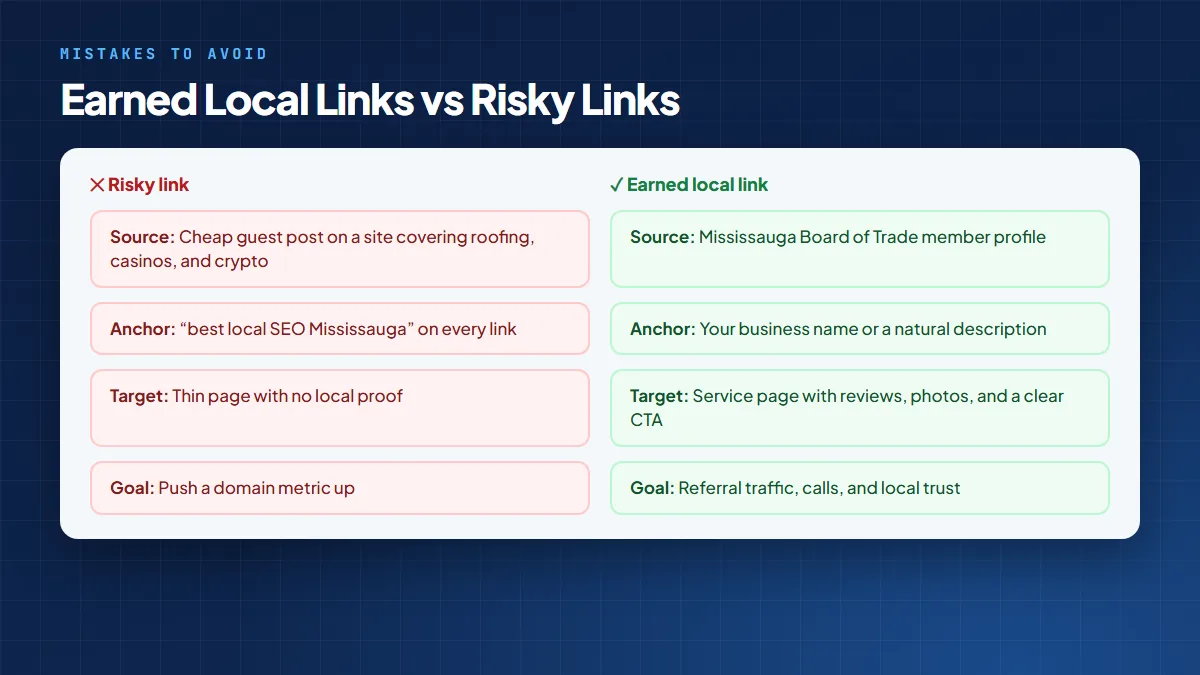
Local link building works best when it is based on real relationships, useful content, and relevant local visibility. It becomes risky when it turns into link manipulation. Google’s spam policies define link spam as creating links to or from a site primarily to manipulate search rankings. That includes paid link schemes, excessive link exchanges, and low-quality links created only for ranking manipulation.
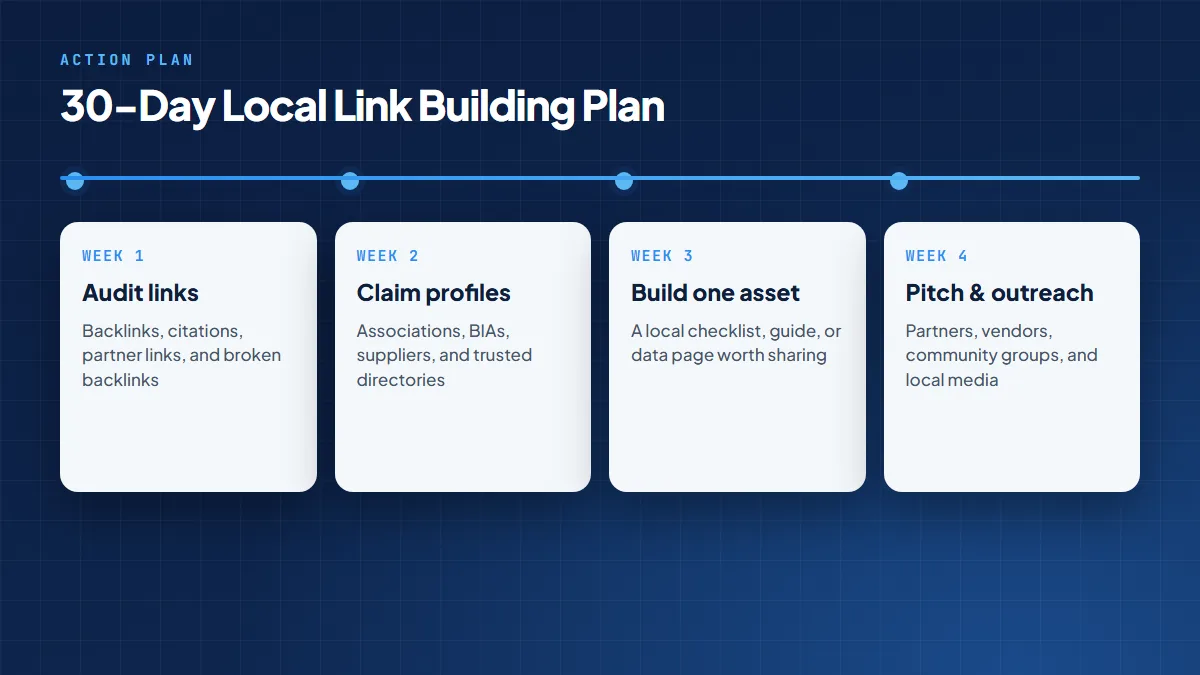
| Week | Action | Goal |
|---|---|---|
| Week 1 | Audit current backlinks, citations, partner links, and broken backlinks. | Find fast wins and clean obvious problems. |
| Week 2 | Claim or improve association, BIA, supplier, and directory profiles. | Build foundational local trust. |
| Week 3 | Create one linkable local asset, such as a checklist, guide, or data page. | Give outreach a strong reason to exist. |
| Week 4 | Pitch partners, vendors, community groups, and local publications. | Earn relevant mentions and links. |
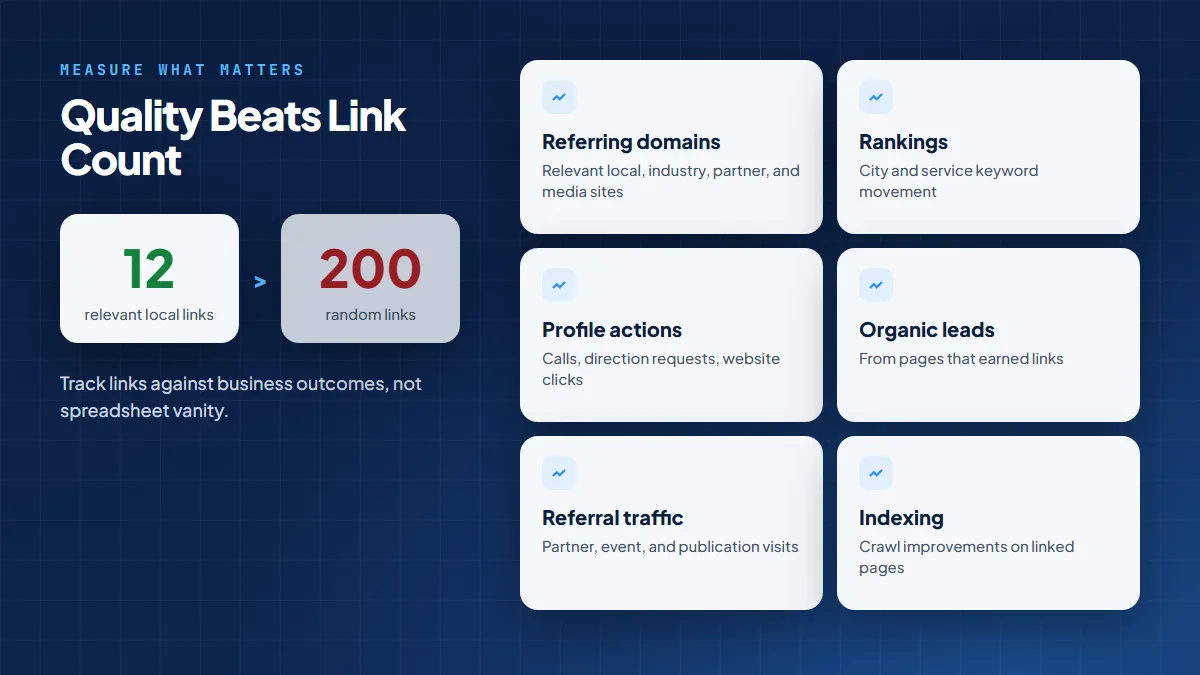
Do not judge link building by link count alone. Twelve relevant local links can outperform 200 random links from sites no customer has heard of. Measure the quality of the strategy, not just the volume.
If this sounds like a lot to track, that is because it is. This is where professional link building SEO in Mississauga can help. The right campaign maps links to pages that drive calls, not just pages that look nice in a report.
Local link building is the process of earning backlinks and mentions from relevant local websites, such as associations, partners, community groups, local media, event pages, and trusted directories. The goal is to build real local authority, not fake popularity.
They can support Maps visibility because local rankings consider prominence, and Google says prominence can be influenced by information from across the web, including links, articles, and directories. Links are not the only factor, but they can strengthen the bigger local SEO system.
There is no magic number. A local plumber, dentist, lawyer, clinic, restaurant, or contractor needs enough relevant authority to compete in their specific category and neighbourhood. Quality, relevance, and page strength matter more than raw link count.
Yes, if they are real, trusted, and relevant. Business associations, BIAs, industry directories, and reputable Canadian directories can support local trust. Spam directories with no real users should be avoided.
No. Buying links mainly to manipulate rankings can violate Google’s spam policies. A safer approach is to earn links through partnerships, sponsorships, useful resources, PR, and legitimate local visibility.
A good local backlink comes from a relevant, trusted website and points to a useful page. It should make sense to a real reader. If the link would look strange to a customer, it probably looks strange to Google too.
Genuine sponsorships can be valuable for brand visibility and local trust, but paid or sponsored links should be handled carefully and qualified when needed. The purpose should be community visibility, not ranking manipulation.
Nofollow links may not pass ranking signals the same way followed links do, but they can still bring referral traffic, brand recognition, and local discovery. Do not reject a useful local mention just because the link is nofollow.
Link to the page that best matches the context. Association profiles may link to your homepage. A guest quote about a service should link to the relevant service page. A local guide should link to the guide itself.
Some foundational links can go live in days or weeks. PR, partnerships, and strong content assets usually take longer. Most businesses should think in months, not days.
Watch for sites with unrelated content, obvious spam, auto-generated pages, copied articles, gambling or adult content beside business articles, and anchors that look forced. If a link exists only to manipulate search rankings, it is risky.
Yes. Local SEO Mississauga offers local link building, SEO audits, local SEO services, content strategy, technical SEO, and internal linking support for businesses that want safer authority growth in Mississauga and the GTA.
Disclaimer: The information provided in this blog is for general informational purposes only. For professional assistance and advice, please contact experts.
Get a free SEO audit and a clear, prioritized plan for your Mississauga business — no long-term contract required.
Get a Free SEO Audit· 8 min read
See what an HTTP 401 error means, how it differs from 403 and how users or developers can fix authentication problems. Check the steps now.
Read article· 11 min read
Improve brand mentions in ChatGPT, Gemini and AI Overviews with stronger entities, citations and answer-ready content. Use the 2026 checklist.
Read article· 14 min read
Build a keyword plan around search intent, competition and business value, then map terms to the right pages. Follow the step-by-step process.
Read article