Technical SEO
· 8 min read
HTTP 401 Error: Meaning, Causes & Fixes
See what an HTTP 401 error means, how it differs from 403 and how users or developers can fix authentication problems. Check the steps now.
Read article
See which local SEO ranking factors actually move the map pack and local search results, and which ones are overrated. Check the 2026 guide.
Two plumbers, three blocks apart, same city, same rough pricing. One shows up in the map pack every time someone searches "plumber near me." The other is nowhere on the first page. It's rarely about who does better work. It's about which one actually built the signals Google uses to decide who shows up first.
Local SEO ranking factors aren't one thing. They're a combination of signals, some you control directly, some you influence indirectly, and a few you can't touch at all, that Google weighs together every time someone searches for a business like yours nearby.
This guide covers what those factors actually are according to Google's own documentation, which ones carry the most weight in practice, how your Google Business Profile, reviews, citations, and website content each play a role, and where the effort you put in usually pays off first.
Local SEO ranking factors are the signals Google uses to decide which businesses appear in local search results and the map pack. Google groups them into three official categories: relevance, distance, and prominence, and every tactic in local SEO exists to influence one of those three.
That's a shorter list than most guides make it sound. Reviews, citations, backlinks, website content: none of them are separate ranking factors in Google's own framework. They're all inputs that feed one of the three pillars, mostly prominence. Understanding that hierarchy is what separates a focused local SEO plan from a scattered checklist of tactics.
These three pillars come straight from Google's own explanation of how local results are determined, and each one answers a different question about a business.
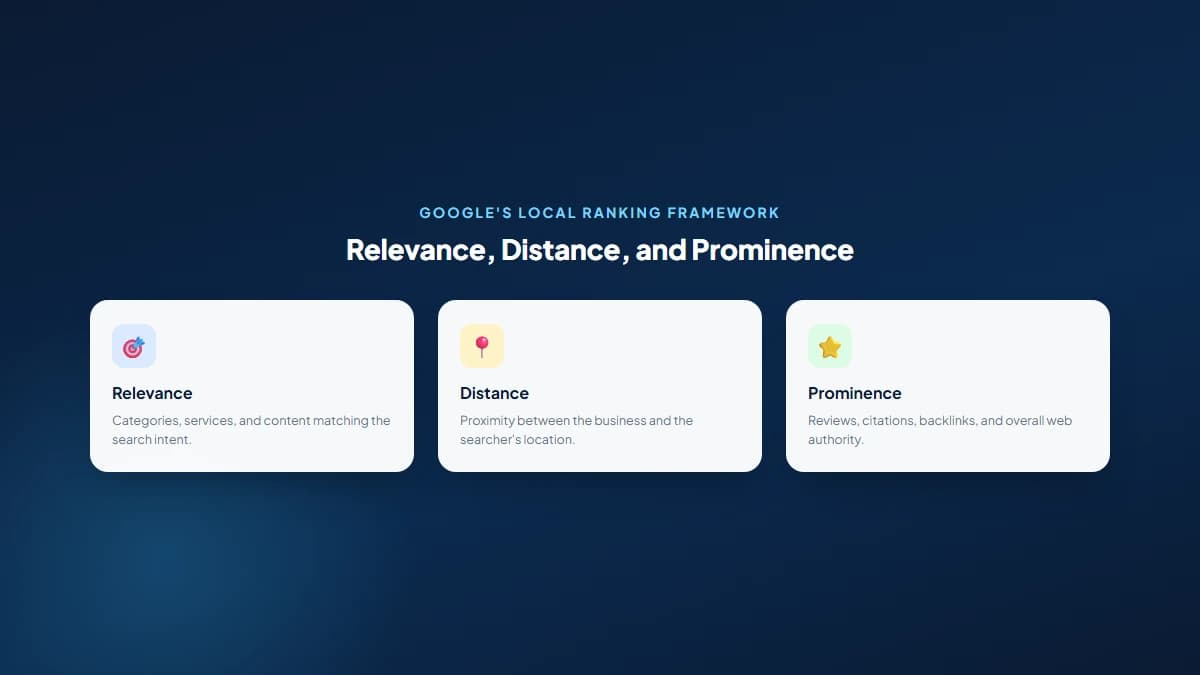
| Factor | What It Measures | What You Control |
|---|---|---|
| Relevance | How well a business profile matches the search terms and intent | Categories, services, description, on-page content |
| Distance | How close the business is to the searcher or the searched location | Little to nothing, aside from serving the right areas |
| Prominence | How well-known and well-reviewed the business is, on and off Google | Reviews, citations, backlinks, overall SEO authority |
Distance is the one you truly can't influence. A dentist five minutes from the searcher generally beats one twenty minutes away, all else equal, and no amount of SEO changes that. Relevance and prominence are where the actual work happens, and they're what the rest of this guide focuses on.
Your Google Business Profile affects local rankings more than almost any other single factor, since it's the primary source Google uses to judge both relevance and prominence: your categories, services, reviews, photos, and posting activity all feed directly into how the algorithm evaluates your business.
Start with categories. Your primary category carries more weight than most business owners realize, and picking a close-but-not-quite match ("General Contractor" instead of "Roofing Contractor") quietly caps your relevance for the searches that actually matter to you. Secondary categories and a complete services list round that out, giving Google more specific terms to match against real searches.
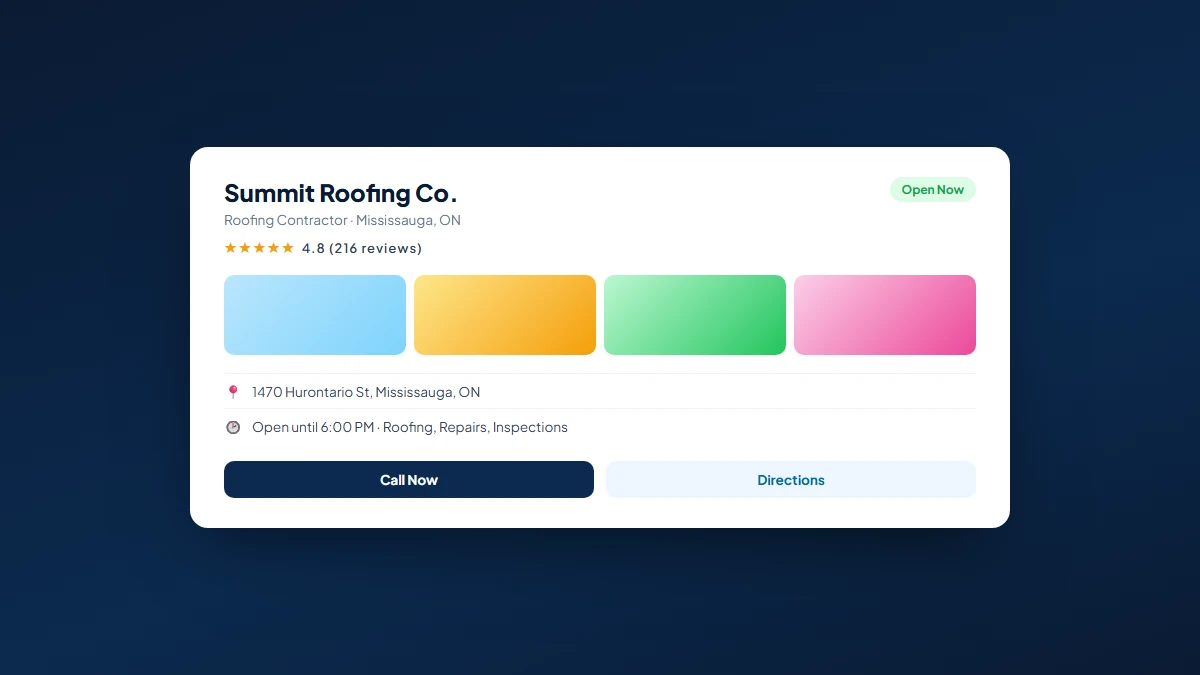
Review count and average rating matter, but recency matters just as much. A business with 200 reviews from three years ago and nothing since reads as less active than one with 40 reviews trickling in weekly. Responding to reviews, especially negative ones, is also a prominence signal Google can detect, separate from the star rating itself.
An active profile signals a real, operating business. Regular photos, Google Posts, and updated hours around holidays all contribute to that picture. None of them move rankings dramatically on their own, but a stale, half-filled profile is an easy way to lose ground to a competitor who treats theirs like a real marketing asset, the same discipline we bring to every Google Business Profile optimization engagement.
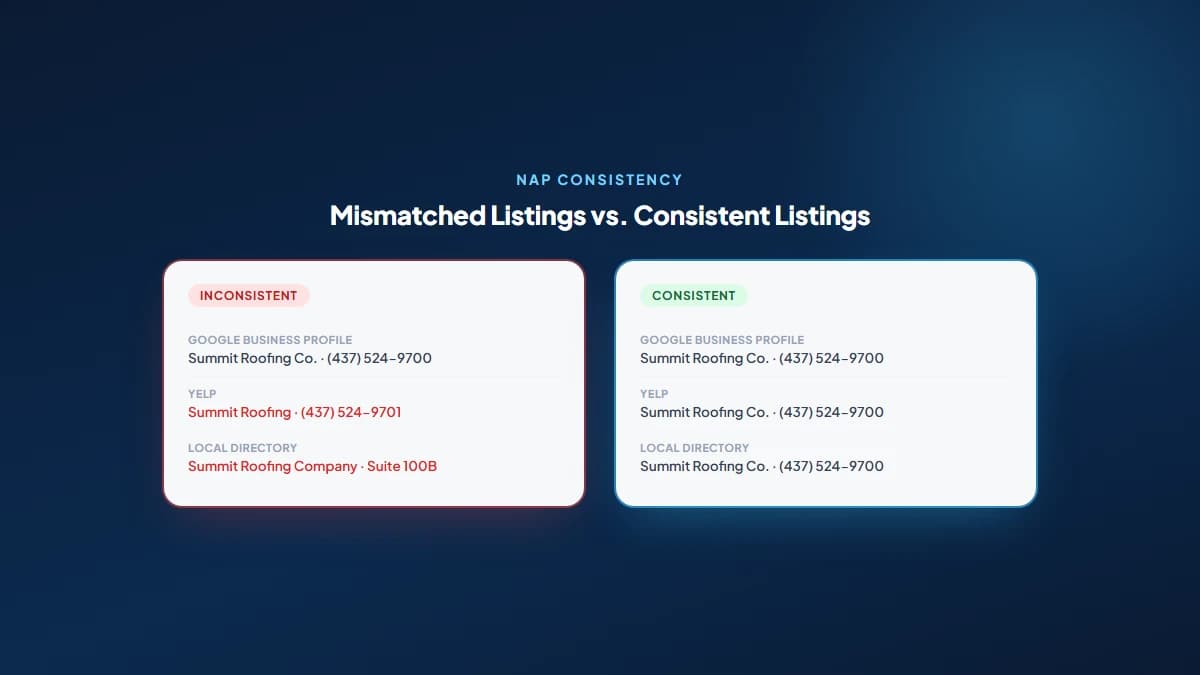
NAP citations and local backlinks both feed prominence, but they work differently: citation consistency confirms to Google that your business is who it says it is across the web, while backlinks, especially from other local sites, signal that real people and organizations in your area vouch for you.
NAP stands for Name, Address, Phone number, and the goal isn't collecting as many citations as possible. It's making sure the ones that exist, on Yelp, industry directories, the Chamber of Commerce, your Facebook page, all say exactly the same thing your Google Business Profile says. A mismatched suite number or an old phone number still floating around a directory creates the kind of doubt that erodes trust signals over time. Industry research like Moz's annual local search ranking factors survey has tracked this shift for years: raw citation volume matters less than it used to, while consistency and review signals have grown more important.
Not all backlinks carry equal weight for local prominence. A link from a national blog is fine for general authority, but a link from your local Chamber of Commerce, a sponsored Little League team page, or a Mississauga news write-up tells Google something a generic link can't: that you're a real, active participant in a specific community. That's the exact distinction we build into every local link building plan rather than chasing volume for its own sake.
Yes. Website content affects local rankings through relevance signals Google can't get from your Google Business Profile alone: city and service terms in your title tags and headings, dedicated location pages for each area you serve, and structured data that spells out your business type and service area in a format search engines parse directly.
Site speed and Core Web Vitals have a smaller, more indirect effect on local rankings than most SEO content suggests: the map pack leans heavily on Google Business Profile signals rather than your website's technical performance, while the organic local results underneath it behave much more like standard SEO, where page experience genuinely matters.
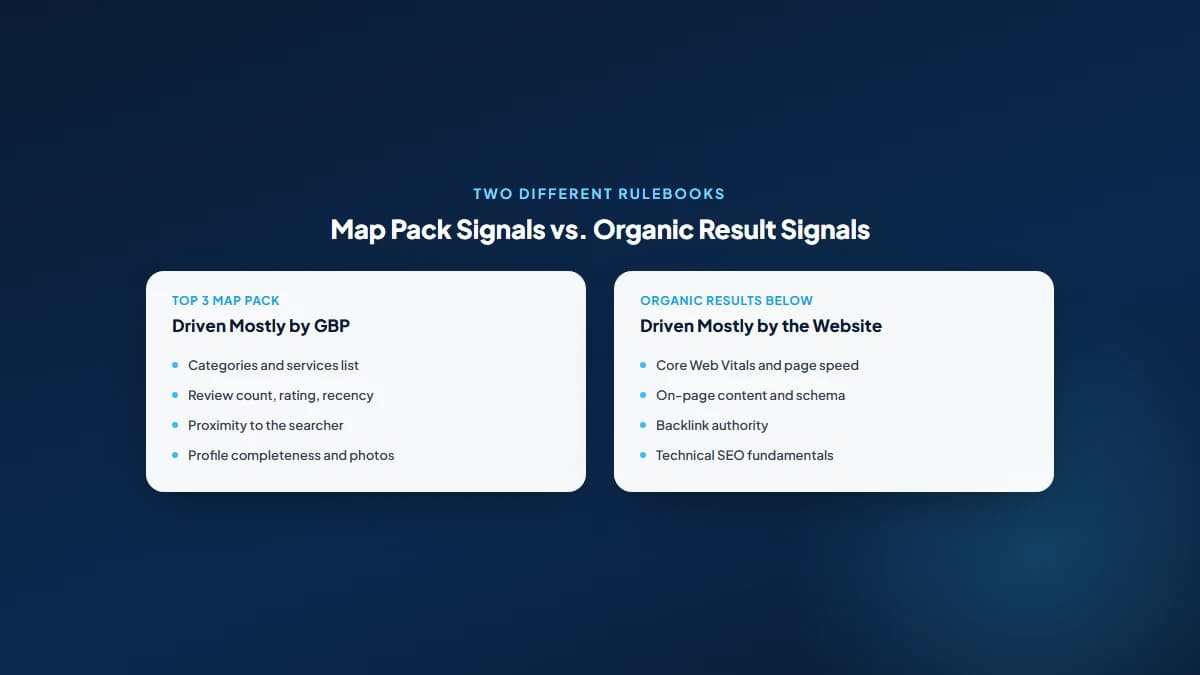
That distinction matters because it's easy to over-invest in one and neglect the other. A gorgeous, lightning-fast website won't rescue a thin, uncategorized Google Business Profile. And a five-star GBP with 300 reviews won't carry a website that fails Core Web Vitals badly enough to lose organic visibility beneath the map pack, or the technical SEO fundamentals sitting under all of it.
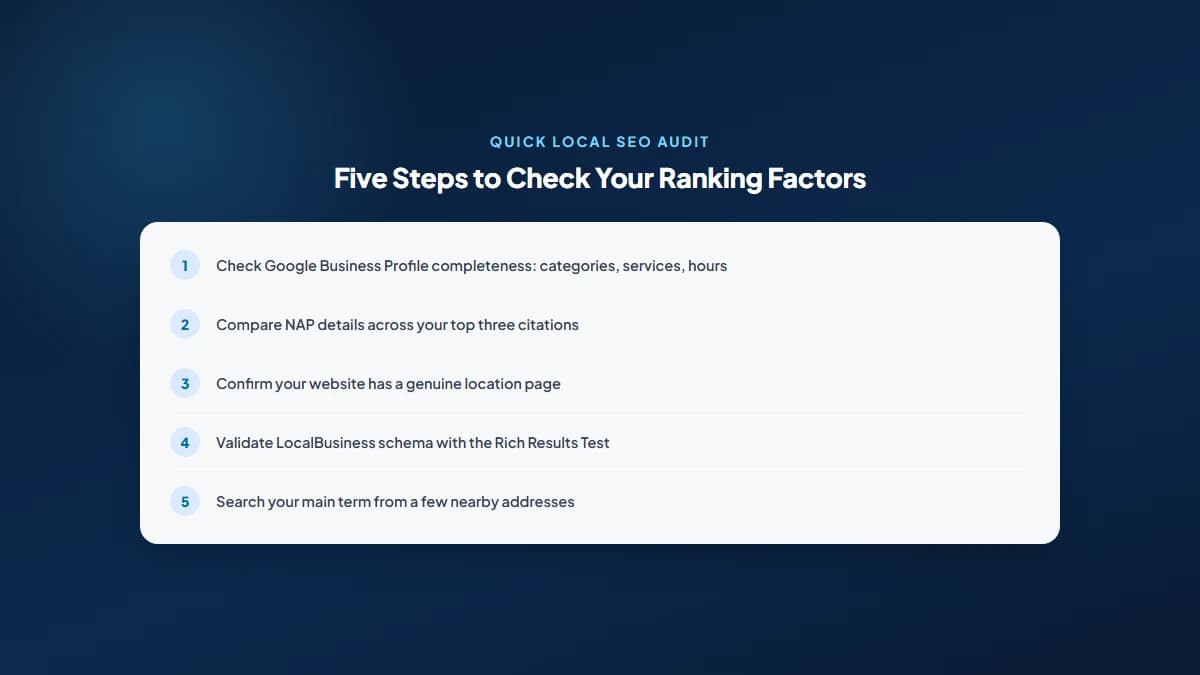
Check your local ranking factors by auditing your Google Business Profile completeness, scanning your top three citations for NAP consistency, confirming your website has a location page and LocalBusiness schema, and searching your main service term from a few different nearby addresses to see where you actually land.
No. Getting every ranking factor right improves your odds significantly, but distance alone can keep you out of a specific searcher's map pack no matter what you do, and a well-funded competitor with more reviews and more local links can still outrank a smaller business doing everything correctly.
What these factors reliably do is put you in contention. A business with a complete, well-categorized profile, consistent citations, real local links, and a website that backs it all up is competing on a level field. One that's missing half of these isn't losing to a smarter algorithm. It's losing to a competitor who filled in the gaps first, which is exactly the work behind every local SEO for small businesses engagement we run, and the same checklist a proper SEO audit works through before recommending a single tactic.
Google groups every local ranking factor into relevance, distance, and prominence. Relevance and prominence are where a business can meaningfully compete; distance is mostly outside your control, tied to how close a searcher is to your location.
More reviews generally help, but recency and response rate matter alongside raw count. A steady trickle of new reviews with active responses outperforms a large but stagnant review count that hasn't grown in over a year.
Not strictly, since the map pack draws heavily from your Google Business Profile. But a website strengthens relevance and prominence signals, and it's required to compete in the organic local results that appear below the map pack.
There's no fixed number, and chasing volume past the major, relevant directories for your industry has diminishing returns. Consistency across the citations you have matters far more than adding dozens more.
Yes, through a service-area business profile, which hides your exact address but still lets you rank for searches within the areas you've defined. Categories, reviews, and service-area accuracy matter even more without a storefront to anchor prominence.
Google Business Profile changes like category fixes can influence rankings within a few weeks. Prominence signals like reviews and backlinks build more slowly, typically three to six months of consistent effort before a clear ranking shift shows up.
Get a free SEO audit and a clear, prioritized plan for your Mississauga business — no long-term contract required.
Get a Free SEO Audit· 8 min read
See what an HTTP 401 error means, how it differs from 403 and how users or developers can fix authentication problems. Check the steps now.
Read article· 11 min read
Improve brand mentions in ChatGPT, Gemini and AI Overviews with stronger entities, citations and answer-ready content. Use the 2026 checklist.
Read article· 14 min read
Build a keyword plan around search intent, competition and business value, then map terms to the right pages. Follow the step-by-step process.
Read article