Technical SEO
· 8 min read
HTTP 401 Error: Meaning, Causes & Fixes
See what an HTTP 401 error means, how it differs from 403 and how users or developers can fix authentication problems. Check the steps now.
Read article
Dental SEO helps your clinic rank in Google Maps, earn trust with reviews, and turn local searches into booked patients. Book a free SEO audit.
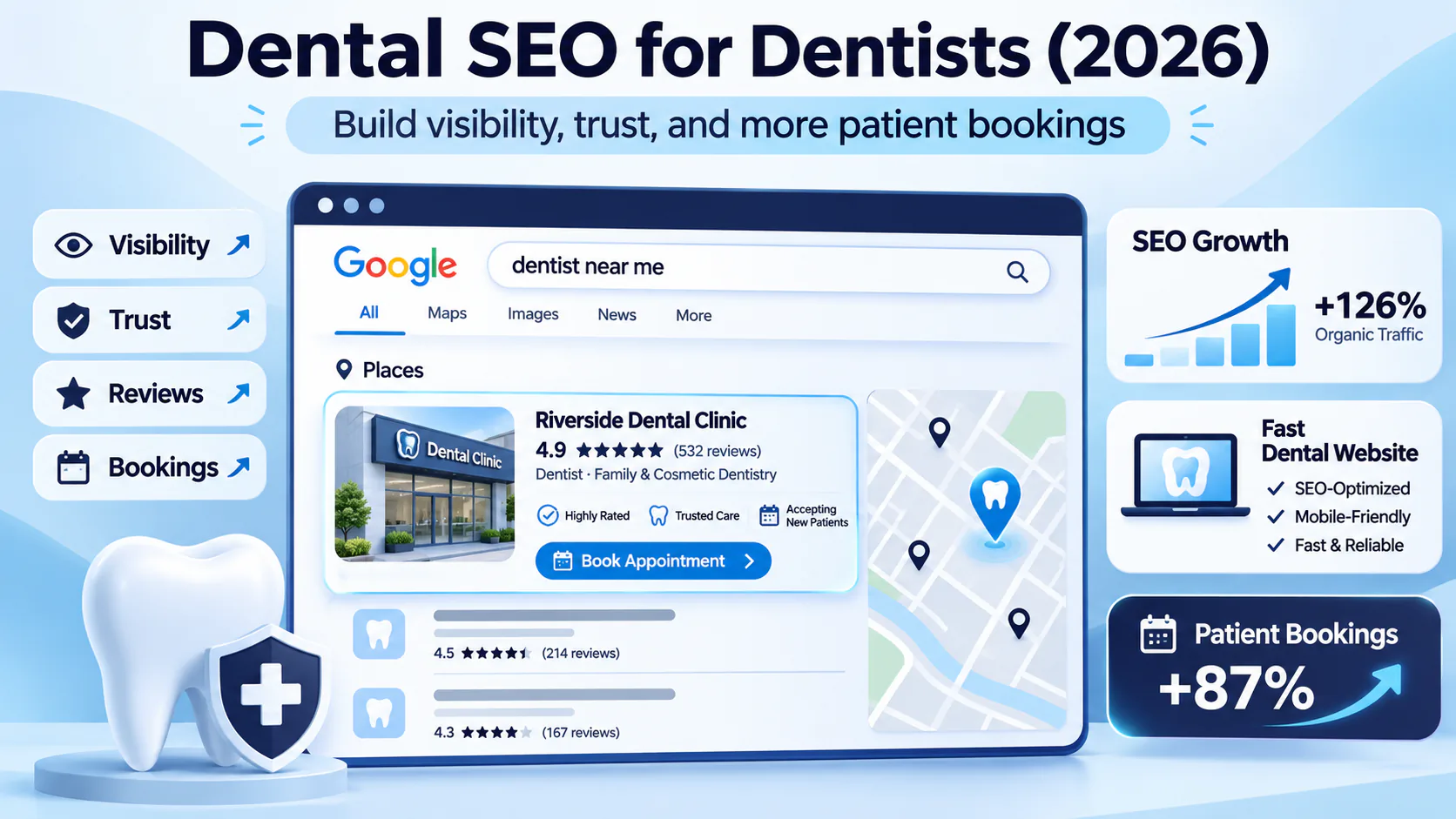
Patients search fast, but they choose based on trust. They scan your name, your reviews, your photos, and your “can you help me today” signals. Then they call one clinic and ignore the rest.
In dental search, patients decide fast. And Google says research shows almost 70% of users see complete business listings as more reputable. That is why your visibility and your profile details matter before a patient ever clicks your website.
This guide is built to be useful, not fuzzy. It covers what dental SEO is, how it works, what to do first, what it costs, and how to choose the right SEO partner without wasting months.
Dental SEO is not a one-time task. It is an ongoing system that helps your clinic get found and chosen. It is also not about stuffing keywords into every paragraph. If a page reads oddly to a patient, it usually performs poorly anyway.
You make it easy for search engines to understand your practice, and easy for patients to take the next step. That includes dentist SEO work on your website, your Google Maps presence, your reviews, and your local authority signals.
It comes down to speed and staying power. Ads can bring quick calls when you need a short-term push. Dental practice SEO builds a stronger base that keeps working after the initial setup, especially for high-intent searches like “emergency dentist” or “Invisalign near me.”
Most patients do not open ten tabs and do deep research. They narrow the list quickly. If your listing looks incomplete, your photos look outdated, or your website feels unclear, you can lose the call even if you “rank.”
Many patients get what they need directly from local results, like hours, location, and reviews. That means your local presence and trust proof often matter as much as your website.
That is why dentists should invest in dentist SEO: it builds the trust signals that help you win the shortlist, not just a keyword.
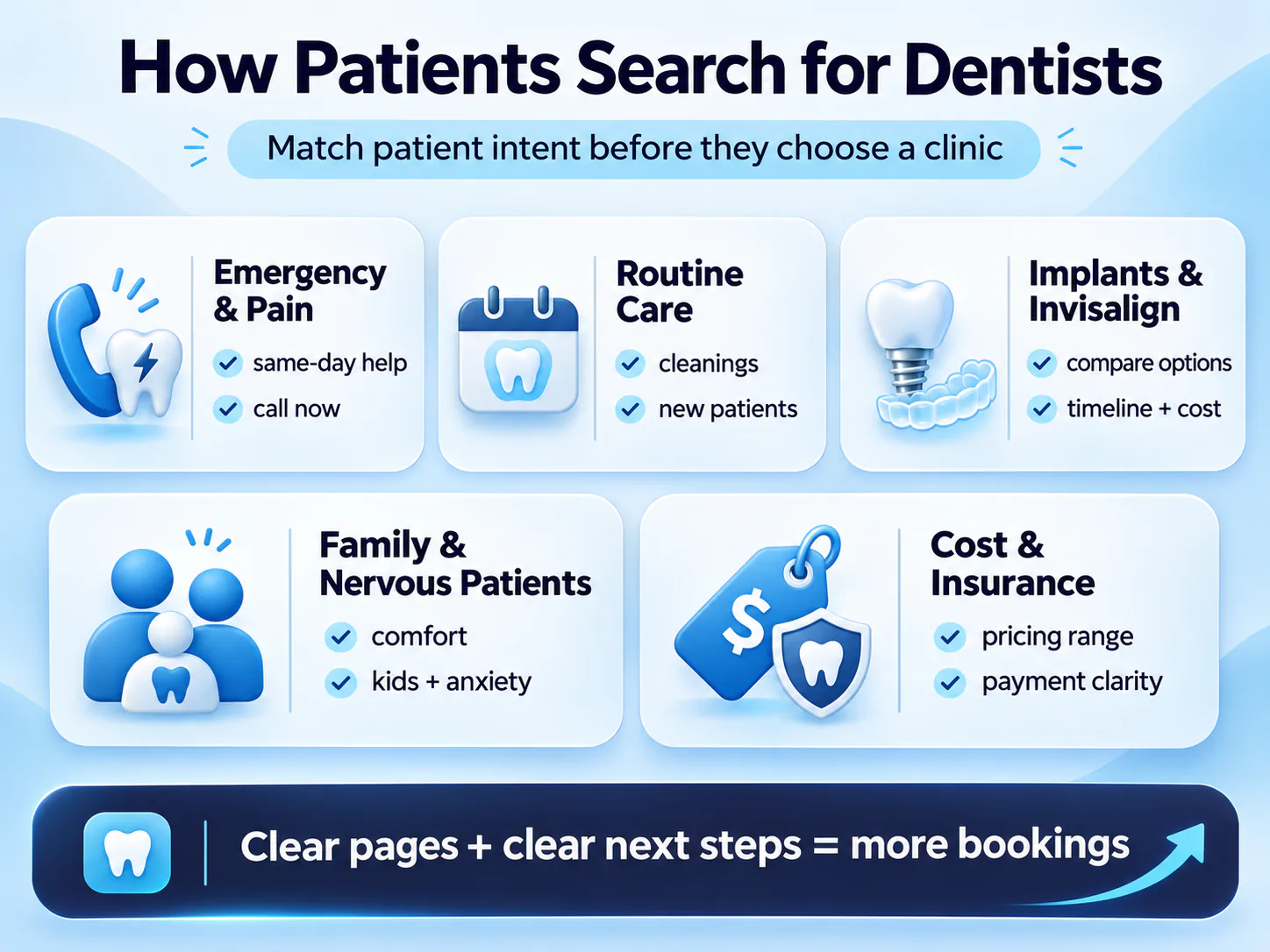
These searches usually include urgency words and timing. These patients want a clear “call now” path, same-day expectations, and direct guidance on what happens next.
These searches are calmer, but they still need confidence. These patients want to know if you take new patients, how booking works, and what to expect on the first visit.
These involve more comparison. Patients look for candidacy, timeline, financing options, and proof that feels real. They also look for clarity, because confusion makes them delay.
These often include fear words or comfort needs. If your website and profile do not address anxiety, kids, or comfort options, you may never make the shortlist.
These are common. Patients want ranges, what affects cost, financing options, and how insurance is handled. You do not need to publish perfect pricing, but you do need to reduce uncertainty.
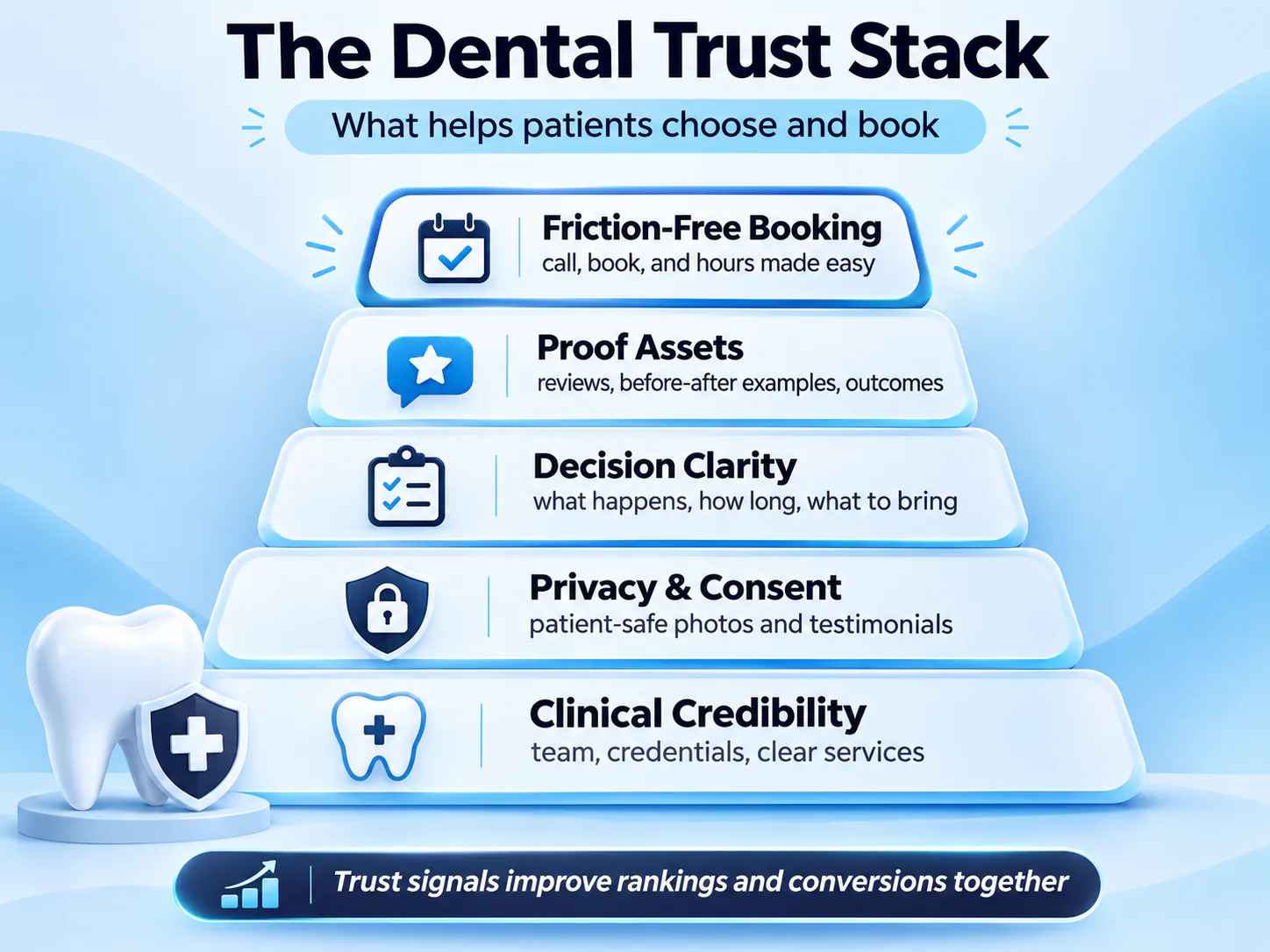
Credibility starts with your team pages, credentials, and clear service descriptions. Patients want to know who they are trusting, especially when they are in pain or worried.
These matter more than many clinics realize. If you share photos, testimonials, or case stories, you need clear consent and privacy safeguards. HIPAA rules protect patient information and explain how protected health information can be used and disclosed.
This is simple, but powerful. Explain what happens on the first visit, what to bring, how long it takes, and what the next step is. Patients do not want surprises.
Proof includes reviews, before-and-after examples where appropriate, and clear explanations of outcomes without hype. Keep it grounded. Patients can tell when a page is trying too hard.
This is the final layer. Make calling and booking easy. Reduce form fields. Make your hours easy to spot. Do not hide the “Book” button halfway down the page.
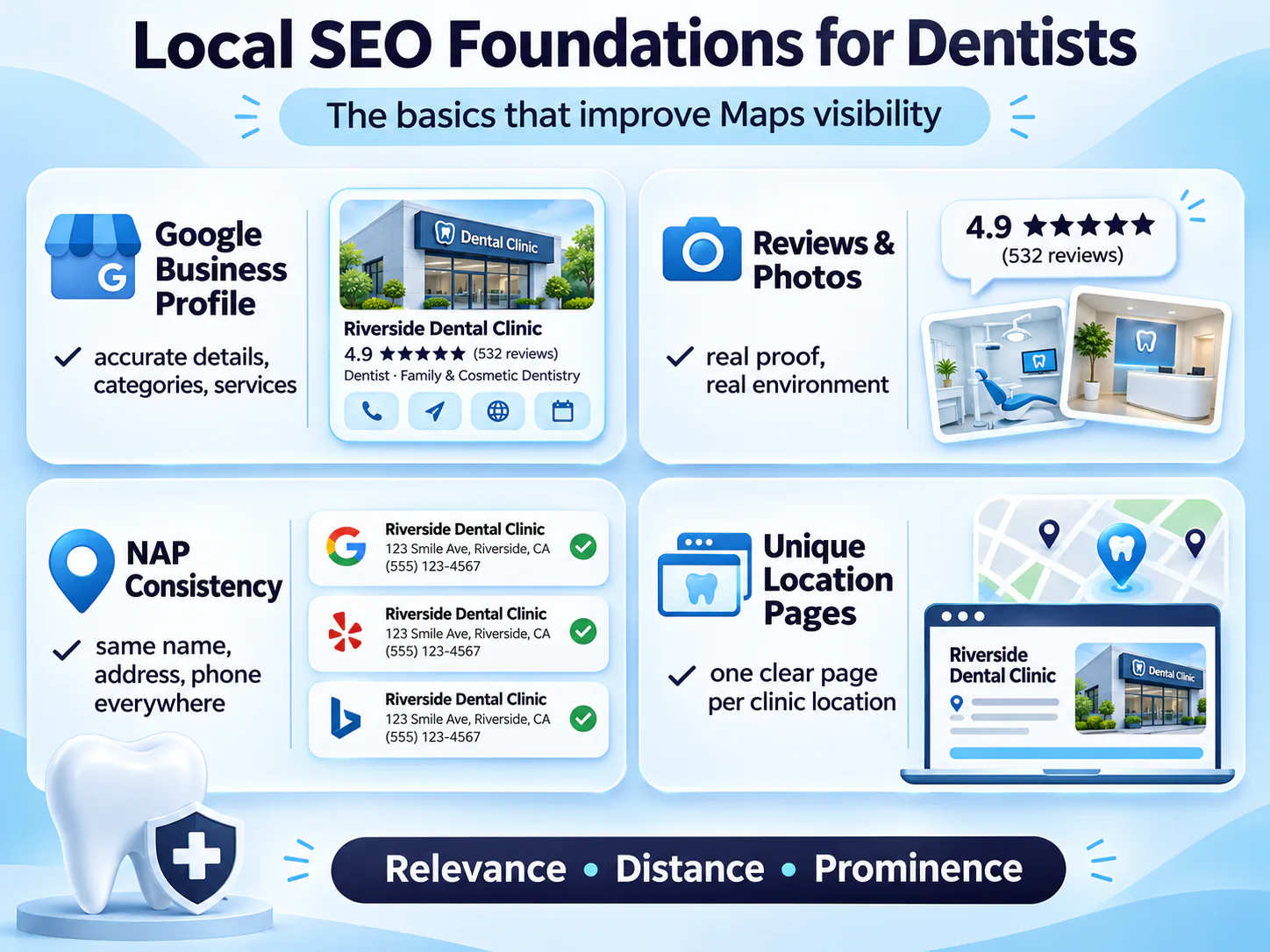
Your Google Business Profile is often the fastest place to unlock better visibility. Make sure your core details are accurate, your primary category matches your main service focus, your services are filled out properly, and your photos show real work and a real environment.
Choosing the right primary and secondary categories matters because categories shape relevance. You want your profile to match the way patients search, not the way a clinic might label itself internally.
This is the boring work that protects everything else. If your name, address, or phone number varies across local citations, you can split trust signals and confuse patients.
SEO for multi-location businesses requires unique location pages and unique proof for each location. Avoid repeating the same blocks of text across locations. Patients can spot that too.
Google explains that local results are mainly based on relevance, distance, and prominence. You cannot buy your way around that, so your best play is to improve relevance and prominence in clean, patient-friendly ways.
This is the first win. A patient should reach the right service page in one or two clicks. Clear navigation reduces drop-offs and helps search engines understand your site.
This is non-negotiable. Most patients search on a phone, often while stressed. If your site is hard to use on mobile, your conversions will suffer even if your rankings improve.
Improving your Core Web Vitals can raise both user satisfaction and lead flow. Heavy images, slow templates, and clunky booking widgets can quietly kill conversions.
These are also part of good design. WCAG 2.2 explains how to make web content more accessible to people with disabilities.
This is about clarity. Place your call and booking actions where they are easy to find, especially on service pages. Match the call-to-action to intent. Emergency pages should feel immediate. Elective pages should feel confident and calm.
These are your core assets. Each major service should have its own page that explains who it is for, what happens, timing expectations, and what the next step is.
These should explain exactly how the first visit works. Patients want a clear plan: paperwork, timing, insurance handling, and what they should expect.
These should be direct and fast. Make the call path obvious. Explain your hours, what qualifies as urgent, and what you can do today.
These help patients move from “maybe later” to “let us book.” Even simple explanations reduce hesitation.
These should show real people, real credentials, and a friendly tone. Patients do not only choose services. They choose people.
High-performing location pages should include what makes each location unique, who works there, parking or transit notes, and location-specific proof.
Writing these is mostly about clarity. Give the short answer first, then explain. Use simple headings. Keep it accurate and current. Our answer engine optimization guide covers this format in more depth.
Hubs help high-consideration services the most. A hub can link to candidacy, timelines, aftercare, costs, and FAQs, then funnel into a clear booking step.
FAQ blocks work best when they match real front-desk questions. If your team answers it three times a day, it belongs on the page.
These matter in healthcare. If you change hours, policies, or services, update your pages quickly. Old info breaks trust fast.
Your title tags and headings should reflect what patients search for, not internal jargon. Use clear service language and location context where it fits naturally.
Internal links should move users from general pages to the exact service page they need, then to booking. Think of internal linking as patient navigation, not a “SEO trick.”
This matters because images are part of the patient’s decision. Compress images, name them clearly, and use helpful alt text.
Schema markup can support your local presence. Keep it accurate. Do not mark up things you cannot support, like fake reviews or claims you cannot prove.
Partnerships that make sense can build real-world trust and online proof at the same time. Think community sponsorships, local charities, school partnerships, and local business networks, where it is natural to be listed. Our guide to local link building in Mississauga has more ideas.
These can help too, as long as they are relevant and legitimate. The point is to show you are a real clinic with real connections.
These are easiest when they are patient-first. For example, seasonal dental care tips, community outreach, or a local event. Keep it helpful, not promotional.
This is simple. Do not buy shady links. Do not use junk directories. Do not chase volume. A few strong, relevant mentions beat a pile of random links.
Start with timing. Ask after a good visit, make it easy, and keep the request friendly. A steady review pace is more believable than a sudden spike. Our guide on how to get Google reviews walks through the request process.
It comes down to discipline. Thank them, keep it general, and do not confirm treatment details in public replies.
This is also common. If your photos look poor, your services are unclear, or your website feels confusing, reviews alone may not save the conversion.
This is a quiet advantage. If a service page has strong proof and clear next steps, the review trust transfers into bookings.
Track calls, direction requests, booking clicks, and form fills. Watch lead quality too. If calls increase but they are not the right patients, adjust your targeting and page clarity.
Track which pages bring bookings, which services gain traction, and whether your local visibility is expanding across your service area. Google Search Console shows which pages and queries are growing.
This is straightforward. First you see more visibility. Then you see more actions. Then you see more revenue outcomes. If you skip steps, you can misread progress.
This is one of the best skills you can develop. If your visibility rises but actions do not, it is usually a messaging, trust, or booking-path issue.
This helps you set expectations. Maps can move sooner when your profile and business data are improved. Organic often takes longer, but it can become more stable over time. For a broader view, see how long local SEO takes.
These usually include whether your visibility signals and profile actions are trending upward. If everything is flat, you likely have foundation issues like incorrect categories, inconsistent listings, or weak service pages.
Focus on actions and lead quality. If calls rise but bookings do not, your conversion path needs work. If calls do not rise at all, your relevance and prominence signals need strengthening.
This is where many clinics build beyond the immediate neighbourhood. This often comes from stronger service content, stronger location pages, and better local authority signals.
This is the honest answer. A clinic with strong reviews, clear services, and a fast website starts closer to the finish line.
Build a profile that answers patient questions before they ask. Clear services, strong photos, accurate details, and steady reviews do more than most “tricks.”
Own the real questions patients type: cost factors, timelines, candidacy, fear-based concerns, and what to expect on visit one.
This is your moat. Do not overpromise. Explain clearly. Show real people. Make patients feel safe to take the next step.
This is where many clinics win. If you remove friction, you turn the same traffic into more bookings.
These usually include a monthly plan, a one-time cleanup, or a multi-location plan. The right model depends on how competitive your market is and how much work your foundation needs. Our breakdown of SEO cost in Mississauga shows typical ranges.
The number of locations, the current condition of your website, the amount of content needed, and whether you need cleanup work for citations and duplicates.
This is more important than the sticker price. A solid plan should cover local profile work, website improvements, content priorities tied to patient intent, reputation support, and clear reporting tied to actions.
This is the simplest filter. If you cannot connect the work to calls, bookings, and new patients, you do not have a real plan.
Focus on outcomes and process. What will they do in the first 30 days? How do they measure success? How will they improve conversions, not just rankings? It also helps to know what an SEO company actually does before you compare proposals.
These are easy to spot. Guarantees, vague reporting, secret methods, and “we will build a huge number of links” are not good signs.
Good reporting starts with patient actions, then visibility, then rankings. Rankings alone are not the scoreboard.
The right fit depends on your team. Many clinics do well with a hybrid approach: internal staff handles photos, review requests, and updates, while an SEO team handles the technical and strategy work.
These include inconsistent business info, duplicate listings, thin service pages, and broken booking paths. These problems slow results more than competition does.
Stay calm and stay clean. Improve your own relevance and proof first. If you document clear guideline violations, report them through the proper channels, but do not build your strategy around reacting.
This should be a clinic rule, not a marketing afterthought. Keep consent documented and keep public replies general.
Keep it simple: accurate, helpful, updated, and locally relevant, with real-world proof.
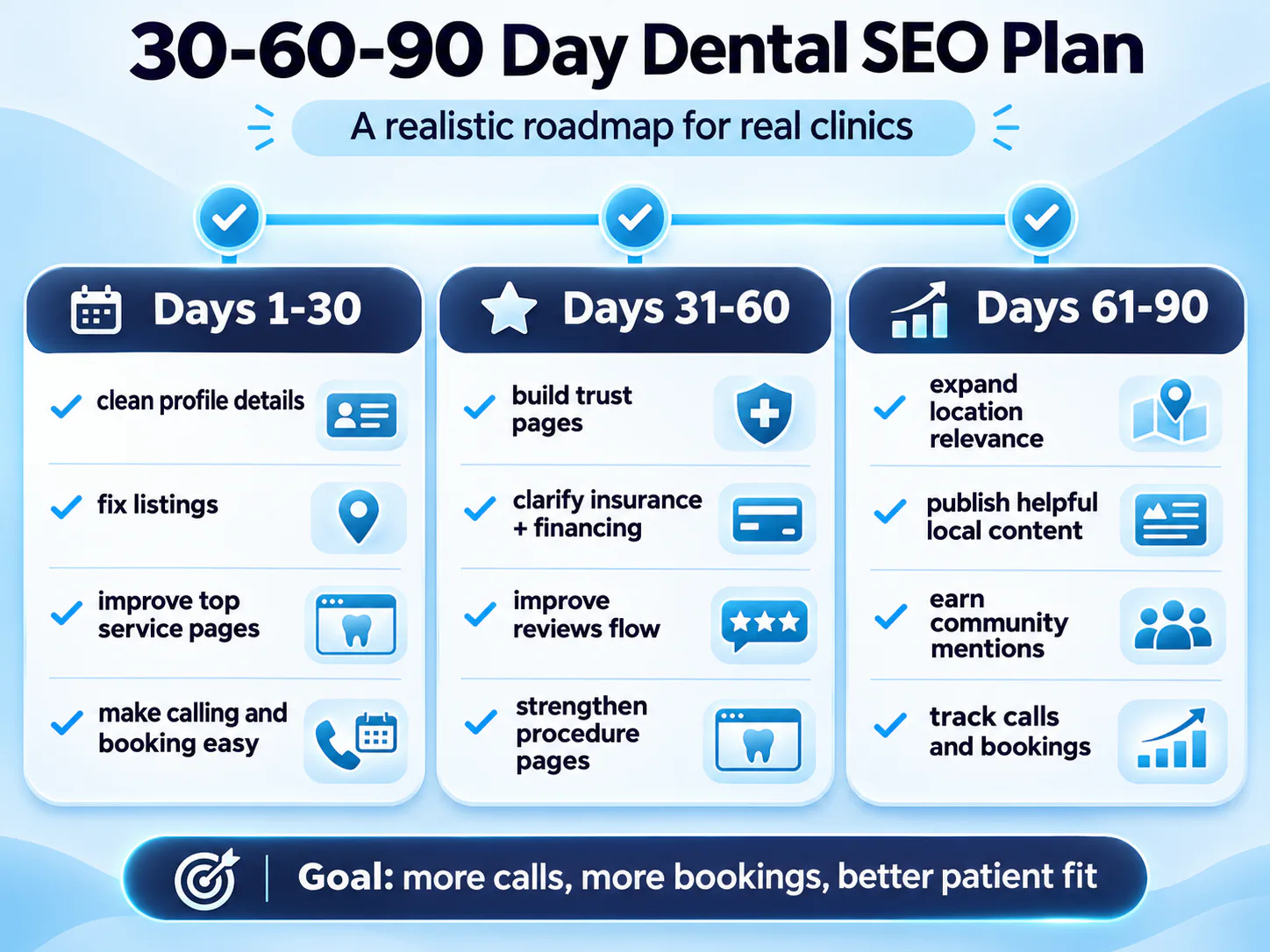
Fix your profile details, clean up listings, strengthen your top service pages, and make calling and booking simple.
Add or improve your new patient page, insurance and financing clarity, and the procedure pages that match your most valuable services.
Strengthen location relevance, publish helpful local content that matches real patient questions, and build legitimate local mentions through real community connections.
Dental SEO is the process of helping your clinic show up in unpaid search results, especially local results like Google Maps, so more people book appointments.
Because it helps you show up at the exact moment a patient is ready to choose, and it builds trust signals that improve bookings over time.
If you want new patients from local searches, yes. Even clinics with strong referrals benefit from visibility in Maps and local organic results.
The goal is not “rankings for bragging rights.” The goal is more of the right actions: calls, online bookings, direction requests, form fills, and new patient starts.
Make services easy to find, make the site fast on mobile, keep the booking path simple, and build trust with clear proof and clear next steps.
Pricing depends on competition, location count, and website condition. Focus on what is included and how outcomes will be tracked, not just the monthly number.
Most clinics see early movement first in visibility signals, then in calls and bookings. The timeline changes based on competition, your current website, your review profile, and how consistent your business info is online.
Pick a team that talks about patient actions, not vanity rankings, and can explain the first 30 days of work in plain steps.
Start with the foundation moves that remove confusion for both Google and patients: fix your business details, strengthen your main services and booking path, and build trust signals that match what anxious patients need before they contact you.
Start with a clean Google Business Profile, solid tracking, and improved core service pages. Then build the Trust Stack and match each page to real patient intent so results turn into appointments, not just impressions.
If you want a team to set this up cleanly and keep it white-hat, Local SEO Mississauga can help you turn dentist SEO into a steady system that brings calls, bookings, and real new patient growth. See how our dental SEO services work for clinics in Mississauga and the GTA.
Disclaimer: The information provided in this blog is for general informational purposes only. For professional assistance and advice, please contact experts.
Get a free SEO audit and a clear, prioritized plan for your Mississauga business — no long-term contract required.
Get a Free SEO Audit· 8 min read
See what an HTTP 401 error means, how it differs from 403 and how users or developers can fix authentication problems. Check the steps now.
Read article· 11 min read
Improve brand mentions in ChatGPT, Gemini and AI Overviews with stronger entities, citations and answer-ready content. Use the 2026 checklist.
Read article· 14 min read
Build a keyword plan around search intent, competition and business value, then map terms to the right pages. Follow the step-by-step process.
Read article